Cerebras revenue doubles but stock drops on margins
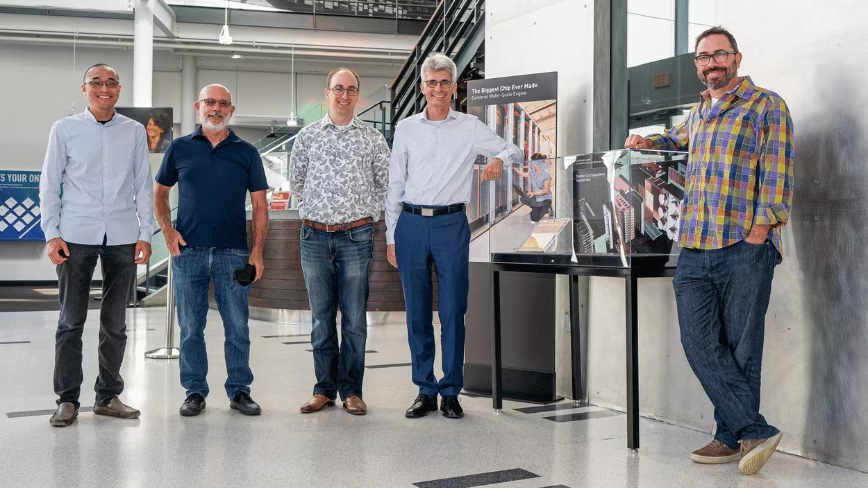
Cerebras's stock drop reveals the hidden costs of scaling AI hardware beyond just chip production.
30-Second TL;DR
What Changed
Revenue nearly doubled year-over-year.
Why It Matters
The market is signaling that even for high-growth AI hardware companies, the cost of scaling physical data center infrastructure is a critical factor for valuation.
What To Do Next
Analyze Cerebras's financial reports to understand the capital expenditure requirements for deploying large-scale AI hardware.
Key Points
- •Revenue nearly doubled year-over-year.
- •2026 sales guidance exceeded Wall Street expectations.
- •Stock price dropped 10% due to margin pressure from physical infrastructure constraints.
Deep Insight
AI-generated analysis for this event — not the original article.
Enhanced Key Takeaways
- •Cerebras' margin compression is specifically linked to the high capital expenditure required for deploying their Wafer-Scale Engine (WSE) clusters in third-party data centers.
- •The company has shifted its business model toward a 'Cerebras Inference' cloud service, which requires significant upfront investment in cooling and power infrastructure compared to selling standalone hardware.
- •Analysts noted that while software revenue is growing, it currently represents a smaller percentage of total income than hardware-as-a-service contracts.
- •The 10% stock decline reflects investor anxiety regarding the 'cost-to-serve' for their massive WSE-3 chips, which demand specialized liquid cooling systems.
- •Cerebras has begun diversifying its supply chain to mitigate risks associated with TSMC's advanced packaging capacity, which previously constrained their ability to meet demand.
Competitor Analysis
- Cerebras (WSE-3)
- Wafer-Scale (Single Chip)
- NVIDIA (Blackwell B200)
- GPU (Multi-Chip Module)
- Groq (LPU)
- LPU (Tensor Streaming)
- Cerebras (WSE-3)
- Memory Bandwidth/Latency
- NVIDIA (Blackwell B200)
- Ecosystem/Software (CUDA)
- Groq (LPU)
- Inference Speed
- Cerebras (WSE-3)
- Cloud/Hardware-as-a-Service
- NVIDIA (Blackwell B200)
- Hardware/Cloud/DGX Systems
- Groq (LPU)
- Cloud API/Hardware
- Cerebras (WSE-3)
- Large Model Training
- NVIDIA (Blackwell B200)
- General AI/Data Centers
- Groq (LPU)
- Real-time Inference
| Feature | Cerebras (WSE-3) | NVIDIA (Blackwell B200) | Groq (LPU) |
|---|---|---|---|
| Architecture | Wafer-Scale (Single Chip) | GPU (Multi-Chip Module) | LPU (Tensor Streaming) |
| Primary Strength | Memory Bandwidth/Latency | Ecosystem/Software (CUDA) | Inference Speed |
| Pricing Model | Cloud/Hardware-as-a-Service | Hardware/Cloud/DGX Systems | Cloud API/Hardware |
| Target Market | Large Model Training | General AI/Data Centers | Real-time Inference |
Technical Deep Dive
- The WSE-3 architecture utilizes 4 trillion transistors and 900,000 AI-optimized cores on a single 300mm wafer.
- Cerebras MemoryX technology allows for the off-chip storage of model parameters, enabling the training of models with trillions of parameters by streaming weights to the wafer.
- SwarmX interconnect fabric facilitates the scaling of multiple WSE-3 units, allowing them to function as a single logical processor.
- The current infrastructure scaling challenge involves the integration of high-density power delivery units (PDUs) capable of supporting the 23kW power consumption of a single WSE-3 system.
Future ImplicationsAI analysis grounded in cited sources
Timeline
- 2021-04Cerebras announces the WSE-2, the first wafer-scale processor with 2.6 trillion transistors.
- 2023-03Launch of the Cerebras Inference service, marking a strategic pivot toward cloud-based AI delivery.
- 2024-03Unveiling of the WSE-3, featuring 4 trillion transistors and 900,000 cores.
- 2025-02Cerebras secures major contract for large-scale AI cluster deployment in the Middle East.
- 2026-05Company reports record quarterly revenue but highlights rising infrastructure deployment costs.
Weekly AI Recap
Read this week's curated digest of top AI events →
Related Updates



AI-curated news aggregator. All content rights belong to original publishers.
Original source: The Next Web (TNW) ↗
This is a summary, not the original. Read the source, or get the weekly briefing.
The weekly digest
One email a week. Unsubscribe anytime.