Cerebras Maps Its Next Wafer-Scale AI Era
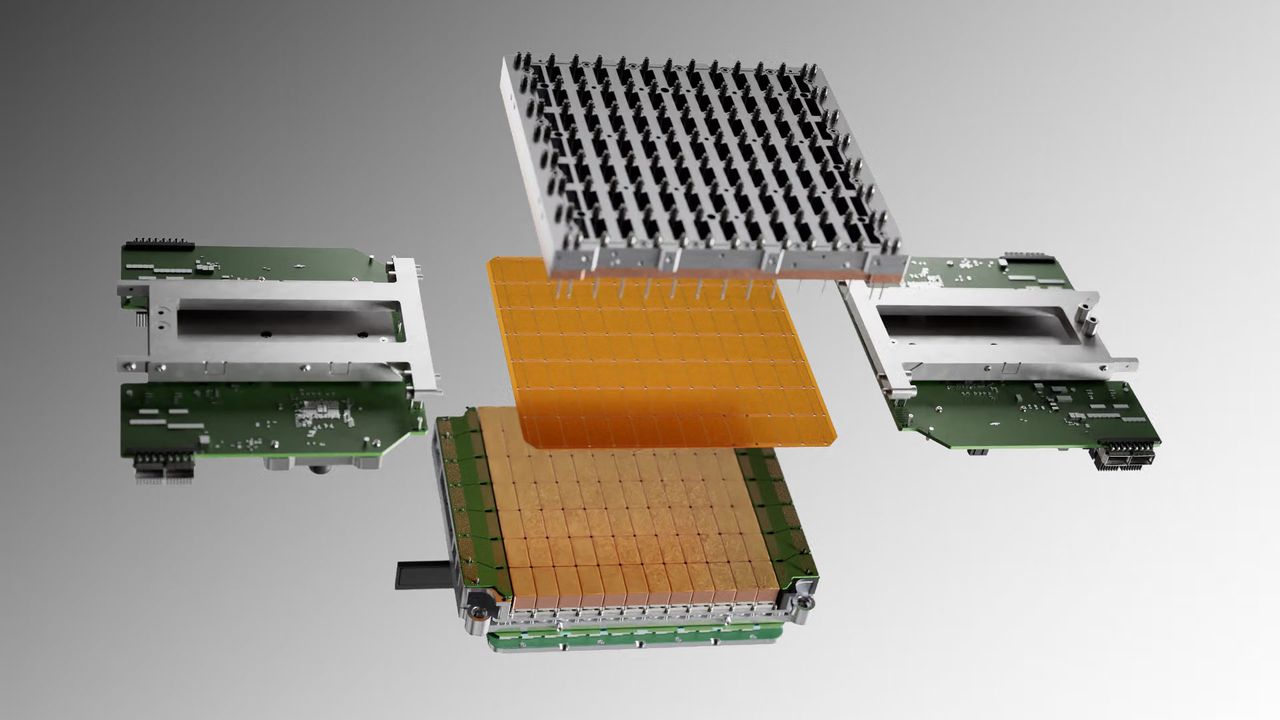
💡Cerebras claims triple rack performance and plans stacked DRAM for its next wafer-scale system.
⚡ 30-Second TL;DR
What Changed
Cerebras disclosed two upcoming generations of wafer-scale AI accelerators.
Why It Matters
If the claimed scaling materializes, Cerebras could improve throughput for large-model training and inference without relying solely on conventional multi-GPU clusters. Stacked DRAM may also help reduce memory bottlenecks in wafer-scale workloads.
What To Do Next
Request Cerebras CS-4 and Nexus workload benchmarks for your largest training or inference model before comparing them with GPU clusters.
Key Points
- •Cerebras disclosed two upcoming generations of wafer-scale AI accelerators.
- •The Nexus rack design is designed to triple rack-scale performance for the CS-4 system.
- •The CS-6 wafer is planned to incorporate stacked DRAM for greater memory capacity and bandwidth.
🧠 Deep Insight
Background and context from public sources — not the original article. 7 sources cited.
🔑 Enhanced Key Takeaways
- •Cerebras officially launched the CS-4 system on August 18, 2026, at the Supernova 2026 event, featuring the WSE-3 Turbo processor.
- •The Nexus platform introduces a modular 'compute backpack' design that decouples power, cooling, and I/O, reducing system deployment time from days to hours.
- •Cerebras reported a $25.4 billion order backlog as of Q2 2026, with manufacturing capacity scaling to support 600 MW of data center power.
- •The CS-4 architecture supports disaggregated inference, enabling integration with external technologies like AMD Helios and AWS Trainium for prefill optimization.
- •Independent verification by Artificial Analysis in May 2026 confirmed Cerebras systems running Moonshot AI's Kimi K2.6 model at 981 tokens per second, outperforming GPU clouds by 6.7x.
📊 Competitor Analysis▸ Show
| Feature | Cerebras CS-4 | NVIDIA H200/B200 | AMD Instinct MI300X |
|---|---|---|---|
| Architecture | Wafer-Scale Engine | GPU Cluster | GPU Cluster |
| Memory Bandwidth | 43.2 PB/s (On-wafer) | ~4.8 TB/s (HBM3e) | ~5.3 TB/s (HBM3) |
| Inference Speed | ~981+ tokens/sec | ~150-200 tokens/sec | ~150-200 tokens/sec |
| Deployment | Modular Rack (Hours) | Multi-rack Cluster (Days/Weeks) | Multi-rack Cluster (Days/Weeks) |
🛠️ Technical Deep Dive
- WSE-3 Turbo: Features 900,000 AI-optimized cores and 44 GB of on-wafer SRAM.
- Nexus Platform: Utilizes a disaggregated architecture separating compute from I/O and power to facilitate independent scaling.
- Memory Hierarchy: CS-6 generation will move beyond SRAM-only designs by incorporating 3D-stacked DRAM directly onto the wafer-scale logic.
- Throughput: CS-4 delivers 10x higher throughput per watt compared to the CS-3 generation.
🔮 Future ImplicationsAI analysis grounded in cited sources
⏳ Timeline
📎 Sources (7)
Factual claims are grounded in the sources below. Forward-looking analysis is AI-generated interpretation.
Weekly AI Recap
Read this week's curated digest of top AI events →
👉Related Updates



AI-curated news aggregator. All content rights belong to original publishers.
Original source: Tom's Hardware ↗
This is a summary, not the original. Read the source, or get the weekly briefing.
Weekly AI briefing
One email a week. Unsubscribe anytime.