Cerebras CEO Challenges the 38-Hour Workweek
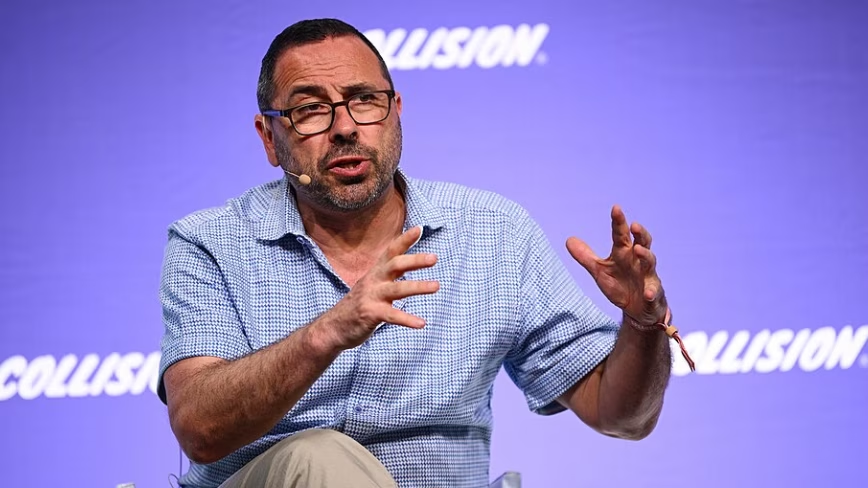
A Cerebras founder’s extreme-work stance raises hard questions about scaling AI teams without burning them out.
30-Second TL;DR
What Changed
Andrew Feldman called the 38-hour-workweek expectation for building extraordinary companies “mind-boggling.”
Why It Matters
For AI founders, the comments may reignite debate about whether long hours create sustainable technical advantage. They also raise practical questions about burnout, retention, and whether execution speed should come from process improvements rather than simply more hours.
What To Do Next
Use GitHub Projects and engineering metrics to compare output, cycle time, and defect rates before increasing your AI team’s working hours.
Key Points
- •Andrew Feldman called the 38-hour-workweek expectation for building extraordinary companies “mind-boggling.”
- •The comments reflect a founder debate over work-life balance, ambition, and startup execution speed.
- •Cerebras is an AI chip company, so the remarks arrive in the context of a highly competitive infrastructure market.
Deep Insight
AI-generated analysis for this event — not the original article.
Enhanced Key Takeaways
- •Andrew Feldman's remarks were delivered during a specific interview or public appearance where he contrasted the 'Silicon Valley' work ethic with traditional corporate structures.
- •Cerebras has historically maintained a high-intensity culture to support the development of its Wafer-Scale Engine (WSE) technology, which requires solving unique thermal and power challenges.
- •The debate over work hours in AI startups has intensified as companies race to achieve AGI, with many founders arguing that the 'moat' is built through execution speed rather than just capital.
- •Feldman's stance aligns with a broader trend among AI hardware leaders who emphasize that the complexity of AI infrastructure necessitates a 'wartime' operational mindset.
- •Critics of Feldman's perspective point to potential burnout and long-term retention issues as significant risks for companies attempting to sustain such high-intensity work environments.
Competitor Analysis
- Cerebras (WSE-3)
- Wafer-Scale Engine
- NVIDIA (Blackwell)
- GPU Cluster
- Groq (LPU)
- LPU (Language Processing Unit)
- Cerebras (WSE-3)
- Training/Inference Efficiency
- NVIDIA (Blackwell)
- General Purpose AI/HPC
- Groq (LPU)
- Low-Latency Inference
- Cerebras (WSE-3)
- 21 PB/s
- NVIDIA (Blackwell)
- 8 TB/s (HBM3e)
- Groq (LPU)
- High (SRAM-based)
- Cerebras (WSE-3)
- Specialized AI Supercomputing
- NVIDIA (Blackwell)
- Industry Standard/Ecosystem
- Groq (LPU)
- Real-time Inference Speed
| Feature | Cerebras (WSE-3) | NVIDIA (Blackwell) | Groq (LPU) |
|---|---|---|---|
| Architecture | Wafer-Scale Engine | GPU Cluster | LPU (Language Processing Unit) |
| Primary Focus | Training/Inference Efficiency | General Purpose AI/HPC | Low-Latency Inference |
| Memory Bandwidth | 21 PB/s | 8 TB/s (HBM3e) | High (SRAM-based) |
| Market Position | Specialized AI Supercomputing | Industry Standard/Ecosystem | Real-time Inference Speed |
Technical Deep Dive
- Cerebras utilizes Wafer-Scale Engine (WSE) technology, which integrates an entire wafer into a single chip to minimize data movement latency.
- The WSE-3 architecture features 4 trillion transistors and 900,000 AI-optimized cores, specifically designed for massive-scale model training.
- Cerebras implements a unique memory architecture where memory is distributed across the wafer, providing significantly higher bandwidth than traditional HBM-based GPU designs.
- The company's software stack, Cerebras Software Language (CSL), allows developers to map neural network graphs directly onto the wafer's fabric.
Future ImplicationsAI analysis grounded in cited sources
Timeline
- 2016-04Cerebras Systems is founded by Andrew Feldman and colleagues.
- 2019-08Cerebras unveils the WSE-1, the world's largest computer chip.
- 2021-04Launch of the WSE-2, featuring 2.6 trillion transistors.
- 2024-03Cerebras announces the WSE-3, built on a 5nm process.
Weekly AI Recap
Read this week's curated digest of top AI events →
Related Updates

AI-curated news aggregator. All content rights belong to original publishers.
Original source: The Next Web (TNW) ↗
This is a summary, not the original. Read the source, or get the weekly briefing.
The weekly digest
One email a week. Unsubscribe anytime.