CATL partners with Galaxy General for humanoid robot power
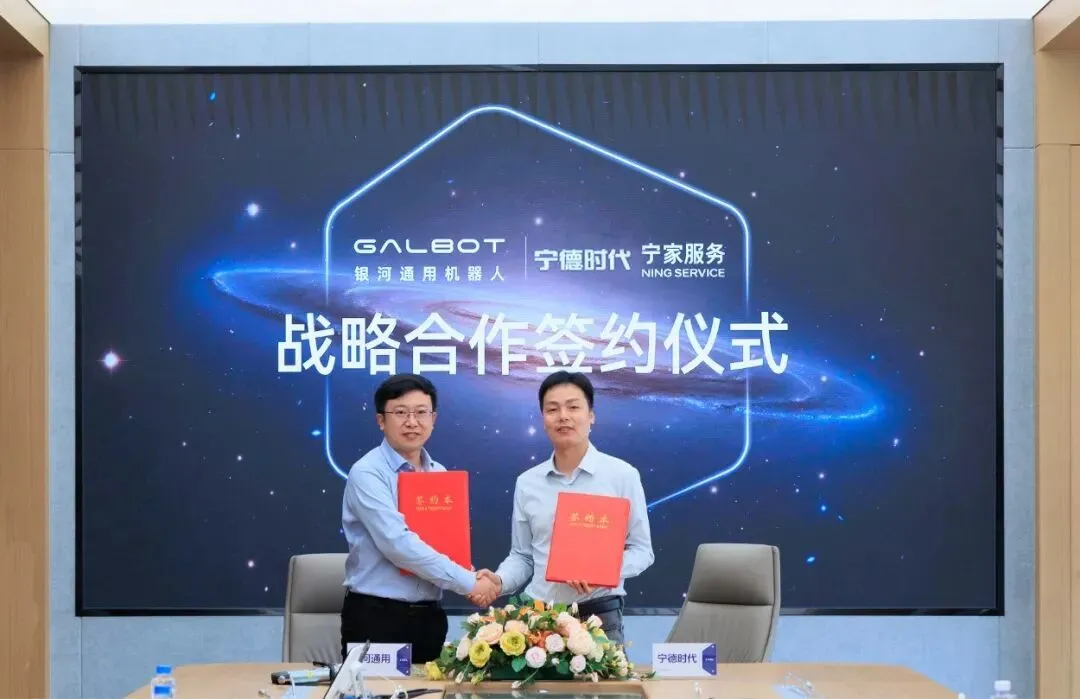
CATL's entry into robotics marks a critical supply chain shift for the future of embodied AI and humanoid hardware.
30-Second TL;DR
What Changed
CATL enters the humanoid robotics market with specialized battery solutions
Why It Matters
This partnership signals a shift in battery technology requirements for robotics, emphasizing high energy density and reliability for embodied AI hardware.
What To Do Next
Evaluate the power density requirements of your robotics hardware stack against CATL's new industrial battery specifications.
Key Points
- •CATL enters the humanoid robotics market with specialized battery solutions
- •Partnership focuses on scaling embodied AI and smart manufacturing
- •Robots feature 50kg payload capacity for dual-arm operations
Deep Insight
AI-generated analysis for this event — not the original article.
Enhanced Key Takeaways
- •Galaxy General Robotics, founded by former Meituan robotics lead Wang Huiwen, is positioning its 'Galaxy' humanoid series to specifically target industrial automation and hazardous environment tasks.
- •The partnership leverages CATL's high-energy-density 'Condensed Battery' technology, which is designed to provide the extended operational runtime required for untethered humanoid mobility.
- •CATL is establishing a dedicated 'Robotics Energy Business Unit' to standardize power management systems for humanoid platforms, moving beyond its core EV battery focus.
- •The collaboration includes the development of a proprietary battery management system (BMS) that integrates with the robot's central AI controller to enable real-time power consumption optimization based on task intensity.
- •This deal marks CATL's first major foray into the embodied AI hardware ecosystem, signaling a strategic shift to diversify revenue streams away from the slowing growth of the global passenger EV market.
Competitor Analysis
- CATL/Galaxy General
- Specialized high-density packs
- BYD/Various Robotics
- Vertical integration (LFP)
- Tesla (Optimus)
- Proprietary internal packs
- CATL/Galaxy General
- Industrial/Manufacturing
- BYD/Various Robotics
- Logistics/Warehouse
- Tesla (Optimus)
- General Purpose/Consumer
- CATL/Galaxy General
- 50kg (Dual-arm)
- BYD/Various Robotics
- 20-40kg
- Tesla (Optimus)
- ~20kg
| Feature | CATL/Galaxy General | BYD/Various Robotics | Tesla (Optimus) |
|---|---|---|---|
| Battery Strategy | Specialized high-density packs | Vertical integration (LFP) | Proprietary internal packs |
| Primary Focus | Industrial/Manufacturing | Logistics/Warehouse | General Purpose/Consumer |
| Payload Capacity | 50kg (Dual-arm) | 20-40kg | ~20kg |
Technical Deep Dive
- Battery Chemistry: Utilization of semi-solid state or condensed battery cells to achieve higher energy-to-weight ratios compared to standard LFP cells.
- Power Architecture: Implementation of a high-voltage (48V-800V) bus architecture to reduce cabling weight and improve motor efficiency in high-torque joints.
- Thermal Management: Integrated liquid cooling loops within the battery chassis to handle the heat generated by high-frequency actuator movements during continuous operation.
- BMS Integration: CAN-FD communication protocol for low-latency feedback between the battery pack and the robot's motion control unit.
Future ImplicationsAI analysis grounded in cited sources
Timeline
- 2023-07Galaxy General Robotics is founded by Wang Huiwen to develop embodied AI.
- 2024-04CATL unveils its 'Condensed Battery' technology at the Beijing Auto Show.
- 2025-11Galaxy General demonstrates its latest humanoid prototype with enhanced payload capabilities.
- 2026-06CATL and Galaxy General sign the global strategic partnership agreement.
Weekly AI Recap
Read this week's curated digest of top AI events →
Related Updates
AI-curated news aggregator. All content rights belong to original publishers.
Original source: cnBeta (Full RSS) ↗
This is a summary, not the original. Read the source, or get the weekly briefing.
The weekly digest
One email a week. Unsubscribe anytime.