🐯虎嗅•Freshcollected in 29m
Capital Migration in China's AI Sector
💡Understand the shifting investment landscape in China's AI sector, from pure VC to industrial-led strategic funding.
⚡ 30-Second TL;DR
What Changed
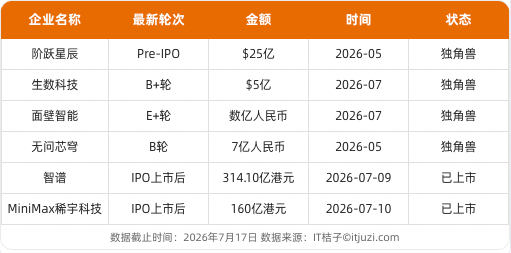
LLM and embodied AI sectors have raised over 100 billion RMB in the last 18 months.
Why It Matters
The shift toward industrial capital implies that AI startups must now demonstrate immediate commercial落地 (deployment) capabilities to survive.
What To Do Next
Analyze the strategic partnerships of your target AI startups to understand if they are aligned with industrial giants for long-term survival.
Who should care:Founders & Product Leaders
Key Points
- •LLM and embodied AI sectors have raised over 100 billion RMB in the last 18 months.
- •StepFun (Jieyue Xingchen) raised $2.5 billion in a Pre-IPO round, signaling a shift to industrial capital.
- •Embodied AI companies like Galbot have seen 'compressed financing' with multiple rounds in under two years.
- •Industrial giants (SAIC, CATL, Tencent) are replacing pure financial VCs as the primary investors.
🧠 Deep Insight
AI-generated analysis for this event.
🔑 Enhanced Key Takeaways
- •The Chinese government's 'Artificial Intelligence +' initiative has catalyzed local municipal funds to act as anchor investors, often requiring companies to establish regional headquarters in exchange for capital.
- •There is a marked trend of 'talent poaching' where major tech firms are acquiring entire research teams from academia to bypass the long-term R&D cycle for foundational models.
- •Regulatory scrutiny regarding data security and cross-border data flow has forced AI startups to prioritize 'sovereign AI' architectures, utilizing domestic hardware ecosystems like Huawei Ascend chips.
- •The shift toward industrial capital has led to a decline in 'valuation inflation' seen in 2023, with investors now demanding clear proof of commercial deployment in manufacturing or automotive sectors.
- •Energy consumption constraints in Tier-1 Chinese cities are forcing AI startups to relocate data center operations to Western provinces, impacting operational expenditure models.
🛠️ Technical Deep Dive
- StepFun utilizes a Mixture-of-Experts (MoE) architecture designed to optimize inference costs for long-context tasks, specifically targeting 1M+ token windows.
- Embodied AI firms like Galbot are integrating end-to-end transformer models that map visual-tactile sensor data directly to motor control commands, bypassing traditional symbolic AI planning.
- Integration of multimodal large models (LMMs) into robotic operating systems (ROS) is becoming the standard, allowing for natural language instruction following in unstructured environments.
- Deployment strategies increasingly rely on model quantization (INT8/FP8) to run foundational models on edge-computing hardware within industrial robots.
🔮 Future ImplicationsAI analysis grounded in cited sources
Consolidation of the Chinese AI startup ecosystem will accelerate by Q4 2026.
The exhaustion of 'easy' venture capital and the requirement for industrial integration will force smaller, non-specialized startups to merge or exit.
Domestic hardware dependency will reach 80% for new AI infrastructure projects by 2027.
Ongoing export controls and the maturation of the domestic GPU ecosystem are making non-Chinese hardware increasingly unviable for large-scale industrial AI deployments.
⏳ Timeline
2023-07
StepFun (Jieyue Xingchen) is founded by former Microsoft and Baidu AI researchers.
2024-03
StepFun releases its first multimodal foundational model, marking its entry into the competitive LLM market.
2025-05
StepFun secures a massive Pre-IPO round led by industrial giants, signaling a pivot toward commercial application.
2026-07
WAIC 2026 highlights the dominance of industrial capital over traditional VC in the Chinese AI sector.
📰
Weekly AI Recap
Read this week's curated digest of top AI events →
👉Related Updates


AI-curated news aggregator. All content rights belong to original publishers.
Original source: 虎嗅 ↗