Canva Previews AI 2.0
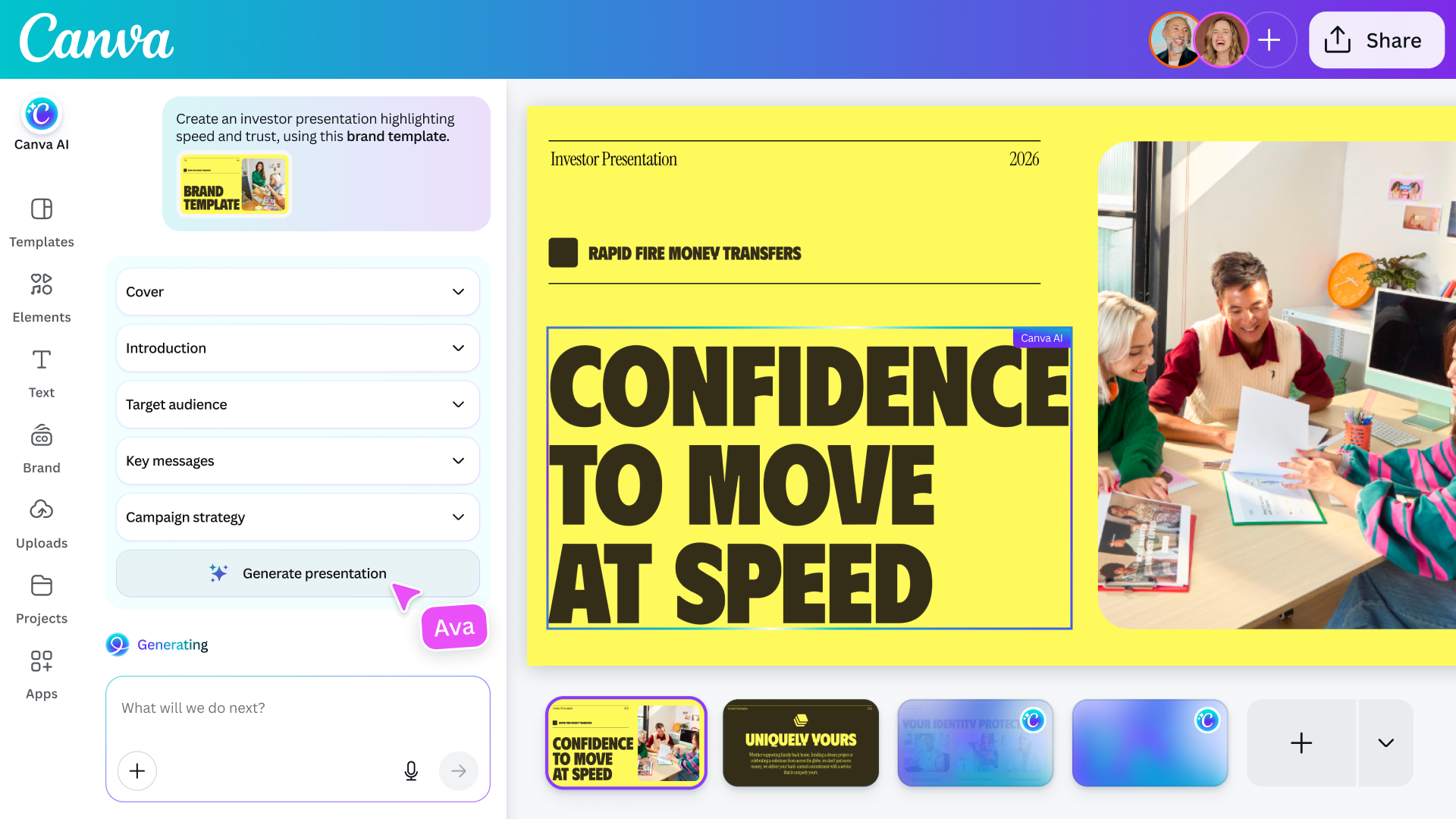
💡AI 2.0: editable designs, tool orchestration, app integrations for workflows
⚡ 30-Second TL;DR
What Changed
Conversational interface generates designs from ideas
Why It Matters
Elevates AI in creative workflows, rivaling Adobe for marketers and creators. Demonstrates scalable LLM orchestration for production apps. Expands AI to branding and multi-channel campaigns efficiently.
What To Do Next
Sign up for Canva AI 2.0 preview to test orchestration for design automation.
Key Points
- •Conversational interface generates designs from ideas
- •Orchestration layer automates multi-tool workflows
- •Editable elements like traditional editors
- •Persistent memory adapts to user style
- •Integrations with Notion, Slack, Gmail; HTML imports
🧠 Deep Insight
AI-generated analysis for this event — not the original article.
🔑 Enhanced Key Takeaways
- •Canva AI 2.0 leverages a proprietary 'Magic Studio' architecture that now incorporates multi-modal reasoning, allowing the system to interpret complex design intent across both visual and textual inputs simultaneously.
- •The orchestration layer utilizes a new agentic framework that enables the platform to autonomously execute tasks in third-party applications, such as updating a Notion project board or drafting a Slack announcement, based on the generated design assets.
- •The platform has introduced a 'Brand Guardrails' feature within the AI 2.0 suite, which uses fine-tuned models to ensure all AI-generated content strictly adheres to pre-uploaded brand assets, color palettes, and typography guidelines.
📊 Competitor Analysis▸ Show
| Feature | Canva AI 2.0 | Adobe Firefly (GenStudio) | Figma (AI Features) |
|---|---|---|---|
| Core Focus | Conversational Orchestration | Professional Creative Workflow | UI/UX Prototyping |
| Pricing | Subscription (Canva Pro/Enterprise) | Subscription (Creative Cloud) | Subscription (Figma Pro/Org) |
| Key Benchmark | Multi-step workflow automation | High-fidelity image generation | Design system consistency |
🛠️ Technical Deep Dive
- •Orchestration Layer: Implemented as a multi-agent system where a central 'Planner' agent decomposes user prompts into sub-tasks, delegating them to specialized 'Worker' agents (e.g., Image Generator, Layout Engine, Code Generator).
- •Persistent Memory: Utilizes a vector database architecture to store user-specific design preferences, historical project styles, and brand assets, enabling RAG (Retrieval-Augmented Generation) for personalized output.
- •HTML Integration: Employs a custom transformer-based model trained on web-standard CSS/HTML to convert design layouts into functional, responsive code snippets.
- •Editable Elements: Uses a proprietary object-detection and segmentation model that converts flattened AI-generated images into layered, vector-based components compatible with Canva's native editor.
🔮 Future ImplicationsAI analysis grounded in cited sources
⏳ Timeline
📰 Event Coverage
Weekly AI Recap
Read this week's curated digest of top AI events →
👉Related Updates
AI-curated news aggregator. All content rights belong to original publishers.
Original source: Engadget ↗
This is a summary, not the original. Read the source, or get the weekly briefing.
The weekly digest
One email a week. Unsubscribe anytime.