Can Manufacturing Giants Win Humanoid Robotics?
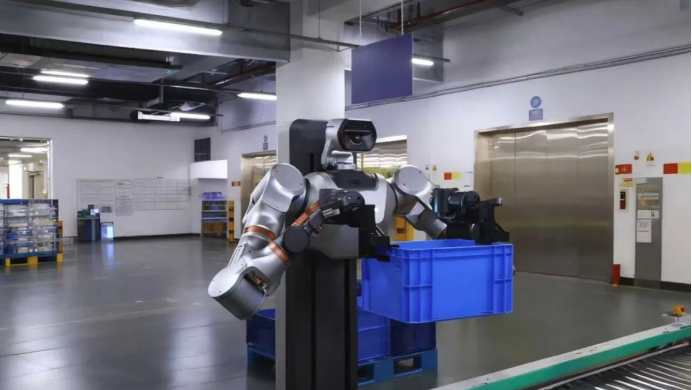
Manufacturing giants may reshape humanoid-robot costs, deployment data, and battery performance.
30-Second TL;DR
What Changed
BYD has reportedly confirmed an August debut for its first humanoid robot, but has not publicly disclosed product specifications.
Why It Matters
If BYD and CATL successfully deploy robots in their own factories, they could accelerate hardware iteration, reduce unit costs, and create a strong commercial reference for embodied-AI startups. The shift also suggests that manufacturing scale and access to real industrial data may become as important as model quality.
What To Do Next
If you are building embodied-AI systems, run a ROS 2 pilot on one repetitive factory task and measure grasp success, cycle time, battery runtime, and recovery rate before scaling.
Key Points
- •BYD has reportedly confirmed an August debut for its first humanoid robot, but has not publicly disclosed product specifications.
- •BYD established an embodied-intelligence research team in 2022, partnered with Hong Kong University of Science and Technology in 2025, and invested in Zhiyuan Robotics and Pacini Robotics.
- •CATL has explored humanoid and quadruped robots, built an internal robotics team, and invested in Galaxy General, Robopeak, and other embodied-AI startups.
- •Automotive and humanoid robots share more than half of their supply-chain resources, including motors, controllers, batteries, sensors, and chips.
- •CATL batteries reportedly power Galaxy General's Galbot S1, enabling up to eight hours of operation compared with the typical two-to-four-hour humanoid-robot runtime.
Deep Insight
AI-generated analysis for this event — not the original article.
Enhanced Key Takeaways
- •BYD's humanoid robotics strategy leverages its 'vertical integration' model, allowing the company to manufacture over 90% of the robot's components in-house, significantly reducing cost structures compared to startups.
- •CATL's entry into the sector is strategically focused on 'energy-dense embodied intelligence,' specifically targeting the development of specialized battery management systems (BMS) that allow humanoid robots to operate in high-temperature or hazardous industrial environments.
- •The integration of BYD's proprietary 'DiPilot' autonomous driving algorithms into humanoid robot navigation systems is a key technical differentiator, allowing for faster deployment in complex factory floor environments.
- •Industry analysts note that BYD and CATL are shifting the humanoid market from 'general-purpose research' to 'task-specific industrial automation,' prioritizing ROI and durability over human-like aesthetics.
- •Both companies are utilizing their massive internal factory footprints as 'living labs,' allowing them to collect proprietary motion-capture and task-execution data at a scale that pure-play robotics startups cannot match.
Competitor Analysis
- BYD/CATL (Industrial)
- Factory Automation
- Tesla (Optimus)
- Mass Market/Home
- Figure AI (General Purpose)
- General Purpose AI
- BYD/CATL (Industrial)
- 8+ Hours (Optimized)
- Tesla (Optimus)
- 2-4 Hours
- Figure AI (General Purpose)
- 4-5 Hours
- BYD/CATL (Industrial)
- In-house (Vertical)
- Tesla (Optimus)
- In-house/External
- Figure AI (General Purpose)
- External/Partnerships
- BYD/CATL (Industrial)
- Immediate (Internal)
- Tesla (Optimus)
- Pilot (Internal)
- Figure AI (General Purpose)
- Pilot (Commercial)
| Feature | BYD/CATL (Industrial) | Tesla (Optimus) | Figure AI (General Purpose) |
|---|---|---|---|
| Primary Focus | Factory Automation | Mass Market/Home | General Purpose AI |
| Battery Life | 8+ Hours (Optimized) | 2-4 Hours | 4-5 Hours |
| Supply Chain | In-house (Vertical) | In-house/External | External/Partnerships |
| Deployment | Immediate (Internal) | Pilot (Internal) | Pilot (Commercial) |
Technical Deep Dive
- BYD utilizes a proprietary high-torque density motor design derived from their EV powertrain technology, achieving a torque-to-weight ratio exceeding 20 Nm/kg.
- CATL's battery integration for humanoid platforms employs a solid-state or semi-solid-state electrolyte architecture to minimize thermal runaway risks during high-intensity mechanical tasks.
- Both manufacturers are implementing a 'Digital Twin' synchronization layer, where robot movements are simulated in a virtual factory environment before physical deployment to optimize energy consumption.
- Control systems are shifting toward edge-based transformer models, allowing robots to process visual and tactile feedback locally without relying on cloud latency.
Future ImplicationsAI analysis grounded in cited sources
Timeline
- 2022-05BYD establishes its internal embodied-intelligence research division.
- 2023-11CATL begins internal R&D on specialized battery modules for quadruped and humanoid robotics.
- 2024-06BYD completes strategic investment in Zhiyuan Robotics to accelerate motion control development.
- 2025-03BYD formalizes a joint research partnership with the Hong Kong University of Science and Technology.
- 2026-05CATL-powered Galbot S1 demonstrates 8-hour continuous operation in industrial testing.
Weekly AI Recap
Read this week's curated digest of top AI events →
AI-curated news aggregator. All content rights belong to original publishers.
Original source: 虎嗅 ↗
This is a summary, not the original. Read the source, or get the weekly briefing.
The weekly digest
One email a week. Unsubscribe anytime.