Cambricon Revenue Doubles on China’s AI Chip Push
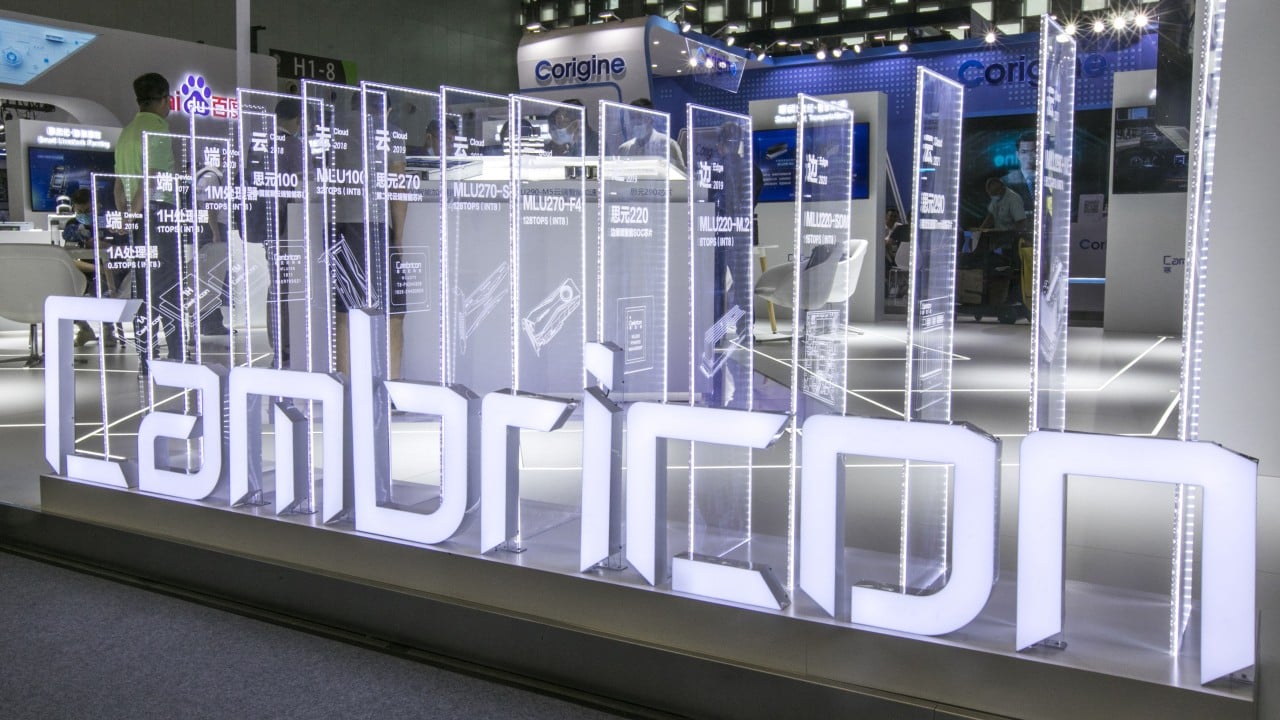
Cambricon’s results reveal how quickly China’s domestic AI accelerator market is scaling.
30-Second TL;DR
What Changed
First-half revenue reached 6 billion yuan, increasing 108% year over year.
Why It Matters
Cambricon’s results indicate that domestic demand for China-made AI accelerators is expanding rapidly. Greater adoption could give local developers and enterprises more alternatives as access to foreign AI hardware becomes constrained.
What To Do Next
If you are evaluating China-based inference hardware, request Cambricon’s latest accelerator specifications and benchmark them against your current GPU workloads before committing.
Key Points
- •First-half revenue reached 6 billion yuan, increasing 108% year over year.
- •First-half profit rose 122.6% year over year to 2.3 billion yuan.
- •Second-quarter revenue totaled 3.1 billion yuan.
- •Growth is being driven by China’s push to replace foreign AI hardware.
Deep Insight
AI-generated analysis for this event — not the original article.
Enhanced Key Takeaways
- •Cambricon's growth is heavily supported by large-scale procurement contracts from Chinese state-owned enterprises and research institutions seeking to mitigate US export control risks.
- •The company has significantly increased its R&D expenditure, focusing on the optimization of its MLU (Machine Learning Unit) architecture to better support large language model (LLM) training and inference.
- •Despite revenue growth, Cambricon remains under strict US Entity List restrictions, which complicates its access to advanced semiconductor manufacturing processes and EDA software tools.
- •The company has shifted its product strategy to prioritize high-margin AI training clusters over consumer-grade edge AI chips to maximize profitability amid supply chain constraints.
- •Cambricon is increasingly integrating its software ecosystem, 'Cambricon Neuware,' to improve compatibility with mainstream frameworks like PyTorch and TensorFlow, aiming to lower the barrier for domestic developers.
Competitor Analysis
- Cambricon (MLU Series)
- Domestic China
- Huawei (Ascend Series)
- Domestic China
- NVIDIA (H20/B20)
- Global / Restricted China
- Cambricon (MLU Series)
- Proprietary MLU
- Huawei (Ascend Series)
- Da Vinci
- NVIDIA (H20/B20)
- Hopper / Blackwell
- Cambricon (MLU Series)
- Neuware
- Huawei (Ascend Series)
- CANN
- NVIDIA (H20/B20)
- CUDA
- Cambricon (MLU Series)
- Competitive (Subsidized)
- Huawei (Ascend Series)
- Competitive (State-backed)
- NVIDIA (H20/B20)
- Premium (High Demand)
- Cambricon (MLU Series)
- LLM Inference/Training
- Huawei (Ascend Series)
- Large-scale Training
- NVIDIA (H20/B20)
- Industry Standard
| Feature | Cambricon (MLU Series) | Huawei (Ascend Series) | NVIDIA (H20/B20) |
|---|---|---|---|
| Primary Market | Domestic China | Domestic China | Global / Restricted China |
| Architecture | Proprietary MLU | Da Vinci | Hopper / Blackwell |
| Ecosystem | Neuware | CANN | CUDA |
| Pricing | Competitive (Subsidized) | Competitive (State-backed) | Premium (High Demand) |
| Benchmark Focus | LLM Inference/Training | Large-scale Training | Industry Standard |
Technical Deep Dive
- MLU Architecture: Utilizes a proprietary scalar, vector, and tensor processing unit design optimized for high-throughput matrix multiplication required by Transformer models.
- Memory Hierarchy: Employs high-bandwidth memory (HBM) integration to reduce latency during massive parameter synchronization in distributed training.
- Interconnect: Features proprietary chip-to-chip interconnect technology designed to scale clusters without relying on restricted Western high-speed networking standards.
- Software Stack: Neuware provides a compiler and runtime library that translates standard deep learning framework graphs into optimized machine code for MLU hardware.
Future ImplicationsAI analysis grounded in cited sources
Timeline
- 2016-03Cambricon Technologies is founded as a spin-off from the Chinese Academy of Sciences.
- 2018-05Company achieves unicorn status following a Series B funding round led by SDIC Venture Capital.
- 2020-07Cambricon completes its initial public offering (IPO) on the Shanghai Stock Exchange's STAR Market.
- 2022-12The US Department of Commerce adds Cambricon to the Entity List, restricting access to US-origin technology.
- 2024-08Cambricon reports significant revenue growth driven by domestic demand for AI infrastructure.
Weekly AI Recap
Read this week's curated digest of top AI events →
Related Updates




AI-curated news aggregator. All content rights belong to original publishers.
Original source: SCMP Technology ↗
This is a summary, not the original. Read the source, or get the weekly briefing.
The weekly digest
One email a week. Unsubscribe anytime.