ByteDance Launches NaviX Ultra with Autonomous AI Agent Queuing
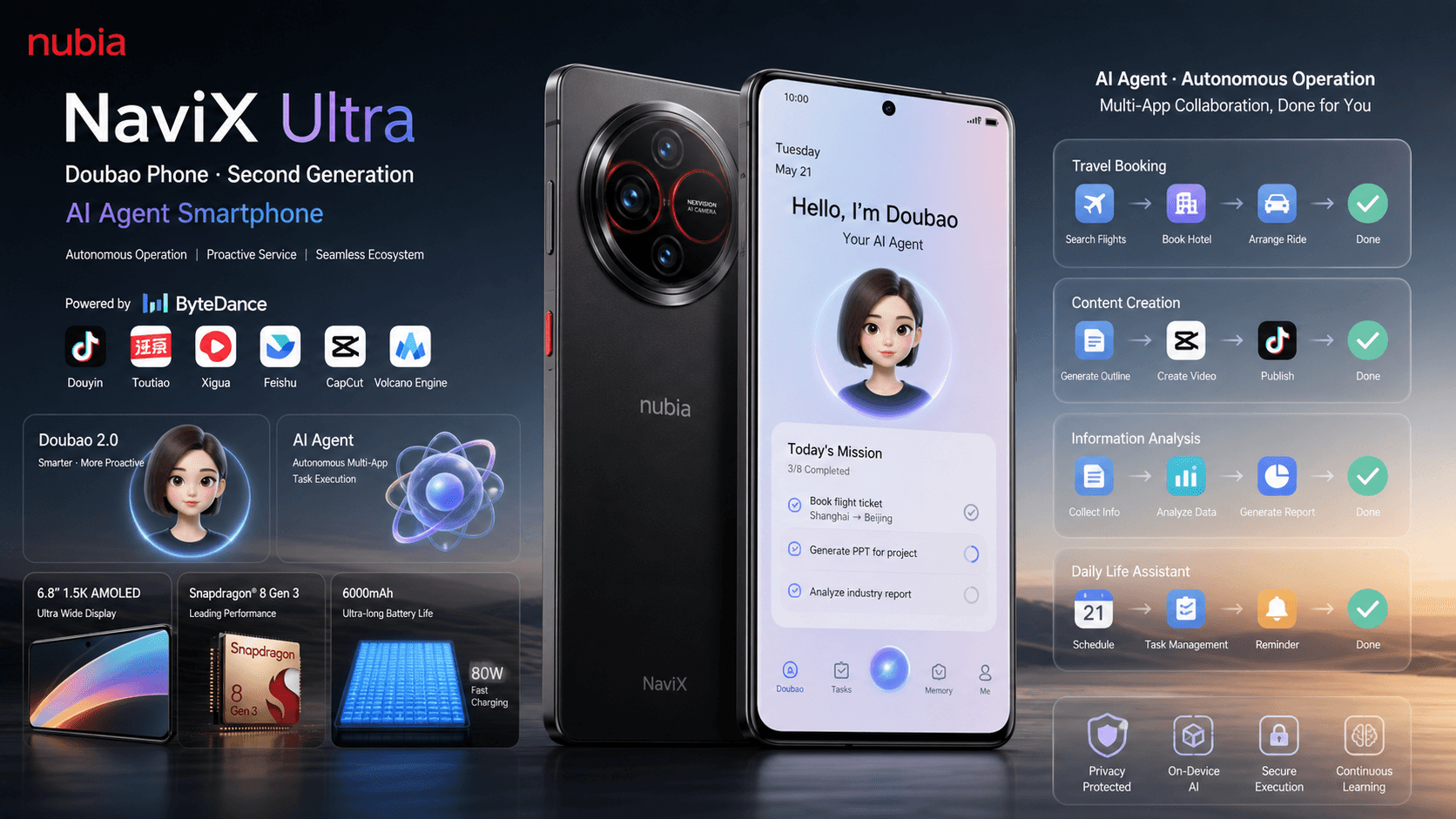
💡See how ByteDance is moving AI agents from the cloud to mobile hardware with cross-app autonomous control.
⚡ 30-Second TL;DR
What Changed
Features multi-app task queuing for automated workflows
Why It Matters
This device signals a shift toward mobile-first autonomous agents that can navigate complex UI environments, potentially changing how users interact with mobile ecosystems.
What To Do Next
Research the integration of autonomous agent frameworks with mobile UI automation tools to prepare for agent-driven mobile UX.
Key Points
- •Features multi-app task queuing for automated workflows
- •Implements a proactive memory system for AI agents
- •Supports autonomous cross-app operations across 10+ platforms
🧠 Deep Insight
AI-generated analysis for this event — not the original article.
🔑 Enhanced Key Takeaways
- •The NaviX Ultra utilizes a proprietary 'Agent-OS' kernel that prioritizes local on-device processing for sensitive task queuing to reduce latency.
- •ByteDance has integrated a new 'Contextual Bridge' API that allows the AI agent to maintain state persistence even when switching between third-party applications.
- •The device hardware includes a dedicated NPU (Neural Processing Unit) optimized specifically for the Doubao large language model's inference tasks.
- •The autonomous operation capability is powered by a reinforcement learning model trained on human-app interaction datasets to mimic natural user navigation patterns.
- •ByteDance has announced an open developer SDK for the NaviX Ultra, allowing third-party apps to register 'agent-ready' hooks for deeper system integration.
📊 Competitor Analysis▸ Show
| Feature | NaviX Ultra | Apple Intelligence (iPhone 17) | Samsung Galaxy AI (S26) |
|---|---|---|---|
| Task Queuing | Multi-app autonomous | Limited/App-specific | Sequential/Manual |
| Cross-Platform | 10+ Platforms | Ecosystem-locked | Limited/Samsung-centric |
| Memory System | Proactive/Persistent | Contextual/Short-term | Reactive/Cloud-based |
| Pricing | $899 (Base) | $999 (Base) | $849 (Base) |
🛠️ Technical Deep Dive
- Architecture: Employs a hybrid cloud-edge architecture where the Agent-OS kernel manages task prioritization locally while complex reasoning is offloaded to the Doubao cloud cluster.
- Memory System: Utilizes a Vector-based Long-Term Memory (LTM) store that indexes user interaction history to predict future task requirements.
- Task Queuing: Implements a Directed Acyclic Graph (DAG) scheduler to manage dependencies between multi-app operations, ensuring correct execution order.
- Cross-App Integration: Uses a proprietary UI-Automation layer that interprets screen elements as semantic objects, bypassing the need for traditional API-only integrations.
🔮 Future ImplicationsAI analysis grounded in cited sources
⏳ Timeline
Weekly AI Recap
Read this week's curated digest of top AI events →
👉Related Updates


AI-curated news aggregator. All content rights belong to original publishers.
Original source: Pandaily ↗
This is a summary, not the original. Read the source, or get the weekly briefing.
The weekly digest
One email a week. Unsubscribe anytime.