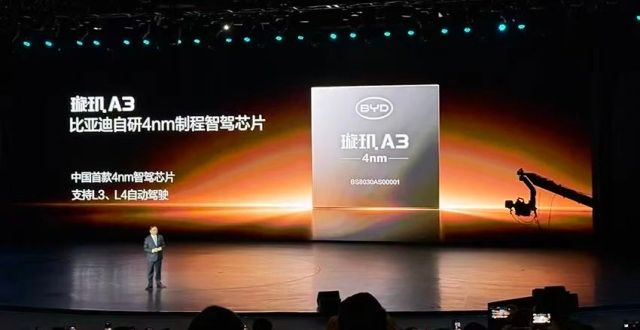
BYD Unveils Self-Developed 4nm Xuanji A3 Autonomous Driving Chip
💡BYD's vertical integration of AI silicon is a major signal for the future of autonomous vehicle cost and supply chains.
⚡ 30-Second TL;DR
What Changed
Self-developed 4nm automotive-grade autonomous driving chip
Why It Matters
BYD's move into proprietary silicon reduces reliance on external suppliers like Nvidia or Qualcomm, potentially lowering costs and increasing control over the autonomous driving stack.
What To Do Next
Monitor the performance benchmarks of the Xuanji A3 against current industry standards like Nvidia Orin to assess the competitive landscape of automotive AI hardware.
Key Points
- •Self-developed 4nm automotive-grade autonomous driving chip
- •Integration with upgraded intelligent driving systems
- •Introduction of city navigation assistance accident liability policy
🧠 Deep Insight
Background and context from public sources — not the original article. 18 sources cited.
🔑 Enhanced Key Takeaways
- •The Xuanji A3 chip is optimized for BYD's proprietary algorithms, which reportedly doubles computational utilization efficiency compared to previous chips.
- •A configuration of three Xuanji A3 chips delivers a combined peak computing power of over 2,100 TOPS, with a single chip offering 700 TOPS, and it has already entered mass production.
- •BYD's new city navigation assistance accident liability policy offers a one-year guarantee covering all direct economic losses from at-fault accidents, with no payout cap and no impact on future insurance premiums, shifting primary liability from users to the automaker.
- •The chip is designed to support Level 3 (L3) and Level 4 (L4) autonomous driving solutions, positioning BYD for future robotaxi fleets and advanced ADAS deployments.
- •The Xuanji A3 chip is a cornerstone of BYD's vertical integration strategy, aiming to control hardware costs, democratize advanced features, and enhance user trust by assuming clear liability for intelligent driving functions.
📊 Competitor Analysis▸ Show
| Feature/Chip | BYD Xuanji A3 (Single) | BYD Xuanji A3 (3-chip cluster) | Li Auto Mach 100 | Xpeng Turing AI | Nvidia Drive Thor |
|---|---|---|---|---|---|
| Process Node | 4nm | 4nm | N/A | N/A | N/A |
| Computing Power (TOPS) | 700 | >2,100 | 1,280 | 750 | 700 |
| Power Consumption | 20% lower per unit | 20% lower per unit | N/A | N/A | N/A |
| Mass Production | Yes | Yes | N/A | N/A | N/A |
| L3/L4 Support | Yes | Yes | N/A | N/A | Yes |
🛠️ Technical Deep Dive
- Process Node: 4nm manufacturing process, described as China's first mass-produced automotive-grade 4nm autonomous driving chip.
- Computing Power: A single Xuanji A3 chip delivers 700 TOPS (Trillion Operations Per Second). A cluster of three chips provides a combined peak computing power exceeding 2,100 TOPS.
- Power Efficiency: Offers 20% lower power consumption per unit of compute compared to competing products.
- Architecture: Features a 16-core CPU and 420,000 DMIPS of processing performance.
- Bandwidth: Carries 273 gigabytes per second of bandwidth.
- Algorithm Optimization: Designed for BYD's proprietary algorithms, doubling computational utilization efficiency.
- Functional Safety: Meets ASIL-D, the highest automotive functional-safety rating.
- LiDAR Compatibility: Compatible with thousand-line LiDAR sensors, including BYD-backed Robosense's 2,160-line sensor.
- System Integration: Forms the core of a new central computing platform that unifies smart cockpit, driver-assistance system (God's Eye), and core electric propulsion domains.
- Xuanji Architecture 2.0: The chip underpins this architecture, which routes raw sensor signals directly to a central brain, achieving an 8-microsecond latency.
- Autonomous Driving Support: Engineered to support Level 3 and Level 4 autonomous driving functions.
🔮 Future ImplicationsAI analysis grounded in cited sources
⏳ Timeline
📎 Sources (18)
Factual claims are grounded in the sources below. Forward-looking analysis is AI-generated interpretation.
Weekly AI Recap
Read this week's curated digest of top AI events →
👉Related Updates

AI-curated news aggregator. All content rights belong to original publishers.
Original source: Pandaily ↗
This is a summary, not the original. Read the source, or get the weekly briefing.
The weekly digest
One email a week. Unsubscribe anytime.