☁️AWS Machine Learning Blog•Freshcollected in 19m
Building visual intelligence with Amazon Bedrock and MCP servers
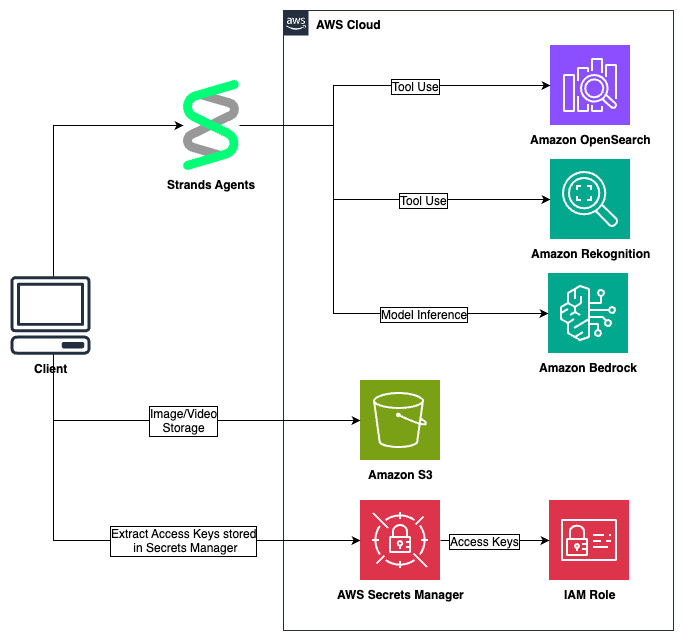
💡Standardize your agent's visual processing capabilities using the new MCP server architecture.
⚡ 30-Second TL;DR
What Changed
Introduces a standardized interface for visual information processing.
Why It Matters
Standardizing visual interfaces allows developers to build more modular and interoperable AI agents that can 'see' and act on visual data.
What To Do Next
Implement the Computer Vision MCP Server in your local environment to test how your agents handle multi-modal visual inputs.
Who should care:Developers & AI Engineers
Key Points
- •Introduces a standardized interface for visual information processing.
- •Demonstrates integration between Amazon Bedrock and MCP servers.
- •Streamlines the development of agentic vision systems.
- •Makes advanced AI visual capabilities accessible to more developers.
🧠 Deep Insight
AI-generated analysis for this event.
🔑 Enhanced Key Takeaways
- •The Model Context Protocol (MCP) is an open-standard initiative originally spearheaded by Anthropic to create a universal language for AI models to interact with external data and tools.
- •Amazon Bedrock's integration with MCP servers enables 'agentic' workflows where models can dynamically query visual data sources without requiring custom-built API connectors for every new vision model.
- •This architecture utilizes a client-host-server model where the Bedrock-powered agent acts as the client, requesting visual context from the MCP server, which abstracts the underlying computer vision processing logic.
- •The implementation supports multi-modal reasoning by allowing agents to pass image metadata and processed visual features directly into the context window of foundation models like Claude 3.5 or Amazon Titan.
- •By adopting the MCP standard, developers can swap out different vision backends (such as specialized OCR or object detection services) without modifying the core agent logic, significantly reducing technical debt.
📊 Competitor Analysis▸ Show
| Feature | Amazon Bedrock + MCP | LangChain Vision Tools | Google Vertex AI Extensions |
|---|---|---|---|
| Standardization | Open Source (MCP) | Proprietary/Community | Proprietary (Google) |
| Integration | Native Bedrock | Framework-level | Native Vertex AI |
| Flexibility | High (Vendor Agnostic) | Medium (Framework Dependent) | Low (Ecosystem Locked) |
🛠️ Technical Deep Dive
- The MCP server acts as a bridge, exposing visual processing functions as standardized tools that the LLM can invoke via function calling.
- Communication between the Bedrock agent and the MCP server typically occurs over Stdio or HTTP/SSE (Server-Sent Events) protocols.
- Visual data is processed into structured JSON schemas that define the capabilities (e.g., detect_objects, extract_text) available to the agent.
- The system leverages the Bedrock Agent's ability to maintain state across multiple turns, allowing the agent to refine visual queries based on previous tool outputs.
- Security is managed through the MCP host, which enforces permission scopes on what visual data or local files the server is permitted to access.
🔮 Future ImplicationsAI analysis grounded in cited sources
MCP will become the industry-standard interface for enterprise AI agent tool-use.
The shift toward open-standard protocols reduces vendor lock-in, incentivizing enterprises to adopt MCP-compatible architectures over proprietary alternatives.
Visual processing latency will decrease as edge-based MCP servers become common.
Moving visual pre-processing to local or near-edge MCP servers reduces the need to transmit raw high-resolution images to the cloud for every inference step.
⏳ Timeline
2023-09
Amazon Bedrock becomes generally available, introducing managed foundation model access.
2024-11
Anthropic introduces the Model Context Protocol (MCP) as an open standard for AI connectivity.
2025-05
AWS expands Bedrock Agent capabilities to support broader tool-use and multi-step reasoning.
2026-07
AWS releases the Computer Vision MCP Server integration for Amazon Bedrock.
📰
Weekly AI Recap
Read this week's curated digest of top AI events →
👉Related Updates

AI-curated news aggregator. All content rights belong to original publishers.
Original source: AWS Machine Learning Blog ↗