Building specialized AI for high-stakes educational exam preparation
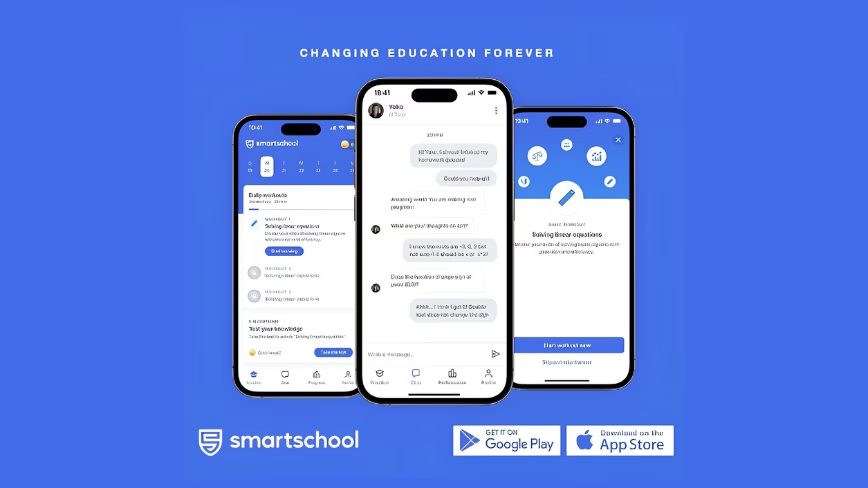
💡Learn why generic chatbots fail in education and how to build high-stakes, reliable AI for specialized domains.
⚡ 30-Second TL;DR
What Changed
Distinguishing between general information retrieval and pedagogical AI instruction
Why It Matters
This highlights the shift toward vertical-specific AI agents that require higher precision and domain-specific grounding than general LLMs. It suggests that educational AI developers must prioritize accuracy and pedagogical alignment over conversational fluency.
What To Do Next
If building for education, implement a multi-stage verification layer in your RAG pipeline to cross-reference AI outputs against verified curriculum datasets.
Key Points
- •Distinguishing between general information retrieval and pedagogical AI instruction
- •Addressing the high-stakes requirements of standardized testing like SAT and ACT
- •Developing specialized AI architectures for reliable educational outcomes
- •Overcoming the limitations of standard LLM-based chatbot frameworks
🧠 Deep Insight
AI-generated analysis for this event — not the original article.
🔑 Enhanced Key Takeaways
- •Integration of Retrieval-Augmented Generation (RAG) specifically tuned for psychometric validity to ensure AI-generated practice questions align with official College Board and ACT, Inc. content specifications.
- •Implementation of 'Chain-of-Thought' verification layers that force the AI to solve problems using multiple pedagogical methods before presenting an answer to the student.
- •Utilization of proprietary datasets consisting of anonymized student performance data to fine-tune models for identifying common misconceptions in high-stakes test takers.
- •Adoption of 'Human-in-the-loop' (HITL) reinforcement learning where certified educators review and grade AI-generated explanations to reduce hallucination rates in complex math and reading comprehension tasks.
- •Development of latency-optimized inference pipelines designed to simulate the time-constrained environment of actual SAT/ACT testing scenarios.
📊 Competitor Analysis▸ Show
| Feature | Smartschool (Specialized) | Khan Academy (Khanmigo) | Princeton Review (AI Tutor) |
|---|---|---|---|
| Focus | High-stakes exam accuracy | General tutoring/guidance | Test prep integration |
| Architecture | Psychometric-tuned RAG | General LLM (GPT-4) | Proprietary/Licensed LLM |
| Benchmarks | High (Exam-specific) | Medium (General) | High (Curriculum-aligned) |
| Pricing | Premium/Subscription | Freemium/Institutional | High-tier course bundle |
🛠️ Technical Deep Dive
- Architecture utilizes a hybrid model combining a frozen base LLM with a specialized 'Pedagogical Reasoning Engine' that acts as a constraint layer.
- Employs vector databases indexed by Bloom's Taxonomy levels to match question difficulty with student proficiency.
- Implements automated fact-checking agents that cross-reference AI outputs against a curated knowledge base of official exam rubrics.
- Uses LoRA (Low-Rank Adaptation) fine-tuning on domain-specific datasets to minimize compute costs while maintaining high accuracy in standardized test formats.
🔮 Future ImplicationsAI analysis grounded in cited sources
⏳ Timeline
Weekly AI Recap
Read this week's curated digest of top AI events →
👉Related Updates


AI-curated news aggregator. All content rights belong to original publishers.
Original source: The Next Web (TNW) ↗
This is a summary, not the original. Read the source, or get the weekly briefing.
Weekly AI briefing
One email a week. Unsubscribe anytime.