Building Enterprise AI Assistants with Amazon Bedrock AgentCore
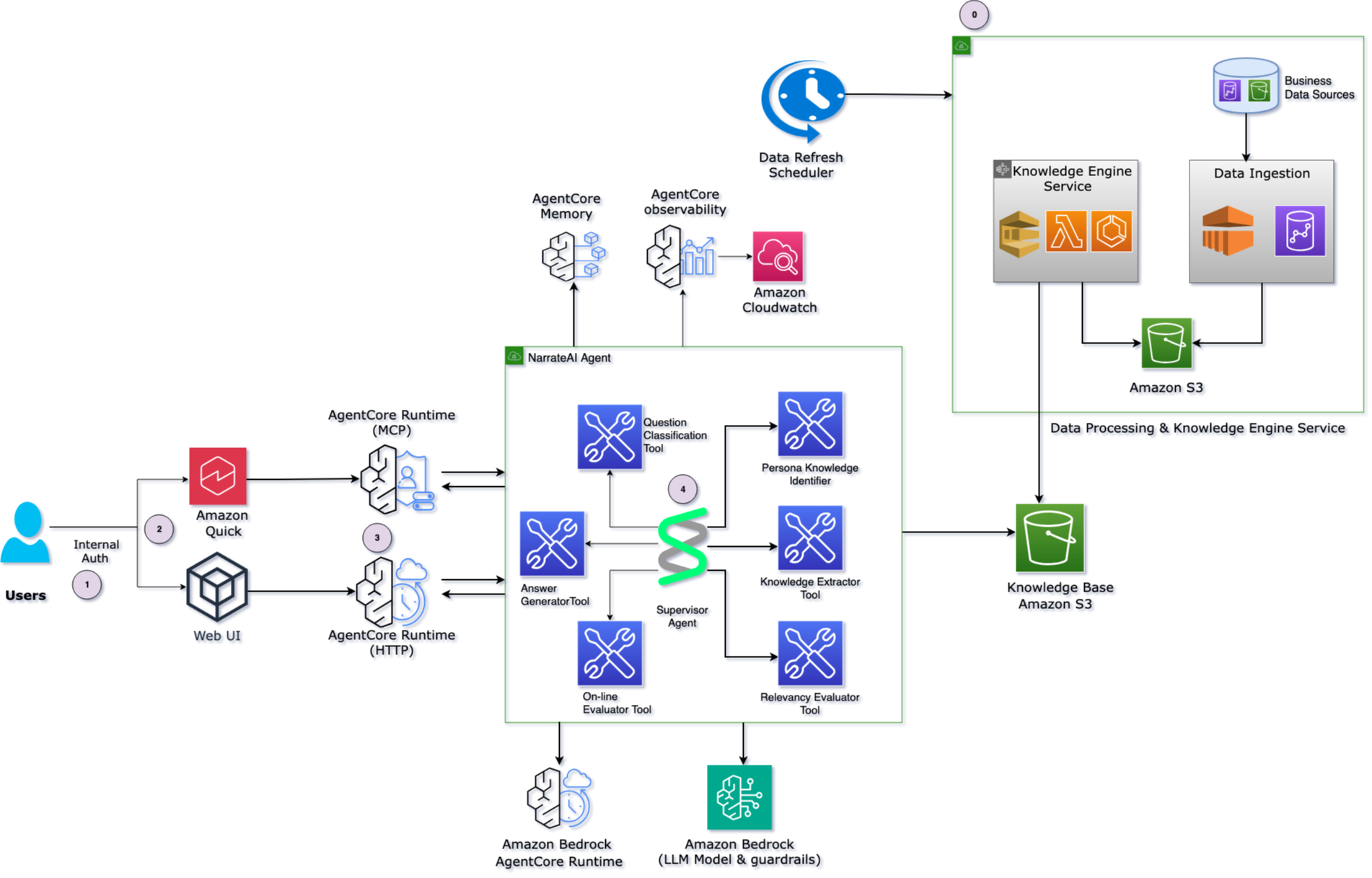
💡Learn how AWS scales enterprise AI agents by decoupling batch processing from real-time conversational interfaces.
⚡ 30-Second TL;DR
What Changed
Implemented a two-layer architecture separating batch processing from real-time user interaction.
Why It Matters
This architecture provides a blueprint for enterprises looking to bridge the gap between heavy data processing and low-latency conversational AI interfaces. It demonstrates how to maintain system reliability while scaling AI agents across complex organizational data.
What To Do Next
Review the NarrateAI architecture patterns to see if your current RAG implementation can benefit from separating batch-processed context from real-time agent reasoning.
Key Points
- •Implemented a two-layer architecture separating batch processing from real-time user interaction.
- •Utilized specialized AI agents for intelligent routing and data validation tasks.
- •Established engineering patterns for deploying production-grade conversational AI at scale.
🧠 Deep Insight
Background and context from public sources — not the original article. 24 sources cited.
🔑 Enhanced Key Takeaways
- •Amazon Bedrock AgentCore provides a fully managed, scalable platform for building and operating AI agents, abstracting away infrastructure complexities like orchestration, security, and session management, allowing developers to focus on agent logic and purpose.
- •The platform features a modular architecture comprising services like AgentCore Runtime, Gateway, Memory, Identity, and Observability, and is designed to be framework-agnostic, supporting popular open-source frameworks such as CrewAI, LangGraph, and LlamaIndex, as well as various foundation models.
- •AgentCore employs a consumption-based pricing model, billing individual services like Runtime, Gateway, and Memory independently based on active usage, which helps separate the cost of the agent infrastructure from the underlying foundation model inference costs.
- •Recent enhancements to AgentCore include Policy for defining agent action boundaries, AgentCore Evaluations for continuous quality assessment with pre-built and custom evaluators, and an enhanced Memory service with episodic functionality for agents to learn from past interactions.
- •NarrateAI, the business intelligence tool mentioned in the article, is an AI-powered conversational assistant built with AgentCore for AWS's SMGS organization, designed to provide on-demand, context-rich business intelligence by connecting to data lakes and offering natural-language querying.
📊 Competitor Analysis▸ Show
| Feature / Platform | AWS Bedrock AgentCore | Google Cloud Agent Builder (ADK/Vertex AI) | Microsoft Azure AI Foundry Agent Service (Copilot Studio) |
|---|---|---|---|
| Core Philosophy | Enterprise-first: strong guardrails, strict schemas, deterministic execution, control, predictability. | Developer-first: flexible, forgiving, fast iteration, local development, designed for experimentation. | Microsoft-stack enterprises: strong governance, CI/CD ready, integrates with M365 permissions. |
| Architecture | Fully managed, modular services (Runtime, Gateway, Memory, Identity, Observability). | Open-source Agent Development Kit (ADK) for building; Vertex AI Agent Builder for managed runtime. | Four-layer architecture with deep integration across Azure ecosystem. |
| Framework/Model Agnostic | Framework-agnostic (CrewAI, LangGraph, LlamaIndex, Strands Agents); Model-agnostic (Anthropic, Meta, Mistral, Amazon Nova, OpenAI, Google Gemini). | Model-agnostic but optimized for Gemini; supports LLM Agents, Workflow Agents. | Aligns Semantic Kernel and AutoGen; supports various models in Foundry catalog. |
| Tool Integration | Secure tool/API integration via AgentCore Gateway (MCP, OpenAPI, Lambda). | Supports Model Context Protocol (MCP) for tool integration. | Integrates with existing APIs, Lambda functions, and services; supports MCP. |
| Security & Governance | Built-in guardrails, Policy for action boundaries, VPC, PrivateLink, CloudFormation, resource tagging, identity-aware authorization. | Inherits M365 permissions (Copilot Studio); role-based access controls (RBAC). | Microsoft Entra identity, RBAC, private networking for supported agent types. |
| Pricing Model | Consumption-based, modular billing per service (vCPU-hours, GB-hours, invocations, records, requests, tokens); separates infrastructure from model inference costs. | Consumption-based (specific details vary by service and usage). | Consumption-based (specific details vary by service and usage). |
| Key Use Cases | Production-grade enterprise AI agents, complex workflows, customer support automation, operational streamlining. | Rapid prototyping, experimentation, multi-vendor agent ecosystems, Google Cloud-native teams. | Microsoft 365 environments, IT/HR support, regulated workflows, Azure DevOps integration. |
🛠️ Technical Deep Dive
- Modular Services: Amazon Bedrock AgentCore is built upon core components including AgentCore Runtime, AgentCore Gateway, AgentCore Memory, AgentCore Identity, and AgentCore Observability, which can be used together or independently.
- AgentCore Runtime: Provides a secure, serverless execution environment purpose-built for deploying and scaling dynamic AI agents and tools. It offers fast cold starts for real-time interactions, extended runtime support for asynchronous agents (up to eight hours), true session isolation, built-in identity, and support for multi-modal and multi-agent workloads.
- AgentCore Gateway: Acts as a unified connectivity layer for multi-agent systems, converting existing APIs, Lambda functions, AWS services, and Model Context Protocol (MCP) servers into agent-ready tools. It handles protocol translation (e.g., MCP to REST/Lambda), security, credential management, and semantic tool discovery.
- AgentCore Memory: A fully managed service that enables AI agents to maintain both short-term (in-session context, event history, branching) and long-term memory (persistent insights, preferences, conversation summaries extracted asynchronously). It features abstracted storage, encrypted data, hierarchical namespaces, and customizable memory strategies.
- AgentCore Identity: Offers comprehensive identity and credential management specifically for AI agents, handling authentication and authorization to agents/MCP servers and managing inbound/outbound authentication using standardized OAuth 2.0/OpenID Connect flows and API keys.
- AgentCore Observability: Delivers complete visibility into end-to-end agent execution and operational metrics across all AgentCore services through dashboards powered by Amazon CloudWatch.
- Auxiliary Tools: The platform includes auxiliary tools such as Code Interpreter for sandboxed code execution and data analysis, and Browser Use, a fully managed cloud-based browser runtime for AI agents to interact with websites at scale.
- Protocol Support: AgentCore supports the Agent-to-Agent (A2A) protocol for inter-agent communication and the Model Context Protocol (MCP) for tool integration.
- Security Features: With general availability, AgentCore services support Virtual Private Cloud (VPC), AWS PrivateLink, AWS CloudFormation, and resource tagging for enhanced enterprise security. Policy in AgentCore actively blocks unauthorized agent actions through real-time, deterministic controls.
🔮 Future ImplicationsAI analysis grounded in cited sources
⏳ Timeline
📎 Sources (24)
Factual claims are grounded in the sources below. Forward-looking analysis is AI-generated interpretation.
Weekly AI Recap
Read this week's curated digest of top AI events →
👉Related Updates
AI-curated news aggregator. All content rights belong to original publishers.
Original source: AWS Machine Learning Blog ↗
This is a summary, not the original. Read the source, or get the weekly briefing.
The weekly digest
One email a week. Unsubscribe anytime.