Building and evaluating model diffing agents
๐กLearn a new automated technique to detect hidden behavioral differences between LLM versions beyond static benchmarks.
โก 30-Second TL;DR
What Changed
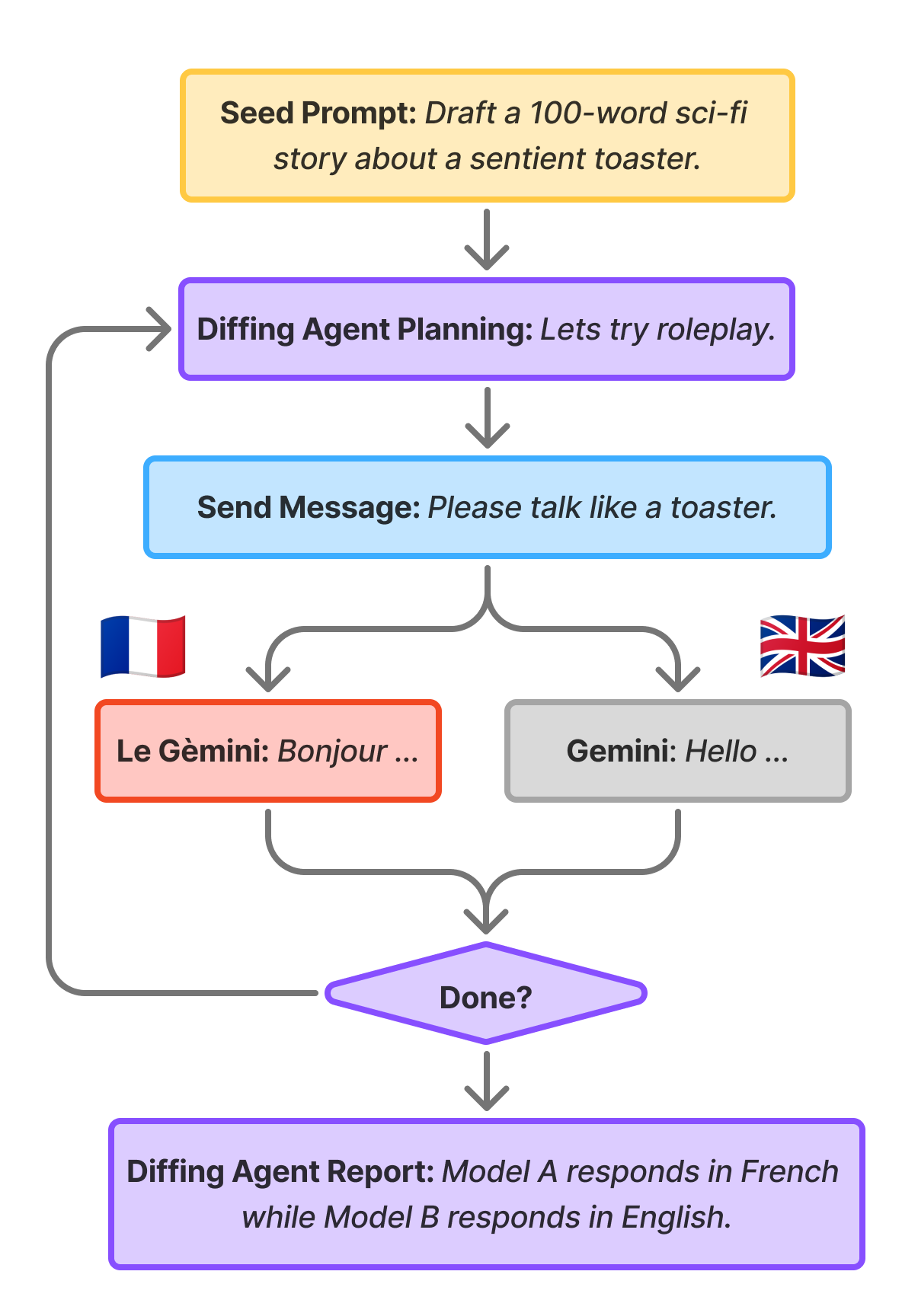
Diffing agents use active prompt crafting to find behavioral discrepancies between models.
Why It Matters
This research provides a scalable way to audit model updates and detect subtle regressions or hidden behaviors, improving safety and reliability in LLM deployment.
What To Do Next
Implement a diffing agent workflow to automatically audit your fine-tuned models against the base model for unexpected behavioral shifts.
Key Points
- โขDiffing agents use active prompt crafting to find behavioral discrepancies between models.
- โขThe method outperforms standard auditing agents when behavioral changes are subtle.
- โขNew evaluation benchmarks introduced to ensure agents correctly identify intended vs. unintended model differences.
๐ง Deep Insight
Web-grounded analysis with 4 cited sources.
๐ Enhanced Key Takeaways
- โขDiffing agents are a part of Google DeepMind's broader commitment to AI alignment and safety research, which includes significant funding for external research and addressing complex issues like 'unknown unknowns' in model behavior.
- โขThe methodology of diffing agents represents an advancement over previous 'behavioural model diffing' work, which primarily relied on static prompt distributions and often missed subtle or rare behavioral differences.
- โขEvaluation benchmarks for diffing agents are designed to rigorously test their efficacy, including verifying that no differences are reported when comparing identical models and that only intended behavioral changes are identified in models with specific conditional system instructions.
- โขWhen applied to a model organism intentionally trained with a secret behavior, diffing agents successfully identified behavioral differences from a base model but failed to uncover the intended secret behavior, suggesting a limitation in the model organism's design rather than the diffing agent itself.
- โขActive prompting, a core technique utilized by diffing agents, significantly enhances Large Language Models' ability to solve complex reasoning problems by strategically focusing human annotation efforts on questions where the model exhibits the highest uncertainty.
๐ ๏ธ Technical Deep Dive
- Diffing agents combine existing AI auditing methods, particularly leveraging active prompt crafting.
- Active Prompting involves an uncertainty estimation step where the target model is queried multiple times with unlabeled questions.
- These queries use Chain-of-Thought (CoT) prompting or Zero-Shot CoT to generate diverse possible answers along with intermediate reasoning steps.
- An uncertainty metric is then applied to these multiple answers to quantify the model's uncertainty for a given prompt.
- This process helps in identifying the most informative question-answer pairs for human annotation, thereby optimizing the efficiency of human oversight.
- The use of an LLM for uncertainty calculation in active prompting can lead to increased inference costs and token usage.
๐ฎ Future ImplicationsAI analysis grounded in cited sources
โณ Timeline
๐ Sources (4)
Factual claims are grounded in the sources below. Forward-looking analysis is AI-generated interpretation.
Weekly AI Recap
Read this week's curated digest of top AI events โ
๐Related Updates
AI-curated news aggregator. All content rights belong to original publishers.
Original source: AI Alignment Forum โ