Building a Robust AI Evaluation System from Scratch
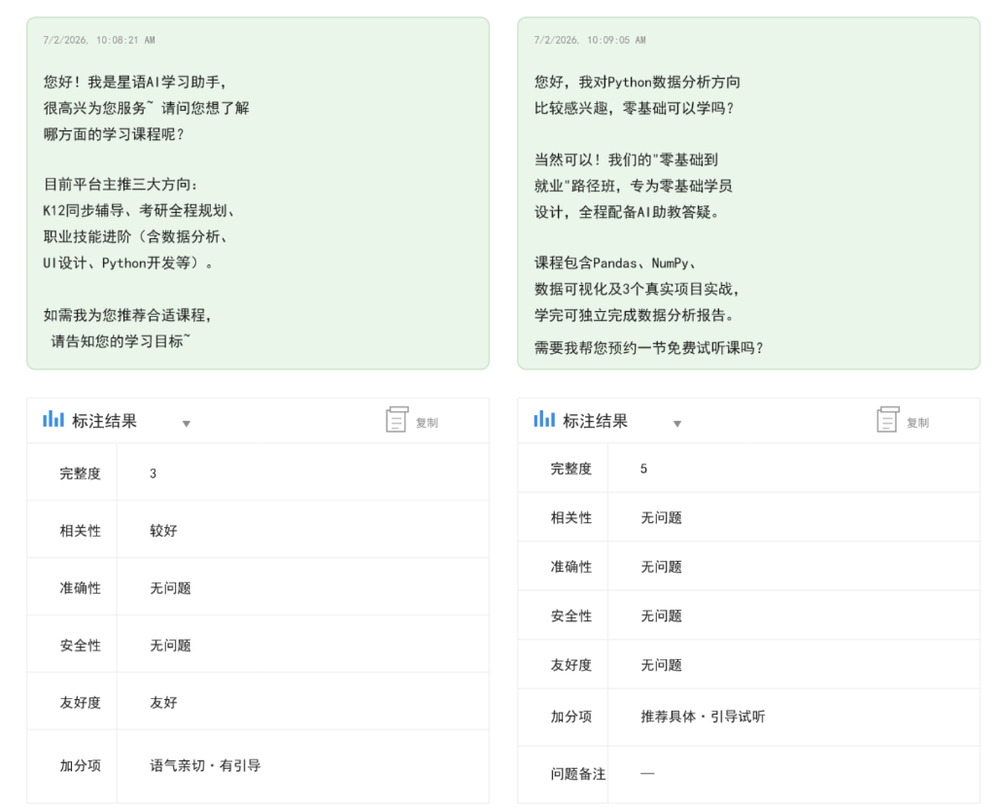
💡Learn how to build a professional-grade AI evaluation system that moves beyond simple manual scoring.
⚡ 30-Second TL;DR
What Changed
Transition from manual 'hand-crafted' workflows to systematic data management and automated pipelines.
Why It Matters
Helps teams move beyond 'vibes-based' evaluation to data-driven model optimization, significantly reducing iteration cycles and improving product quality.
What To Do Next
Decompose your model's 'overall score' into specific, measurable sub-dimensions and run separate evaluation prompts for each to reduce variance.
Key Points
- •Transition from manual 'hand-crafted' workflows to systematic data management and automated pipelines.
- •Implement a three-layer filtering strategy: product stage, core scenario, and user-critical failure points.
- •Use a role-based evaluation matrix to avoid resource mismatch and halo effects in scoring.
- •Adopt a three-step conclusion interpretation method: identify compliance, root cause analysis, and actionable optimization.
🧠 Deep Insight
AI-generated analysis for this event — not the original article.
🔑 Enhanced Key Takeaways
- •Modern AI evaluation frameworks are increasingly adopting 'LLM-as-a-Judge' architectures, where high-capability models (like GPT-4o or Claude 3.5) are used to automate the scoring of smaller, domain-specific models.
- •The industry is shifting toward 'Evaluation-as-Code' (EaC) practices, integrating automated test suites directly into CI/CD pipelines to prevent regression during model fine-tuning or prompt engineering.
- •Adversarial testing (Red Teaming) is now a mandatory component of robust evaluation, specifically focusing on jailbreak detection and prompt injection vulnerabilities before product deployment.
- •Evaluation datasets are evolving from static benchmarks (like MMLU) to dynamic, user-generated 'Golden Datasets' that reflect real-world production traffic and edge cases.
- •Cost-efficiency in evaluation is being addressed through 'Model Distillation for Evaluation,' where smaller, specialized models are trained to mimic the grading behavior of larger, more expensive models to reduce API costs.
📊 Competitor Analysis▸ Show
| Feature | LangSmith (LangChain) | Weights & Biases (W&B) | Promptfoo | Evaluation Framework (Article) |
|---|---|---|---|---|
| Primary Focus | LLM App Lifecycle | Experiment Tracking | CLI-based Prompt Testing | Product-Centric Workflow |
| Pricing | Usage-based | Tiered/Enterprise | Open Source/Paid | Internal Methodology |
| Benchmarking | Integrated | Integrated | CLI-driven | Manual/Role-based |
🛠️ Technical Deep Dive
- Implementation of RAG (Retrieval-Augmented Generation) evaluation often utilizes frameworks like RAGAS, which measures Faithfulness, Answer Relevance, and Context Precision.
- Automated pipelines frequently employ vector database similarity metrics (e.g., Cosine Similarity) to compare model outputs against ground-truth embeddings.
- Evaluation systems often utilize JSON-schema enforcement to ensure that model outputs are structured correctly for downstream programmatic analysis.
- Statistical significance testing (e.g., Bootstrapping or Wilcoxon signed-rank test) is used to determine if performance improvements between model versions are genuine or due to noise.
🔮 Future ImplicationsAI analysis grounded in cited sources
⏳ Timeline
Weekly AI Recap
Read this week's curated digest of top AI events →
👉Related Updates


AI-curated news aggregator. All content rights belong to original publishers.
Original source: 虎嗅 ↗
This is a summary, not the original. Read the source, or get the weekly briefing.
The weekly digest
One email a week. Unsubscribe anytime.