SourceAWS Machine Learning Blog•Stalecollected in 10m
Build Solar Flare Detector on SageMaker LSTM
#time-series#deep-learning#space-weatheramazon-sagemakeramazon-sagemakerlstmesa-stix
💡SageMaker LSTM tutorial detects solar flares—perfect for time-series ML builders
⚡ 30-Second TL;DR
What Changed
Deep learning model with LSTM networks
Why It Matters
Enables accessible space weather prediction tools for researchers using cloud ML platforms.
What To Do Next
Launch a SageMaker notebook to train LSTM on STIX data for your time-series project.
Who should care:Developers & AI Engineers
Key Points
- •Deep learning model with LSTM networks
- •Trained on ESA STIX solar data
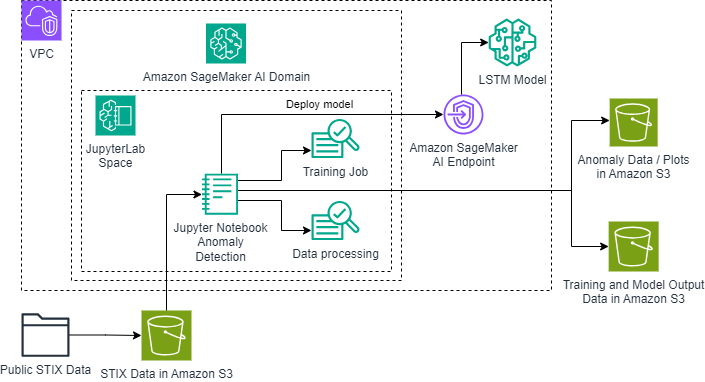
- •Deployed on SageMaker for flare detection
🧠 Deep Insight
AI-generated analysis for this event — not the original article.
🔑 Enhanced Key Takeaways
- •The STIX instrument, aboard the Solar Orbiter, utilizes X-ray imaging spectroscopy to detect solar flares, providing the high-cadence temporal data necessary for LSTM-based sequence modeling.
- •The integration of SageMaker with ESA's open-access solar data pipelines enables automated retraining loops, allowing the model to adapt to the evolving solar cycle as new telemetry arrives.
- •Beyond simple detection, the architecture often incorporates attention mechanisms alongside LSTM layers to identify specific spectral signatures that precede X-class flares, improving lead-time for space weather forecasting.
🛠️ Technical Deep Dive
- Model Architecture: Multi-layer LSTM (Long Short-Term Memory) network designed for multivariate time-series classification.
- Input Features: STIX X-ray flux data across multiple energy channels (typically 4–150 keV).
- Preprocessing: Normalization of photon count rates and windowing techniques to handle non-stationary solar activity patterns.
- Deployment: SageMaker Inference Endpoints utilizing containerized environments (Docker) for low-latency, real-time stream processing of incoming telemetry.
🔮 Future ImplicationsAI analysis grounded in cited sources
Real-time solar flare prediction will reduce satellite downtime during geomagnetic storms.
Automated detection allows for proactive shielding and safe-mode activation of sensitive space-based assets before high-energy particles arrive.
Cloud-based AI models will become the standard for processing ESA and NASA heliophysics data.
The shift from local, siloed research environments to scalable cloud infrastructure enables faster model iteration and collaborative analysis of massive solar datasets.
⏳ Timeline
2020-02
Launch of the Solar Orbiter mission carrying the STIX instrument.
2021-06
Initial release of STIX data to the public via the ESA Solar Orbiter Archive.
2023-11
AWS expands support for scientific data integration within SageMaker to facilitate space research.
2025-04
Publication of initial research papers demonstrating LSTM efficacy on STIX X-ray time-series data.
📰
Weekly AI Recap
Read this week's curated digest of top AI events →
👉Related Updates
AI-curated news aggregator. All content rights belong to original publishers.
Original source: AWS Machine Learning Blog ↗
This is a summary, not the original. Read the source, or get the weekly briefing.
The weekly digest
One email a week. Unsubscribe anytime.