Build Multimodal RAG for Slide Decks
💡See how GPT-4V and LangChain turn slide decks into searchable visual knowledge bases.
⚡ 30-Second TL;DR
What Changed
Builds retrieval-augmented generation applications for slide decks
Why It Matters
Multimodal RAG can make information embedded in charts, diagrams, and slide layouts searchable through natural-language questions. This is useful for enterprise knowledge assistants and teams working with presentation-heavy documentation.
What To Do Next
Use a LangChain multimodal RAG template with a representative slide deck, then benchmark visual-question-answering accuracy against a text-only baseline.
Key Points
- •Builds retrieval-augmented generation applications for slide decks
- •Uses GPT-4V to interpret and answer questions about visual content
- •Compares approaches, benchmarks performance, and provides deployment templates
🧠 Deep Insight
Background and context from public sources — not the original article. 10 sources cited.
🔑 Enhanced Key Takeaways
- •Modern pipelines utilize 'bound' retrieval to maintain persistent links between slide notes, tables, and visual elements, preventing data desynchronization.
- •LlamaParse has emerged as the industry standard for parsing slide decks, specifically for its capability to preserve complex spatial layouts and nested tables that standard OCR fails to interpret.
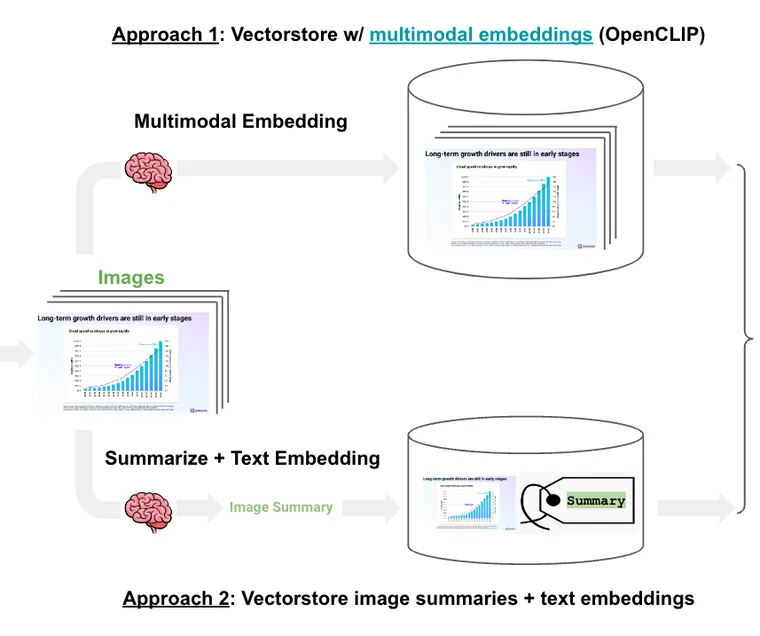
- •The architecture frequently employs a multi-vector retriever pattern where vision models generate detailed image summaries that are embedded for retrieval, rather than embedding the raw image directly.
- •Late-interaction models, such as Nemotron ColEmbed V2 8B, have superseded traditional pooling methods by maintaining granular relationships between page elements during the retrieval process.
- •Hybrid retrieval systems combining dense vector search with BM25 are required to maintain audit trails and support exact string matching alongside visual interpretation.
📊 Competitor Analysis▸ Show
| Feature | LangChain (Multimodal RAG) | LlamaIndex (Data Agents) | Haystack (Multimodal Pipeline) |
|---|---|---|---|
| Primary Focus | Orchestration & Templates | Data Ingestion & Indexing | Modular Search Pipelines |
| Vision Integration | GPT-4V / Qwen3-VL | Multi-modal Vector Stores | Custom Component Integration |
| Pricing | Open Source (Free) | Open Source (Free) | Open Source (Free) |
| Benchmarks | High (Template-driven) | High (Agentic-driven) | Medium (Custom-driven) |
🛠️ Technical Deep Dive
- Architecture: Utilizes a multi-vector retriever pattern where images are processed by vision models to create text-based summaries, which are then indexed for semantic search.
- Parsing: Employs advanced document parsing (e.g., LlamaParse) to maintain spatial hierarchy and table structure, avoiding the flattening effect of standard OCR.
- Interaction: Implements late-interaction techniques to preserve granular relationships between visual elements and text, improving retrieval precision over standard pooling.
- Hybrid Search: Integrates BM25 with dense vector embeddings to ensure exact string matching for audit-heavy enterprise requirements.
- Cost Model: Processing costs are bifurcated, with specific pricing models (e.g., $0.60 per billion pixels) applied to visual data distinct from text token costs.
🔮 Future ImplicationsAI analysis grounded in cited sources
⏳ Timeline
📎 Sources (10)
Factual claims are grounded in the sources below. Forward-looking analysis is AI-generated interpretation.
Weekly AI Recap
Read this week's curated digest of top AI events →
👉Related Updates
AI-curated news aggregator. All content rights belong to original publishers.
Original source: LangChain Blog ↗
This is a summary, not the original. Read the source, or get the weekly briefing.
Weekly AI briefing
One email a week. Unsubscribe anytime.