Build agentic AI semantic layers with Stardog and Bedrock
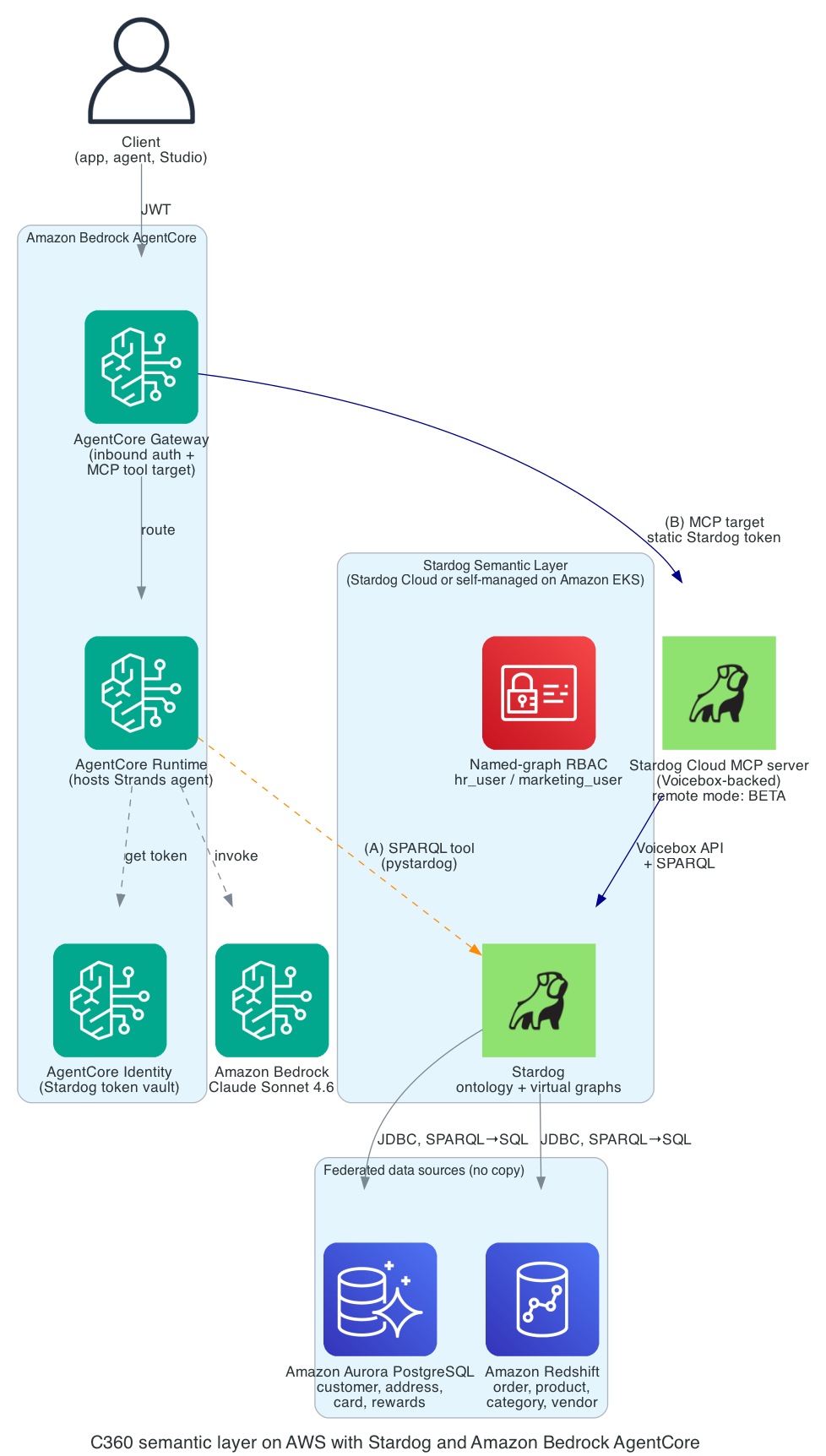
💡Build smarter AI agents by connecting them to a semantic layer without complex ETL pipelines.
⚡ 30-Second TL;DR
What Changed
Integrates Stardog Semantic AI with Amazon Bedrock AgentCore
Why It Matters
Simplifies the architecture for agentic AI by providing a unified semantic layer, reducing data engineering complexity.
What To Do Next
Explore the Stardog Semantic AI integration with Bedrock AgentCore to streamline your agent's data retrieval.
Key Points
- •Integrates Stardog Semantic AI with Amazon Bedrock AgentCore
- •Enables cross-source querying without ETL processes
- •Supports deployment across EKS, ECS, and AWS Lambda
🧠 Deep Insight
AI-generated analysis for this event — not the original article.
🔑 Enhanced Key Takeaways
- •Stardog utilizes Knowledge Graph technology to create a virtualized semantic layer, allowing LLMs to ground their responses in structured enterprise data without moving it.
- •The integration leverages Amazon Bedrock's Knowledge Bases and Agent capabilities to map natural language queries directly to SPARQL or SQL queries via Stardog's reasoning engine.
- •Stardog's 'Voicebox' or similar semantic reasoning capabilities allow the AI agent to infer relationships between disparate data silos in Aurora and Redshift that are not explicitly linked in the schema.
- •The architecture supports 'Human-in-the-loop' workflows, where the semantic layer provides explainability by citing the specific knowledge graph triples used to generate an AI response.
- •Security is maintained through fine-grained access control policies enforced at the semantic layer, ensuring that Bedrock agents only access data authorized for the specific user context.
📊 Competitor Analysis▸ Show
| Feature | Stardog + Bedrock | Neo4j + LangChain | Palantir Foundry |
|---|---|---|---|
| Core Approach | Semantic Knowledge Graph Virtualization | Native Graph Database | Data Integration & Ontology |
| ETL Requirement | Zero-ETL (Virtualization) | Often requires ETL/Ingestion | Heavy Ingestion/Modeling |
| Primary Use Case | Enterprise Data Fabric/AI | Graph Analytics/AI | Operational Decisioning |
| Pricing | Enterprise Licensing | Open Source/Enterprise | High-touch Enterprise |
🛠️ Technical Deep Dive
- Uses Stardog's Virtual Graph feature to map relational schemas from Aurora and Redshift into a unified RDF/OWL ontology.
- Implements a RAG (Retrieval-Augmented Generation) pipeline where Bedrock agents query the Stardog endpoint via a REST API.
- Employs Stardog's reasoning engine to perform inferencing, allowing the agent to answer questions based on implicit data relationships.
- Supports integration with AWS IAM for authentication, ensuring that the semantic layer respects existing AWS security postures.
- Utilizes vector embeddings stored within the knowledge graph to enable hybrid search (semantic + keyword) for agentic retrieval.
🔮 Future ImplicationsAI analysis grounded in cited sources
⏳ Timeline
Weekly AI Recap
Read this week's curated digest of top AI events →
👉Related Updates
AI-curated news aggregator. All content rights belong to original publishers.
Original source: AWS Machine Learning Blog ↗
This is a summary, not the original. Read the source, or get the weekly briefing.
The weekly digest
One email a week. Unsubscribe anytime.