Build a custom portal with embedded SageMaker MLflow Apps
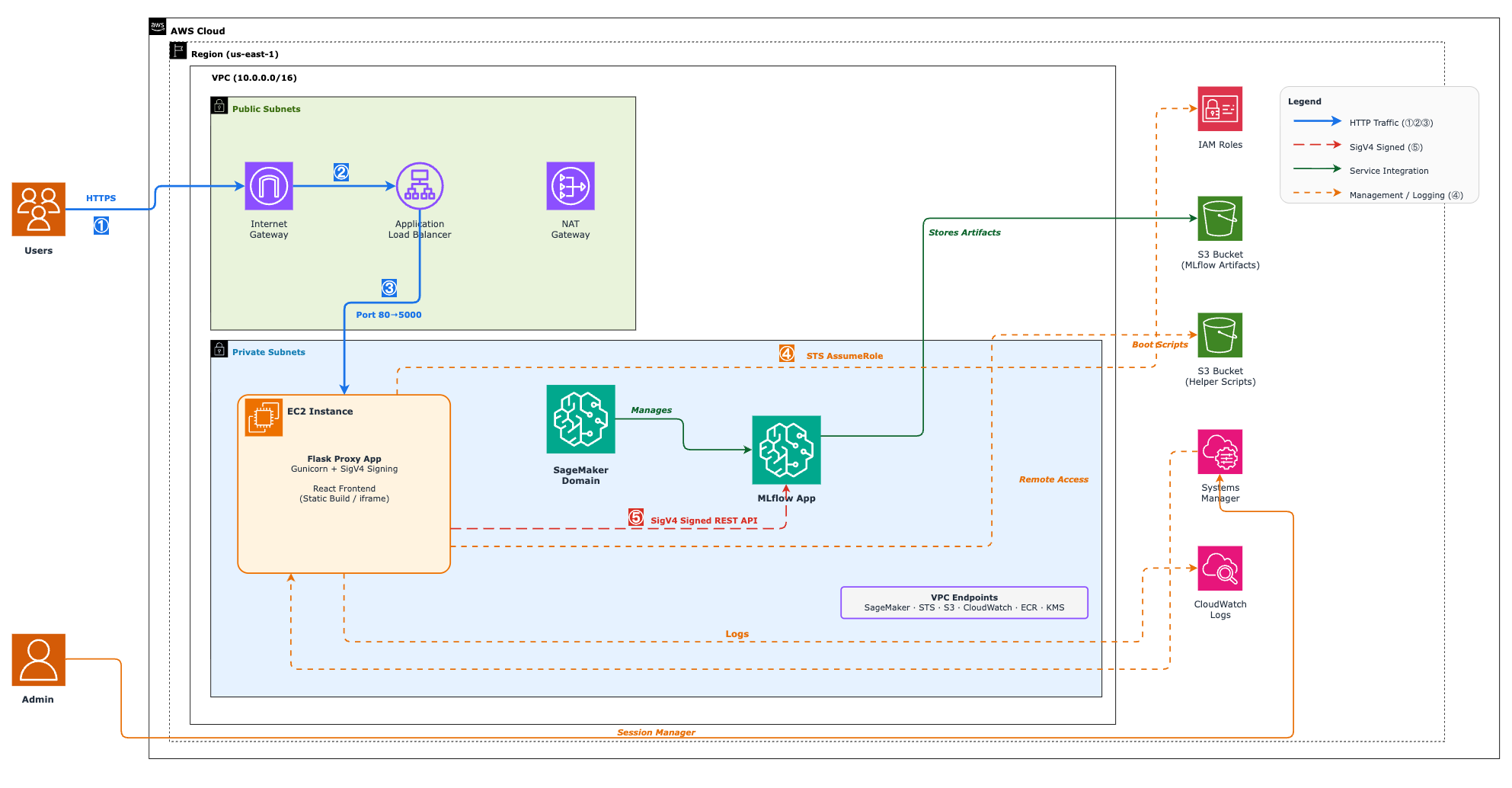
💡Learn how to securely embed SageMaker MLflow into your own custom internal developer portals.
⚡ 30-Second TL;DR
What Changed
Implement React front end with Flask reverse proxy
Why It Matters
Enables teams to provide a seamless, branded MLflow experience while maintaining strict AWS security standards.
What To Do Next
Clone the AWS CDK repository provided in the blog to test the SigV4 proxy implementation in your sandbox.
Key Points
- •Implement React front end with Flask reverse proxy
- •Handle AWS Signature Version 4 (SigV4) authentication
- •Deploy full stack infrastructure using AWS CDK
🧠 Deep Insight
Background and context from public sources — not the original article. 32 sources cited.
🔑 Enhanced Key Takeaways
- •AWS's managed SageMaker MLflow, generally available since June 2024, significantly simplifies the setup, management, and security of MLflow Tracking Servers, alleviating the operational burden of self-hosting for ML practitioners.
- •A serverless capability for Amazon SageMaker MLflow was introduced in December 2025, which eliminates infrastructure management, provides automatic scaling, and is offered at no additional cost, transforming experiment tracking into an immediate, on-demand experience.
- •Beyond experiment tracking, MLflow is a comprehensive open-source platform that includes components for model packaging (Projects), model deployment (Models), and a central Model Registry for versioning, lineage, and stage management, and has evolved to support Generative AI (LLMs and agents) with tracing and evaluation capabilities.
- •AWS Signature Version 4 (SigV4) is a critical security mechanism that authenticates AWS API requests without directly exposing long-term user credentials; instead, it uses finely scoped-down, signed tokens valid for a specific service, region, and day, ensuring request integrity and preventing downgrade attacks.
- •AWS Cloud Development Kit (CDK) serves as an Infrastructure as Code (IaC) framework, enabling developers to define and provision entire MLOps pipelines using familiar programming languages, integrating various AWS services like S3, SageMaker, Lambda, and CodePipeline for automated ML workflows.
📊 Competitor Analysis▸ Show
While the article focuses on embedding the SageMaker MLflow UI, a comparison of MLflow's core MLOps capabilities with alternatives is relevant:
| Feature / Platform | MLflow (Open Source) | Amazon SageMaker MLflow (Managed) | Weights & Biases (W&B) | Neptune.ai | ZenML |
|---|---|---|---|---|---|
| Primary Focus | Experiment Tracking, Model Registry, Projects, Deployment | Fully Managed ML lifecycle (tracking, registry, deployment) | Experiment Tracking, Visualization, Collaboration | Experiment Tracking, Visualization | MLOps Pipeline Orchestration, Tracking |
| Experiment Tracking | Comprehensive logging of parameters, metrics, artifacts, code versions. | Fully managed tracking server, automatic upgrades, integrated with SageMaker Studio, Pipelines, Training Jobs. | Advanced experiment management with rich metadata and visualization, better LLM support than open-source MLflow. | Advanced experiment management with rich metadata and visualization. | Pipeline-based tracking, automatic metadata capture. |
| Model Registry | Centralized versioning, lineage, stage transitions (staging, production, archived). | Unified model governance, models automatically appear in SageMaker Model Registry, seamless deployment to SageMaker Inference. | Model versioning & staging. | Model versioning & staging. | Model registry integration. |
| Deployment Capabilities | Supports various deployment targets (REST APIs, cloud platforms, containerized environments). | Seamless deployment to SageMaker Inference without custom containers, integration with SageMaker Endpoints. | Limited deployment options. | Limited deployment options. | Multiple deployment backends. |
| Managed Service | Self-hosted, requires manual setup and management of infrastructure (e.g., EC2, Fargate, S3, database). | Fully managed by AWS, serverless option, automatic scaling, patching, maintenance, enhanced security via IAM. | Hosted SaaS, reduces infrastructure burden. | Hosted SaaS. | Open-source, self-hosted or managed by third parties. |
| Collaboration/RBAC | Lacks robust multi-user collaboration and role-based access controls natively. | Enhanced security via AWS IAM, fine-grained access controls. | Team workspaces & permissions, better collaboration features. | Team workspaces & permissions. | Comprehensive RBAC & team management. |
| LLM/GenAI Support | Extended to LLM fine-tuning and pre-training tracking, basic tracing. | Fully managed MLflow 3.0 with enhanced tracing, evaluation, and prompt management for generative AI. | W&B Weave extends to LLM tracing and evaluation, but evaluation depth is shallower than specialized platforms. | Supports LLM-specific metrics. | LLMOps-ready with native support for prompt versioning, LLM-specific metrics. |
🛠️ Technical Deep Dive
- AWS Signature Version 4 (SigV4) Authentication: SigV4 is the AWS signing protocol for authenticating API requests. It involves a multi-step process:
- Canonical Request Creation: A standardized string representation of the HTTP request (method, URI, query string, headers, payload hash) is created.
- String to Sign: This string combines algorithm information, request date, credential scope (region, service), and the hash of the canonical request.
- Signing Key Derivation: A signing key is derived from the AWS secret access key, scoped down to the region, service, and date, ensuring that long-term credentials are not directly used.
- Signature Calculation: The derived signing key and the string to sign are used with an HMAC-SHA256 algorithm to create the final signature.
- Authorization Header: The calculated signature, along with credential information, is added to the HTTP
Authorizationheader of the request. - AWS services then re-calculate the signature on their end and compare it to the one provided in the request to verify authenticity and integrity.
- Flask Reverse Proxy: In this architecture, a Flask application acts as a reverse proxy. Its primary role is to intercept requests from the React frontend and add the necessary SigV4 authentication headers before forwarding them to the SageMaker MLflow API endpoint. This pattern is crucial when direct client-side SigV4 signing is complex or undesirable, especially for browser-based applications.
- React Frontend Integration: React applications can integrate with AWS services using various methods. While AWS SDKs are common for backend services, frontend integration can be streamlined using libraries like AWS Amplify, which provides client libraries for authentication, data operations, and file management, and offers cloud-connected UI components.
- SageMaker MLflow Architecture: The managed SageMaker MLflow service consists of three main components:
- Compute: The MLflow Tracking Server compute is securely hosted and fully managed within the SageMaker service account.
- Backend Metadata Storage: This database, which persists metadata like run IDs, start/end times, parameters, and metrics, is automatically configured and fully managed within the SageMaker service account.
- Artifact Storage: For persistent storage of artifacts (e.g., models, plots), an Amazon S3 bucket is used, which resides in the user's AWS account and requires explicit access permissions for MLflow.
- AWS Cloud Development Kit (CDK): CDK is an open-source framework for defining cloud infrastructure as code. It allows developers to use familiar programming languages (like Python) to define AWS resources and provision them through AWS CloudFormation. For MLOps pipelines, CDK can define and deploy resources such as S3 buckets for data/artifacts, SageMaker training jobs, SageMaker endpoints, API Gateway, and monitoring systems like CloudWatch.
🔮 Future ImplicationsAI analysis grounded in cited sources
⏳ Timeline
📎 Sources (32)
Factual claims are grounded in the sources below. Forward-looking analysis is AI-generated interpretation.
- cevo.com.au
- amazon.com
- amazon.com
- amazon.com
- medium.com
- youtube.com
- mlflow.org
- databricks.com
- towardsaws.com
- medium.com
- amazon.com
- medium.com
- github.com
- medium.com
- linuxfoundation.org
- zenml.io
- confident-ai.com
- northflank.com
- amazon.com
- mlflow.org
- amazon.com
- amazon.com
- fundwave.com
- amazon.com
- palletsprojects.com
- blopig.com
- medium.com
- sudoconsultants.com
- amplify.aws
- amazon.com
- infoq.com
- cloudthat.com
Weekly AI Recap
Read this week's curated digest of top AI events →
👉Related Updates
AI-curated news aggregator. All content rights belong to original publishers.
Original source: AWS Machine Learning Blog ↗
This is a summary, not the original. Read the source, or get the weekly briefing.
The weekly digest
One email a week. Unsubscribe anytime.