Bring Managed IDEs to Amazon EKS
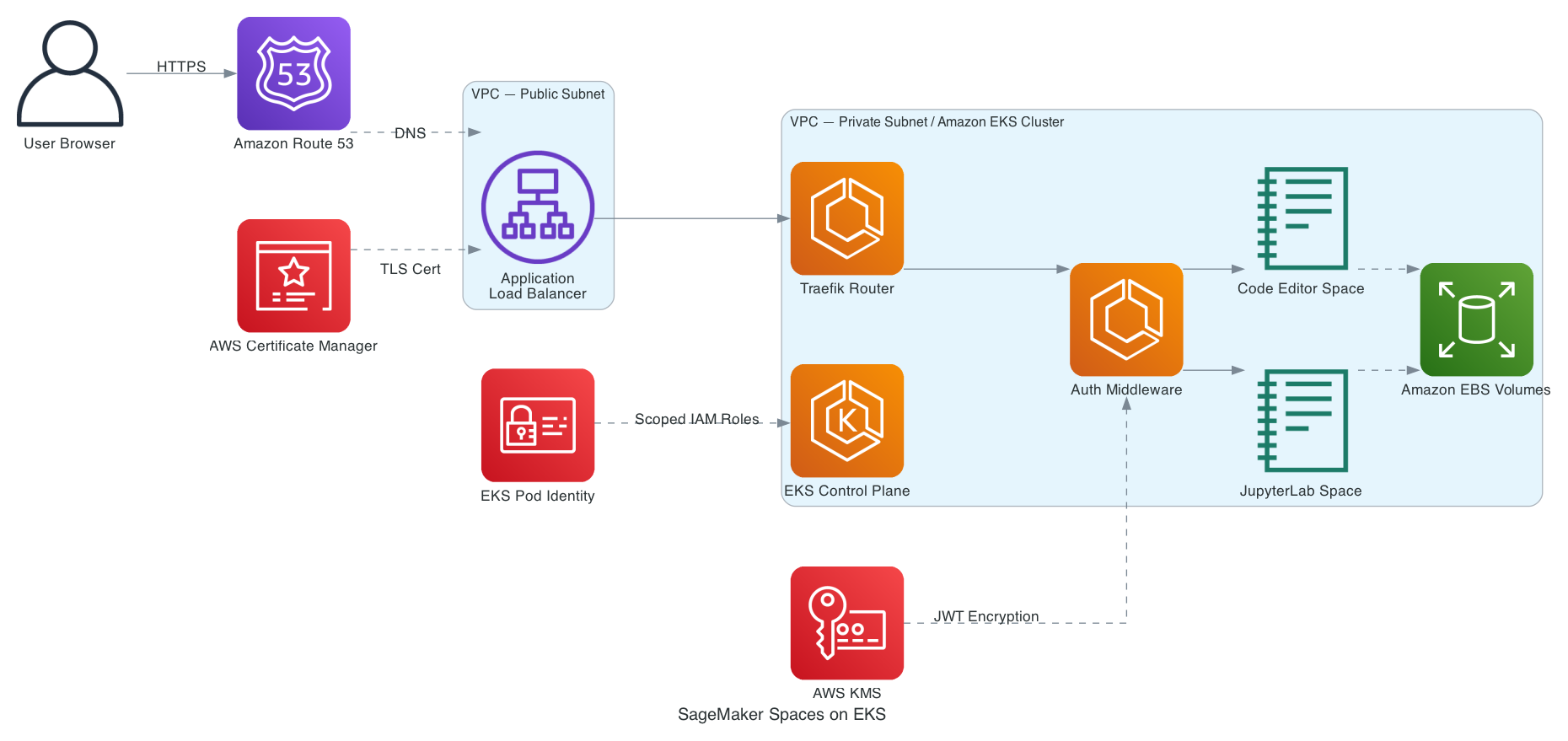
Learn how to give ML teams managed JupyterLab and Code Editor environments inside EKS.
30-Second TL;DR
What Changed
Runs managed JupyterLab and Code Editor environments on an existing Amazon EKS cluster
Why It Matters
ML teams can provide consistent development environments without maintaining separate IDE infrastructure outside their Kubernetes platform. This may simplify access control and improve alignment between experimentation and production cluster operations.
What To Do Next
Install the SageMaker AI Spaces add-on in a non-production Amazon EKS cluster and validate browser, VS Code, and Cognito OIDC workflows.
Key Points
- •Runs managed JupyterLab and Code Editor environments on an existing Amazon EKS cluster
- •Supports browser access and VS Code connections through SSH-over-SSM
- •Enables OpenID Connect sign-in using Amazon Cognito
- •Helps ML teams centralize interactive development within their existing Kubernetes operations
Deep Insight
AI-generated analysis for this event — not the original article.
Enhanced Key Takeaways
- •SageMaker AI Spaces leverages the Amazon SageMaker distribution, ensuring consistency between local development environments and production training jobs.
- •The integration utilizes the AWS Controllers for Kubernetes (ACK) to manage the lifecycle of the development environments directly via Kubernetes custom resources.
- •Data persistence is handled through Amazon EFS (Elastic File System) integration, allowing developers to maintain state across pod restarts and cluster upgrades.
- •The solution includes built-in support for IAM roles for service accounts (IRSA), enabling fine-grained permission control for ML workloads accessing S3 buckets or other AWS services.
- •It reduces operational overhead by offloading the management of IDE container images and patching cycles to the SageMaker service while keeping compute resources within the customer's EKS VPC.
Competitor Analysis
- SageMaker AI Spaces (EKS)
- Customer-managed EKS
- Google Cloud Vertex AI Workbench
- Fully managed GCP service
- Azure Machine Learning Compute Instances
- Fully managed Azure service
- SageMaker AI Spaces (EKS)
- JupyterLab, VS Code
- Google Cloud Vertex AI Workbench
- JupyterLab
- Azure Machine Learning Compute Instances
- JupyterLab, VS Code
- SageMaker AI Spaces (EKS)
- High (Kubernetes-native)
- Google Cloud Vertex AI Workbench
- Moderate (Pre-built images)
- Azure Machine Learning Compute Instances
- Moderate (Custom images)
- SageMaker AI Spaces (EKS)
- EKS compute + SageMaker fee
- Google Cloud Vertex AI Workbench
- Per-instance hourly
- Azure Machine Learning Compute Instances
- Per-instance hourly
| Feature | SageMaker AI Spaces (EKS) | Google Cloud Vertex AI Workbench | Azure Machine Learning Compute Instances |
|---|---|---|---|
| Deployment | Customer-managed EKS | Fully managed GCP service | Fully managed Azure service |
| IDE Support | JupyterLab, VS Code | JupyterLab | JupyterLab, VS Code |
| Customization | High (Kubernetes-native) | Moderate (Pre-built images) | Moderate (Custom images) |
| Pricing | EKS compute + SageMaker fee | Per-instance hourly | Per-instance hourly |
Technical Deep Dive
- Architecture utilizes a custom Kubernetes Operator that watches for SageMaker AI Spaces CRDs to provision IDE pods.
- Connectivity relies on AWS Systems Manager (SSM) Session Manager, eliminating the need for public IP addresses or open inbound SSH ports.
- Authentication flow integrates OIDC tokens from Amazon Cognito, which are exchanged for temporary AWS credentials via STS (Security Token Service).
- IDE pods are injected with sidecar containers to handle the proxying of traffic between the browser/VS Code client and the internal container runtime.
- Resource quotas and limits are enforced via standard Kubernetes ResourceQuotas, allowing integration with existing cluster governance policies.
Future ImplicationsAI analysis grounded in cited sources
Timeline
- 2020-12AWS launches Amazon SageMaker Studio, the first fully managed IDE for ML.
- 2022-05AWS introduces SageMaker support for VS Code, expanding IDE choices.
- 2024-03AWS announces SageMaker AI Spaces to provide collaborative development environments.
- 2026-08SageMaker AI Spaces extends support to Amazon EKS clusters.
Weekly AI Recap
Read this week's curated digest of top AI events →
Related Updates

AI-curated news aggregator. All content rights belong to original publishers.
Original source: AWS Machine Learning Blog ↗
This is a summary, not the original. Read the source, or get the weekly briefing.
The weekly digest
One email a week. Unsubscribe anytime.