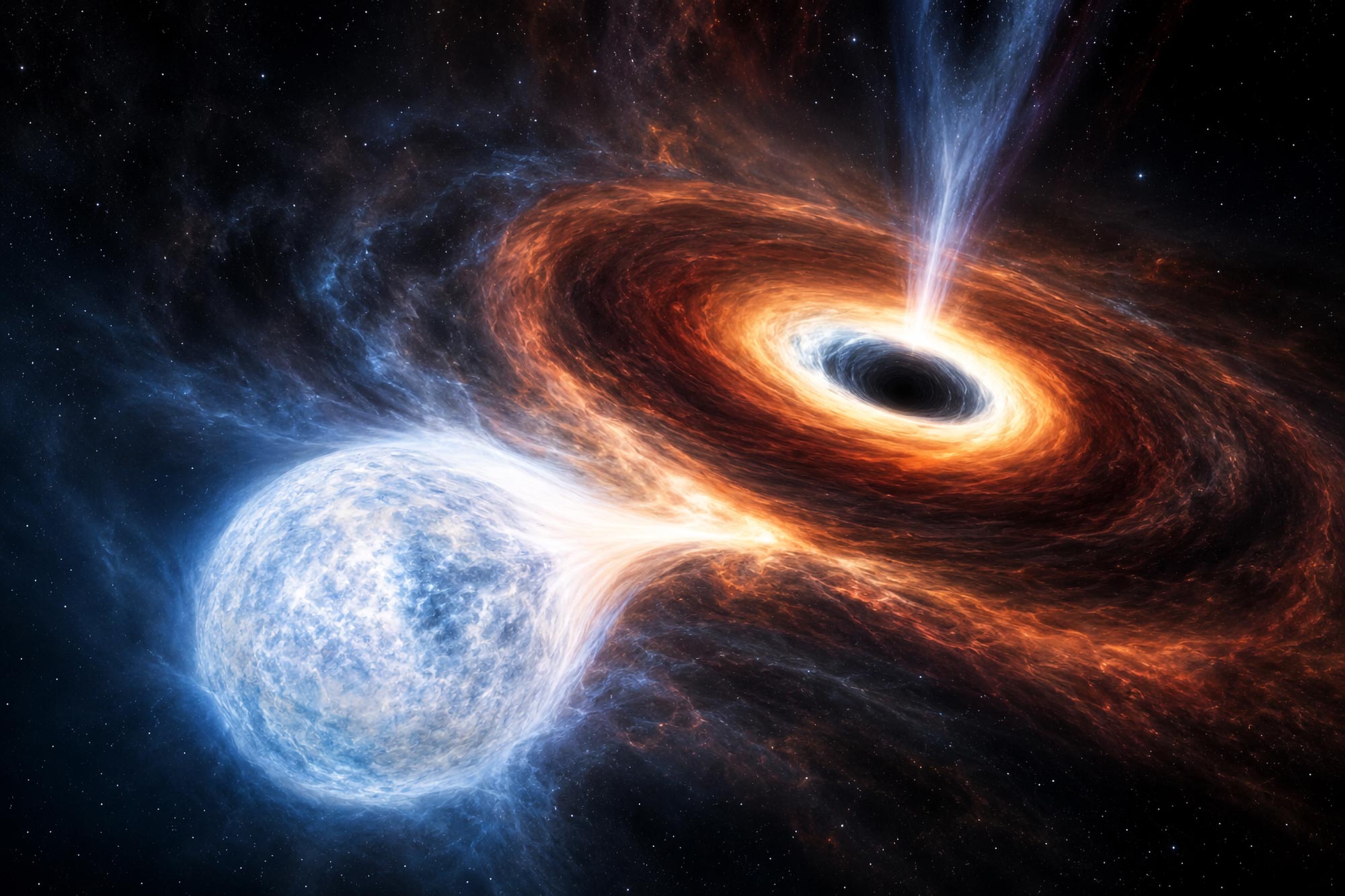
Black hole destroys giant star in massive cosmic explosion
💡High-energy cosmic data events are key benchmarks for testing complex physics simulation algorithms.
⚡ 30-Second TL;DR
What Changed
Black hole tidal disruption event observed
Why It Matters
While primarily astronomical, such high-energy data sets are often used to test advanced computational simulation models in astrophysics.
What To Do Next
Check the Royal Astronomical Society archives for the raw data if you are working on astrophysical simulation models.
Key Points
- •Black hole tidal disruption event observed
- •Explosion magnitude exceeds typical supernova events
- •Research led by Liverpool John Moores University
🧠 Deep Insight
AI-generated analysis for this event — not the original article.
🔑 Enhanced Key Takeaways
- •The event, cataloged as AT2021ehb, occurred in a galaxy located approximately 250 million light-years away from Earth.
- •Observations revealed that the black hole is located at the center of a galaxy and possesses a mass roughly 10 million times that of our Sun.
- •Data from the event provided rare evidence of a 'coronal' structure forming around the black hole, similar to the corona observed around the Sun but on a vastly larger scale.
- •The explosion was monitored using a combination of X-ray and ultraviolet telescopes, including NASA's Swift Observatory and the NICER instrument on the International Space Station.
- •This specific tidal disruption event (TDE) challenged existing models by showing that the accretion disk formed rapidly, emitting high-energy X-rays that persisted for an unusually long duration.
🛠️ Technical Deep Dive
- Event Classification: Tidal Disruption Event (TDE) involving a supermassive black hole and a star.
- Accretion Dynamics: The event demonstrated the formation of a transient accretion disk and a hot, X-ray emitting corona.
- Observational Bandwidth: Multi-wavelength analysis spanning X-ray (NICER, Swift) and UV spectra.
- Energy Output: The luminosity peaked at levels significantly higher than standard Type Ia supernovae, driven by the gravitational potential energy release of the stellar debris.
🔮 Future ImplicationsAI analysis grounded in cited sources
⏳ Timeline
Weekly AI Recap
Read this week's curated digest of top AI events →
👉Related Updates
AI-curated news aggregator. All content rights belong to original publishers.
Original source: cnBeta (Full RSS) ↗
This is a summary, not the original. Read the source, or get the weekly briefing.
The weekly digest
One email a week. Unsubscribe anytime.