Big AI Labs Are Going Anonymous
💡Anonymous models are entering coding workflows first—see how to evaluate Ox Alpha beyond viral benchmark scores.
⚡ 30-Second TL;DR
What Changed
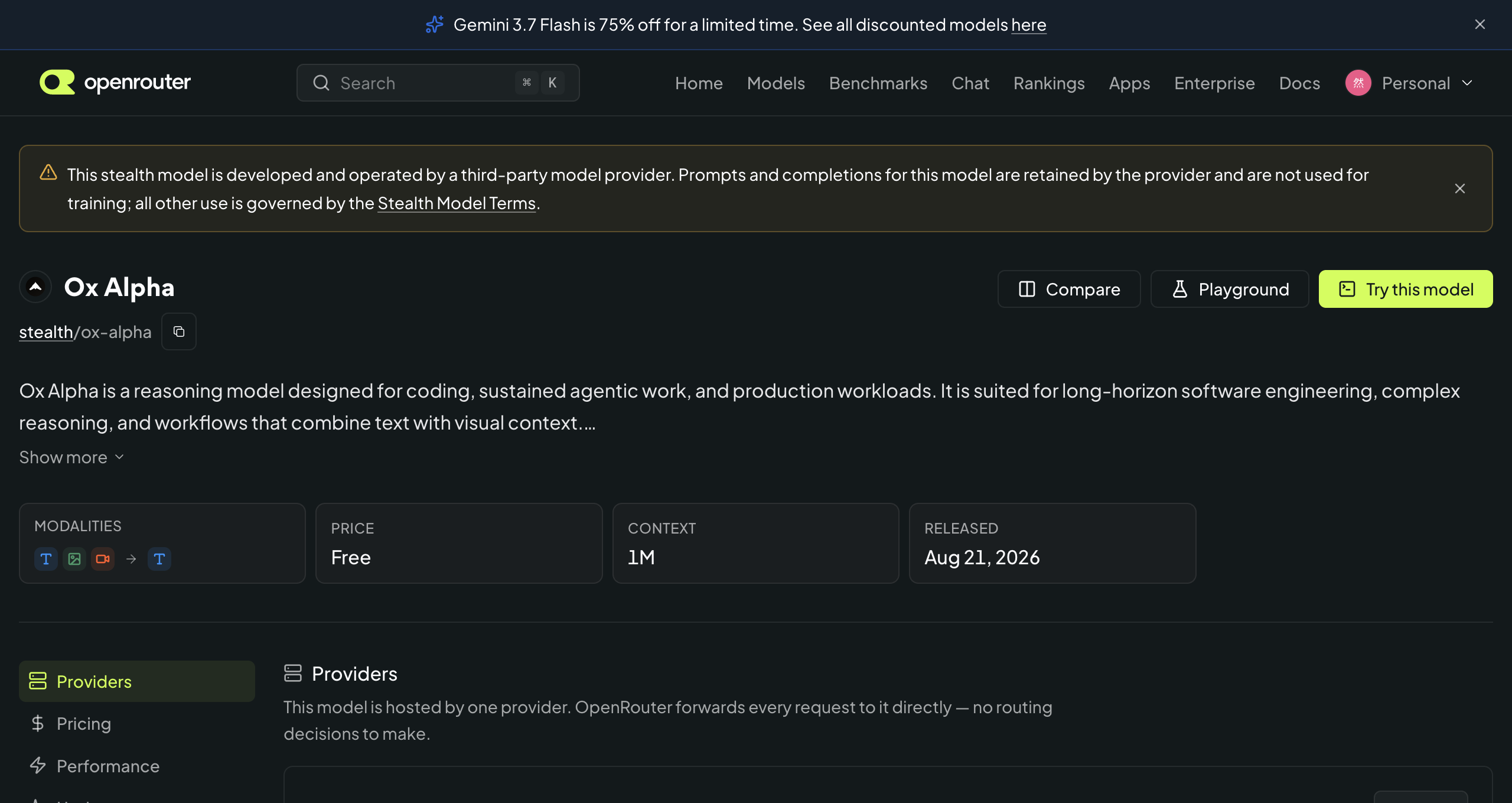
Ox Alpha offers a 1-million-token context window, image and video input, tool calling, and free access through OpenRouter.
Why It Matters
Anonymous testing can reduce brand bias and place models directly inside developers’ workflows, generating faster and more realistic feedback than a conventional launch. However, practitioners should treat early benchmark results cautiously because gateway errors, inference settings, tool use, and small samples can materially change outcomes.
What To Do Next
Run Ox Alpha through OpenRouter on a representative coding-agent workload, logging tool-call failures, recovery behavior, latency, and cost before considering production use.
Key Points
- •Ox Alpha offers a 1-million-token context window, image and video input, tool calling, and free access through OpenRouter.
- •The model has been integrated into coding tools including OpenCode and Hermes, prompting developers to test it on real software-engineering tasks.
- •Small-sample DeepSWE tests suggested roughly 8 successful tasks out of 10, while larger community testing reported a lower score of about 63%.
- •Community researchers suspect a connection to Z.ai’s GLM-5.x models based on tokenizer behavior, error messages, and output patterns, but there is no official confirmation.
- •Anonymous releases such as HappyHorse, Pony Alpha, Hunter Alpha, and Elephant Alpha are becoming a China-based overseas developer acquisition strategy.
🧠 Deep Insight
Background and context from public sources — not the original article. 11 sources cited.
🔑 Enhanced Key Takeaways
- •Anonymous model releases serve as a strategic 'stress test' mechanism, allowing developers to gauge real-world performance and market reception before official, high-stakes product launches.
- •The rise of anonymous models like Ox Alpha is a direct response to the 'prisoner's dilemma' faced by top labs, where the pressure to innovate conflicts with strict safety and ethical compliance standards.
- •AI coding tasks have become the dominant use case for large models, accounting for over 50% of the 140 trillion daily tokens consumed in China as of March 2026.
- •Industry standards for AI infrastructure have shifted from raw GPU counts to 'system engineering capacity,' focusing on the ability to maintain stable, bottleneck-free training across clusters of 100,000+ GPUs.
- •The industry is currently developing 'Accountability Anchors' for AI agents, led by figures like Vint Cerf, to address the identity and trust crises emerging from the proliferation of anonymous, autonomous models.
📊 Competitor Analysis▸ Show
| Model | Developer | Context Window | Primary Focus |
|---|---|---|---|
| Ox Alpha | Anonymous (Suspected Z.ai) | 1M Tokens | Coding/Agentic Tasks |
| GLM-5.x | Z.ai | Variable | General Purpose |
| Elephant Alpha | Anonymous | High Efficiency | Cost/Latency Optimization |
🛠️ Technical Deep Dive
- Architecture: Likely based on the GLM-5.x series, utilizing a modified transformer structure optimized for long-context retrieval and tool-calling efficiency.
- Tokenizer: Community analysis of specific tokenization patterns and error logs suggests a shared lineage with Z.ai's proprietary models.
- Performance: Demonstrates high proficiency in software engineering tasks, with benchmarks showing ~63% success rates in large-scale community-led DeepSWE evaluations.
- Infrastructure: Designed for high-throughput inference, prioritizing token efficiency and low-latency response times for agentic workflows.
🔮 Future ImplicationsAI analysis grounded in cited sources
⏳ Timeline
📎 Sources (11)
Factual claims are grounded in the sources below. Forward-looking analysis is AI-generated interpretation.
Weekly AI Recap
Read this week's curated digest of top AI events →
👉Related Updates
AI-curated news aggregator. All content rights belong to original publishers.
Original source: 极客公园 ↗
This is a summary, not the original. Read the source, or get the weekly briefing.
Weekly AI briefing
One email a week. Unsubscribe anytime.