Barret Zoph Returns to Google DeepMind
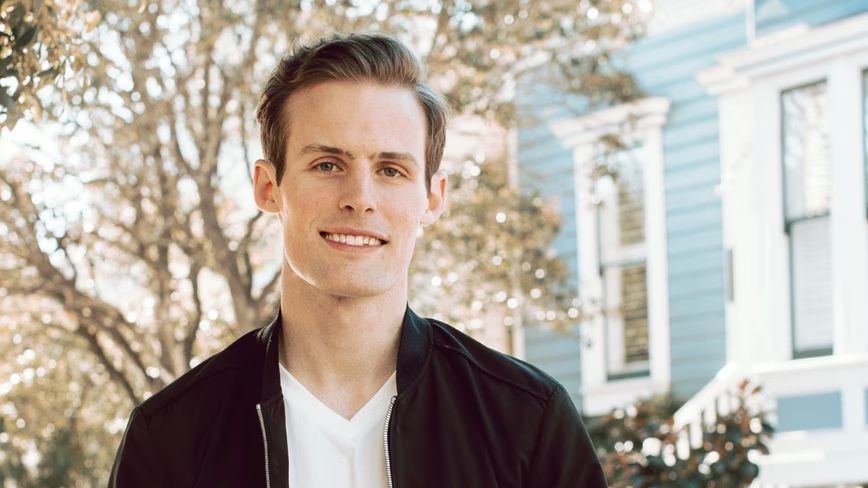
💡A veteran AI researcher’s return may reveal Google DeepMind’s next research priorities.
⚡ 30-Second TL;DR
What Changed
Barret Zoph will become vice president of research at Google DeepMind.
Why It Matters
Zoph’s return could strengthen Google DeepMind’s senior research leadership and reconnect the organization with experienced researchers who have worked outside Big Tech. The timing suggests Google is continuing to realign its AI research structure and leadership responsibilities.
What To Do Next
Track Google DeepMind’s upcoming research releases and team announcements to identify shifts in model priorities or collaboration opportunities.
Key Points
- •Barret Zoph will become vice president of research at Google DeepMind.
- •He previously spent six years at the organization before launching two startups.
- •The move follows a broader Google DeepMind leadership and team restructuring.
🧠 Deep Insight
Background and context from public sources — not the original article. 11 sources cited.
🔑 Enhanced Key Takeaways
- •Barret Zoph originally entered the Google ecosystem through the Google Brain Residency program in 2016, prior to the 2023 merger of Brain and DeepMind.
- •Zoph's new mandate at Google DeepMind specifically prioritizes reinforcement learning (RL) and post-training methodologies.
- •His recent career includes a stint as VP of Research at OpenAI, followed by the co-founding of Thinking Machines Lab with former OpenAI CTO Mira Murati.
- •Zoph's technical reputation is anchored in his foundational research on Neural Architecture Search (NAS) and AutoML, which utilized RL to automate neural network design.
- •His departure from OpenAI in June 2026 preceded his return to Google, following a brief second tenure at the former company earlier that year.
🛠️ Technical Deep Dive
- Neural Architecture Search (NAS): Pioneered methods for using reinforcement learning to discover optimal neural network architectures automatically.
- Post-Training Alignment: Led development of alignment techniques, tool-use capabilities, and evaluation frameworks for large-scale language models during his time at OpenAI.
- Reinforcement Learning: Expertise in applying RL to both the architectural design phase and the post-training optimization of generative models.
🔮 Future ImplicationsAI analysis grounded in cited sources
⏳ Timeline
📎 Sources (11)
Factual claims are grounded in the sources below. Forward-looking analysis is AI-generated interpretation.
Weekly AI Recap
Read this week's curated digest of top AI events →
👉Related Updates
AI-curated news aggregator. All content rights belong to original publishers.
Original source: The Next Web (TNW) ↗
This is a summary, not the original. Read the source, or get the weekly briefing.
Weekly AI briefing
One email a week. Unsubscribe anytime.