Baidu Pits Two AI Office Products
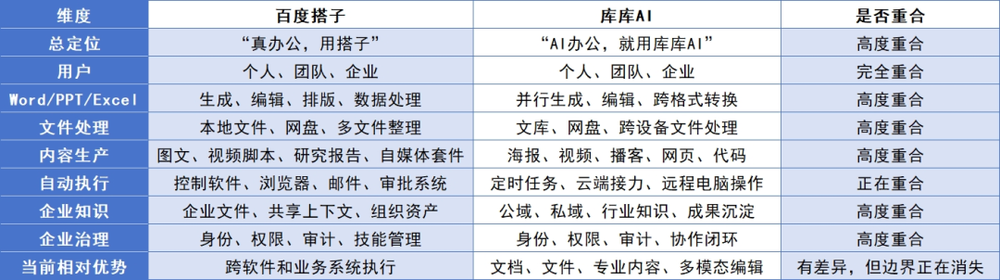
💡Baidu is betting on two overlapping AI-office agents while rivals consolidate around one enterprise entry point.
⚡ 30-Second TL;DR
What Changed
Baidu Tazi connects local files, Office, WPS, browsers, and enterprise systems such as OA, CRM, and ERP.
Why It Matters
Baidu’s parallel strategy may enable faster validation of execution-focused and content-focused use cases, but it risks fragmented investment, messaging, and enterprise sales. For customers, the overlap creates uncertainty over which product will become Baidu’s long-term AI-office platform and where Skills, data, and integrations should be built.
What To Do Next
Pilot Baidu Tazi Enterprise with one OA or CRM workflow, then compare its auditability and task-completion rate against Kuku AI’s document workflow before standardizing on either platform.
Key Points
- •Baidu Tazi connects local files, Office, WPS, browsers, and enterprise systems such as OA, CRM, and ERP.
- •Tazi has added enterprise knowledge bases, permissions, shared Skills, system connectors, audit logs, and integrations with Baidu Miaoda and Baidu Shengsuan.
- •Kuku AI is available through PC, web, mini-program, and enterprise editions, generating research reports, financial models, presentations, posters, videos, podcasts, and web apps.
- •GenFlow, the predecessor of Kuku AI, reportedly reached more than 25 million AI-office monthly active users and had earlier accumulated substantial document and team-workflow usage.
- •Unlike Tencent, Alibaba, and ByteDance, which are consolidating AI-office products around a primary entry point, Baidu still operates two parallel products and organizations.
🧠 Deep Insight
Background and context from public sources — not the original article. 7 sources cited.
🔑 Enhanced Key Takeaways
- •Baidu Dazi achieved a 1,063.79% month-on-month growth rate in July 2026, positioning it as a top-tier performer in the AI office agent category.
- •Baidu's strategic pivot toward agents was formalized at the Create 2026 conference, where CEO Robin Li declared that industry competition has shifted from foundational model capabilities to task-oriented agent execution.
- •Baidu's competitive advantage is anchored in a full-stack architecture that integrates proprietary Kunlun hardware, Intelligent Cloud infrastructure, and the Wenxin model suite.
- •As of Q1 2026, AI-powered business revenue surpassed 50% of Baidu's total general business revenue, marking a critical transition where AI became the company's primary financial engine.
- •The broader Chinese AI office market has reached a valuation exceeding 230 billion yuan, with over 20 new AI agents launched in the first half of 2026 alone.
📊 Competitor Analysis▸ Show
| Feature | Baidu (Dazi/Kuku) | Tencent (WorkBuddy) | Alibaba (Tongyi/DingTalk) |
|---|---|---|---|
| Primary Focus | Task execution & document workflow | Desktop AI agent integration | Enterprise collaboration & SaaS |
| July 2026 Status | High growth (Dazi) | #1 Desktop AI agent (11.15M MAU) | Ecosystem integration |
| Market Strategy | Dual-product agent strategy | Unified entry point | Integrated enterprise suite |
🛠️ Technical Deep Dive
- Architecture: Utilizes a full-stack approach integrating Kunlun AI chips for hardware acceleration, Baidu Intelligent Cloud for scalable compute, and the Wenxin foundation model family for reasoning.
- Integration: Dazi utilizes system-level connectors to interface with local OS environments, enterprise OA, CRM, and ERP systems to facilitate cross-application task automation.
- Deployment: Supports multi-platform accessibility including PC, web, and mini-programs, with specific enterprise-grade features like audit logs, permission management, and shared skill libraries.
🔮 Future ImplicationsAI analysis grounded in cited sources
⏳ Timeline
📎 Sources (7)
Factual claims are grounded in the sources below. Forward-looking analysis is AI-generated interpretation.
Weekly AI Recap
Read this week's curated digest of top AI events →
👉Related Updates

AI-curated news aggregator. All content rights belong to original publishers.
Original source: 虎嗅 ↗
This is a summary, not the original. Read the source, or get the weekly briefing.
Weekly AI briefing
One email a week. Unsubscribe anytime.