AWS ProServe: Rebuilding delivery for the AI frontier
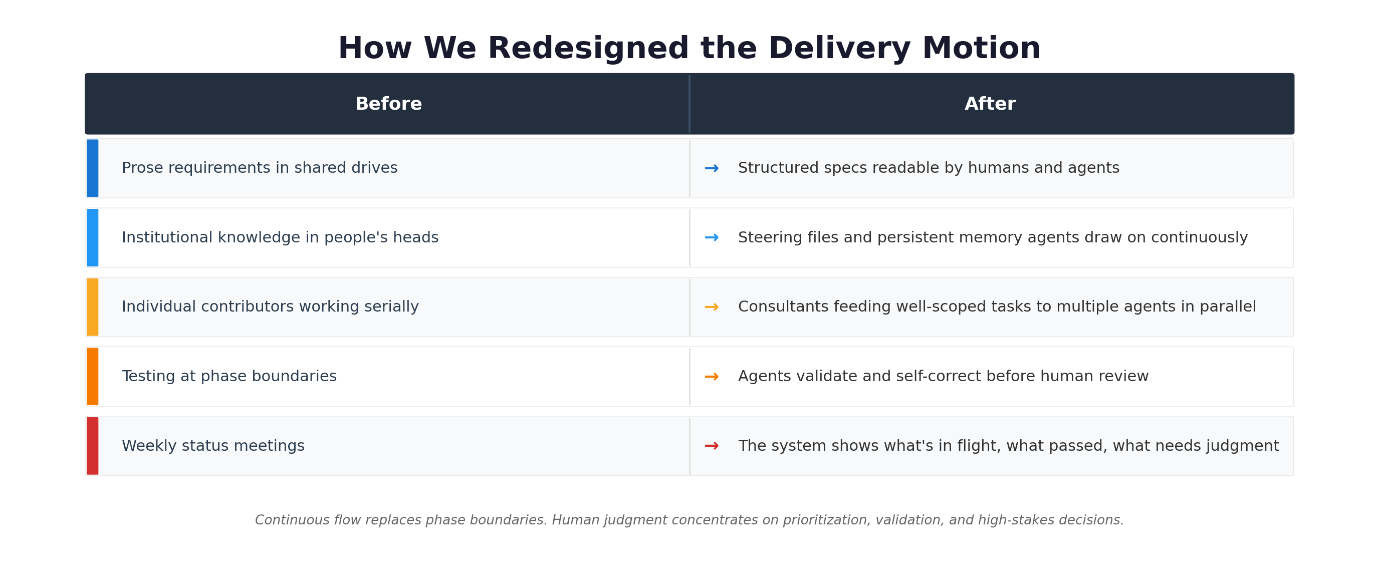
💡Learn how AWS transformed its internal delivery model to accelerate AI project timelines from months to days.
⚡ 30-Second TL;DR
What Changed
Compressed engagement timelines from months to days
Why It Matters
This organizational shift provides a blueprint for enterprises to scale AI adoption by rethinking internal workflows rather than just layering AI on top of legacy processes.
What To Do Next
Review your team's current delivery pipeline and identify one manual process that can be replaced by an AI-integrated workflow to accelerate your project velocity.
Key Points
- •Compressed engagement timelines from months to days
- •Shifted from adding AI tools to rebuilding delivery from the inside out
- •Adopted frontier team practices to improve engineering velocity
- •Focuses on organizational transformation for AI-driven delivery
🧠 Deep Insight
Background and context from public sources — not the original article. 13 sources cited.
🔑 Enhanced Key Takeaways
- •The core mechanism for compressing engagement timelines is the introduction of specialized AI agents, such as the AWS Professional Services Delivery Agent, which automates tasks like design specification, implementation planning, code generation, and testing.
- •This new model enables a hybrid professional services approach, allowing human consultants to focus on high-value strategic guidance and understanding unique business challenges, while AI agents handle repetitive, time-consuming technical implementation details with speed and consistency.
- •AWS ProServe is transitioning towards an outcome-based pricing model, moving away from traditional billable hours, which shifts delivery risk to AWS and aims to improve margins through scalable automation.
- •The 'frontier team' approach is underpinned by an AI-native development lifecycle (AI-DLC) that redefines software engineering by integrating AI as a structured collaborator across inception, construction, and operations, utilizing shorter 'bolts' instead of traditional sprints.
🛠️ Technical Deep Dive
- The AWS Professional Services Delivery Agent and complementary specialized AI agents form the core of the AI-native delivery model.
- These agents are built on enterprise-grade AI infrastructure, leveraging services like Amazon Bedrock AgentCore, AWS Transform, Kiro, and Amazon Q Developer CLI.
- The Delivery Agent processes customer inputs, such as meeting notes and architecture documents, to generate comprehensive design specifications and implementation plans.
- It further automates the development process by generating and testing code, and creating deployment runbooks.
- For migration projects, a custom agent built on AWS Transform automates critical tasks like wave planning, dependency mapping, workload scheduling, and runbook generation.
- The broader category of 'frontier agents' (including Kiro, AWS Security Agent, AWS DevOps Agent, and AWS FinOps Agent) are designed as autonomous systems that operate independently, scale massively, and can run persistently for extended periods without constant human intervention.
- These agents embed AWS's specialized knowledge and best practices, derived from thousands of prior engagements, to ensure consistent and high-quality outcomes.
- The AI-DLC methodology redefines the software development lifecycle with phases like 'Mob Elaboration' (AI transforming business intent into requirements) and 'Mob Construction' (AI proposing architecture, code, and tests).
- It replaces traditional sprints with shorter 'bolts' and epics with 'Units of Work' to align with accelerated AI-driven planning economics.
- The system incorporates robust guardrails to ensure security, compliance, and aims to deliver more consistent outcomes by minimizing human error.
🔮 Future ImplicationsAI analysis grounded in cited sources
⏳ Timeline
📎 Sources (13)
Factual claims are grounded in the sources below. Forward-looking analysis is AI-generated interpretation.
Weekly AI Recap
Read this week's curated digest of top AI events →
👉Related Updates
AI-curated news aggregator. All content rights belong to original publishers.
Original source: AWS Machine Learning Blog ↗
This is a summary, not the original. Read the source, or get the weekly briefing.
The weekly digest
One email a week. Unsubscribe anytime.