AWS Launches Disaggregated Inference with llm-d
💡Scale LLM inference 2x+ efficiently on AWS SageMaker – new disaggregated tech!
⚡ 30-Second TL;DR
What Changed
Introduces disaggregated serving for scalable LLM inference
Why It Matters
Enables AI teams to handle larger models with better throughput and lower costs on AWS infrastructure. Reduces bottlenecks in production inference deployments. Positions SageMaker as leader in efficient LLM serving.
What To Do Next
Set up SageMaker HyperPod EKS cluster and deploy llm-d for disaggregated inference testing.
Key Points
- •Introduces disaggregated serving for scalable LLM inference
- •Features intelligent request scheduling and expert parallelism
- •Implementable on SageMaker HyperPod EKS for performance gains
- •Improves resource utilization and operational efficiency
🧠 Deep Insight
Background and context from public sources — not the original article. 10 sources cited.
🔑 Enhanced Key Takeaways
- •llm-d achieves near-zero Time-to-First-Token (TTFT) latency while scaling to approximately 120,000 tokens/second throughput, with baseline Kubernetes services degrading rapidly under equivalent load[5]
- •The disaggregated architecture removes prefill interruptions to decode operations by asynchronously transferring KV caches, reducing inter-token latency (ITL) impact from an average of 7 interruptions per request (batch size 8) to a single transfer event[4]
- •llm-d v0.5 introduced scale-to-zero capabilities with specialized cold-start activation, enabling cost-efficient resource management for intermittent workloads without dropping incoming requests during provisioning[5]
- •Cache-aware routing now supports LoRA adapter mixing and active-active high availability configurations, with a new UCCL transport backend improving stability in congested network environments[5]
🛠️ Technical Deep Dive
Architecture
- •Disaggregated prefill/decode separation: Prefill phase (compute-intensive, token-parallel) runs on dedicated hardware separate from decode phase (memory bandwidth-intensive)[4]
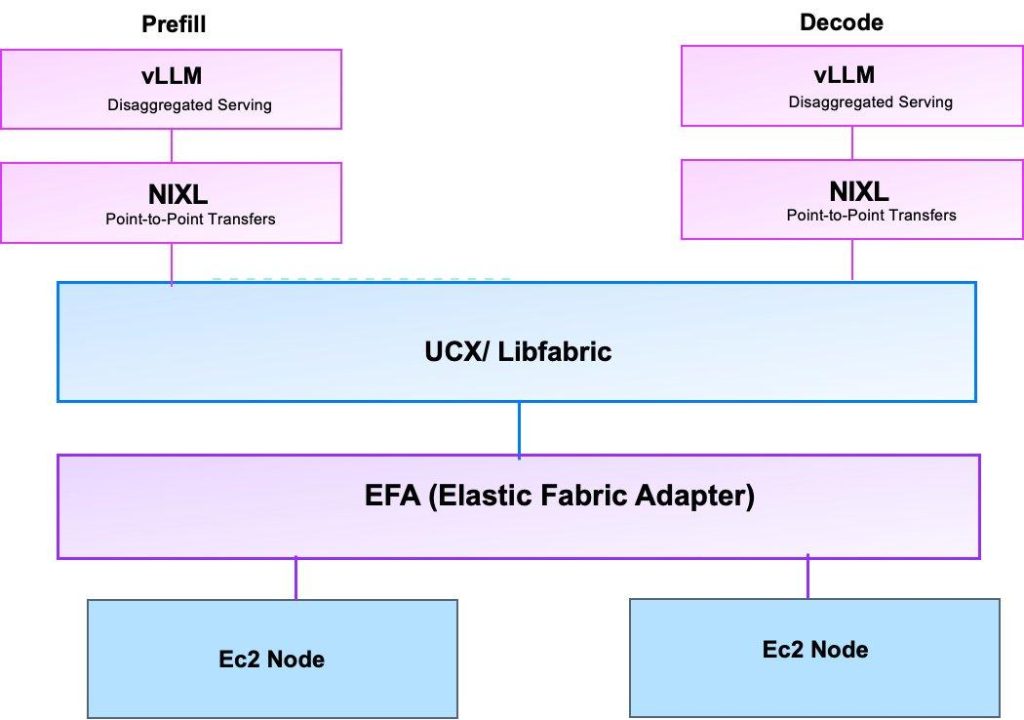
- •KV cache transfer mechanism: Prefill worker computes KV cache and transfers to decode worker via high-speed interconnects (NVIDIA Inference Xfer Library/NIXL or InfiniBand) to resume decoding asynchronously[1][4]
- •Three-component workflow: Router orchestrates requests, prefill cluster processes prompts, decode cluster generates tokens independently[4]
- •Smart scheduling threshold: Configurable PD_PROMPT_LEN_THRESHOLD parameter triggers disaggregation based on prompt size, cached content analysis, and computed vector work weight rather than token count alone[2]
- •Dual-mode caching: Local caching (memory/disk) for low-cost savings; distributed caching (shared memory/storage) for faster reuse across server replicas[1]
- •Inference gateway (kgateway): Routes requests using real-time performance metrics (system load, memory usage, SLOs) and Kubernetes Gateway API inference extension[1]
- •vLLM integration: Powered by vLLM fork with Neuron Runtime for disaggregated inference implementation[4]
Performance_metrics
- •Benchmark topology: 8x vLLM pods / 16x NVIDIA H100 GPUs (TP=2) with shared prefix synthetic workload (150 groups × 5 prompts)[5]
- •Throughput: 4.5-11k output tokens/sec, up to 109% higher than baseline Kubernetes service[5]
- •P50 TTFT: 136–157ms latency[5]
- •ITL improvement: 99% lower TTFT versus baseline Kubernetes service[5]
🔮 Future ImplicationsAI analysis grounded in cited sources
⏳ Timeline
📎 Sources (10)
Factual claims are grounded in the sources below. Forward-looking analysis is AI-generated interpretation.
- developers.redhat.com — Getting Started LLM D Distributed AI Inference
- solo.io — Deep Dive Into LLM D and Distributed Inference
- awsdocs-neuron.readthedocs-hosted.com — Disaggregated Inference Tutorial
- awsdocs-neuron.readthedocs-hosted.com — Disaggregated Inference
- llm-d.ai — LLM D V0.5 Sustaining Performance at Scale
- arXiv — 2511
- aws.amazon.com — Accelerate Generative AI Inference with Nvidia Dynamo and Amazon Eks
- aws-experience.com — Dive Deep Into Mixture of Experts and Disaggregated Architecture on Vllm Nvidia
- developer.nvidia.com — Nvidia Dynamo Adds Support for Aws Services to Deliver Cost Efficient Inference at Scale
- datacenterdynamics.com — Aws Partners with Big Chip Co Cerebras for AI Inference Disaggregation
Weekly AI Recap
Read this week's curated digest of top AI events →
👉Related Updates
AI-curated news aggregator. All content rights belong to original publishers.
Original source: AWS Machine Learning Blog ↗
This is a summary, not the original. Read the source, or get the weekly briefing.
Weekly AI briefing
One email a week. Unsubscribe anytime.