AWS Guide to Operationalizing Agentic AI
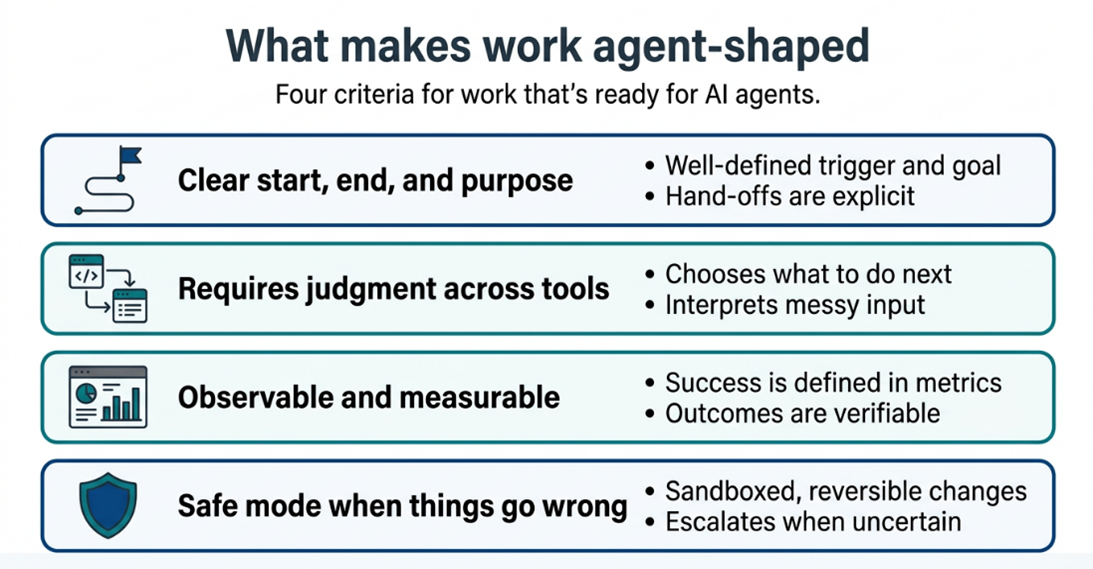
💡C-suite guide from AWS on productionizing agentic AI—proven with 1,000+ customers.
⚡ 30-Second TL;DR
What Changed
AWS aided 1,000+ customers in moving AI to production
Why It Matters
Offers practical advice for leaders scaling agentic AI, potentially accelerating enterprise AI adoption and ROI realization.
What To Do Next
Review AWS ML Blog's Part 1 guide and contact their Innovation Center for agentic AI deployment support.
Key Points
- •AWS aided 1,000+ customers in moving AI to production
- •Delivered millions in documented productivity gains
- •Guidance targets CTOs, CISOs, CDOs, AI officers, business owners, compliance leads
🧠 Deep Insight
Background and context from public sources — not the original article. 6 sources cited.
🔑 Enhanced Key Takeaways
- •AWS guide outlines six strategic focus areas: clarifying agent intent by aligning with business priorities, designing for composability via multi-agent systems and arbiter agents, architecting multi-tenancy with shared services and RBAC, building trust through identity guardrails and observability, managing lifecycle with CI/CD pipelines and prompt versioning, and aligning models with business via usage-based monetization[1][2][5].
- •Recommends forming AgentOps teams akin to DevOps for agent development, using AWS CDK and CodePipeline for infrastructure as code, and frameworks like Strands Agents SDK integrated with Bedrock, Lambda, and EventBridge for rapid prototyping[3].
- •Emphasizes governance with AWS IAM for identities, AppConfig for runtime controls, CloudWatch and X-Ray for telemetry, and reflective agents for continuous auditing to manage risks in autonomous systems[3].
🛠️ Technical Deep Dive
- •Multi-agent systems use task arbitration logic with supervisor or arbiter agents for routing based on context, availability, and policy, including lifecycle tracking for real-time decisions and safe handoffs[2].
- •Design principles include robust error handling, graceful degradation, and progressive composition from single-agent solutions to cooperative systems with shared goals and system-wide context[2].
- •Deployment as a service with unified observability by tenant context, centralized policy engines, config-based toggling, and CI/CD pipelines for testing prompts, tools, and cost-performance[2][3].
- •Strands Agents SDK provides CLI tooling for scaffolding, configuring, and packaging agents, seamlessly integrating with Amazon Bedrock, AWS Lambda, Amazon EventBridge, AWS CDK, and AWS CodePipeline[3].
🔮 Future ImplicationsAI analysis grounded in cited sources
⏳ Timeline
📎 Sources (6)
Factual claims are grounded in the sources below. Forward-looking analysis is AI-generated interpretation.
Weekly AI Recap
Read this week's curated digest of top AI events →
👉Related Updates
AI-curated news aggregator. All content rights belong to original publishers.
Original source: AWS Machine Learning Blog ↗
This is a summary, not the original. Read the source, or get the weekly briefing.
Weekly AI briefing
One email a week. Unsubscribe anytime.