AWS billing bug causes massive trillion-dollar charge errors
💡A critical look at how cloud infrastructure billing systems can fail, impacting trust in automated financial tools.
⚡ 30-Second TL;DR
What Changed
AWS Billing Console experienced a unit pricing computation error.
Why It Matters
While the bug was a display error, it highlights the fragility of automated financial reporting systems in cloud infrastructure. It serves as a reminder for engineers to implement robust sanity checks on automated billing alerts.
What To Do Next
Review your AWS Cost Explorer alerts and set up budget thresholds to prevent automated systems from triggering based on erroneous data.
Key Points
- •AWS Billing Console experienced a unit pricing computation error.
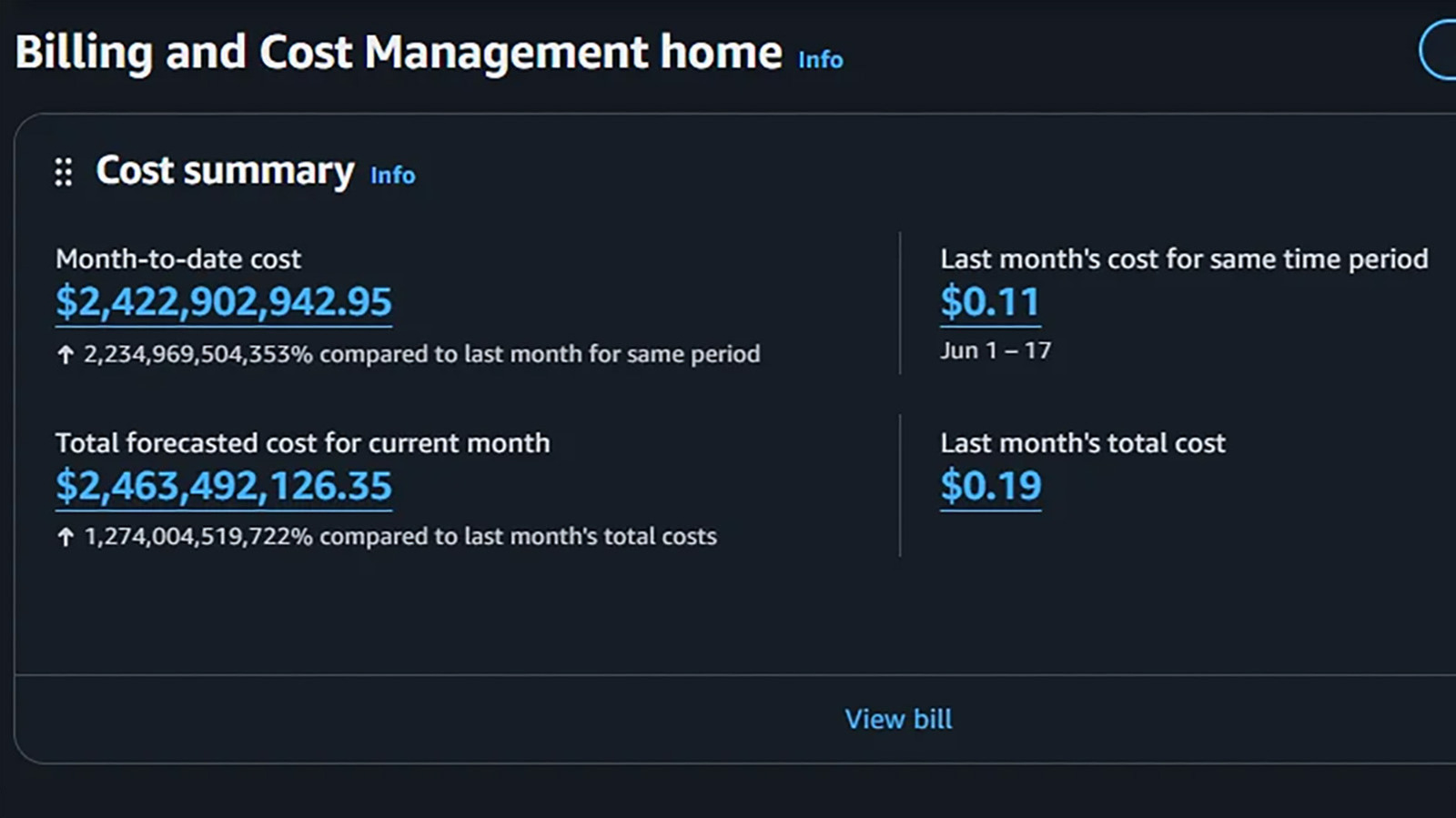
- •Users received erroneous estimated billing emails up to $2.5 trillion.
- •The error was limited to the display of estimated charges and did not affect actual billing.
🧠 Deep Insight
AI-generated analysis for this event.
🔑 Enhanced Key Takeaways
- •The incident occurred in early 2024, specifically affecting the AWS Billing and Cost Management console's 'Bills' page for a subset of users.
- •Social media platforms, particularly X (formerly Twitter), were the primary vectors for the incident's visibility, as users shared screenshots of the trillion-dollar invoices.
- •AWS utilized its Service Health Dashboard to communicate that the issue was a 'display-only' error, preventing a wider panic among enterprise customers.
- •The root cause was identified as a data processing glitch within the billing computation subsystem that incorrectly aggregated unit costs for specific services.
- •No actual charges were processed against customer payment methods, and AWS confirmed that the underlying billing data remained accurate throughout the event.
📊 Competitor Analysis▸ Show
| Feature | AWS Billing Console | Google Cloud Billing | Microsoft Azure Cost Management |
|---|---|---|---|
| Display Accuracy | High (Historical) | High | High |
| Real-time Reporting | Near Real-time | Near Real-time | Near Real-time |
| Error Handling | Automated Alerts | Automated Alerts | Automated Alerts |
| Scale | Global | Global | Global |
🛠️ Technical Deep Dive
- The issue originated in the billing computation subsystem responsible for rendering the 'Estimated Charges' view.
- The bug involved a floating-point arithmetic error or a data aggregation overflow where unit prices were multiplied by an incorrect factor during the UI rendering process.
- The backend billing database (the source of truth for actual invoicing) remained isolated from the frontend display layer, ensuring that the erroneous figures were never committed to the financial ledger.
- AWS uses a distributed microservices architecture for billing, where the UI layer fetches aggregated data from a separate cost-calculation engine; the failure was localized to the data transformation logic within this specific pipeline.
🔮 Future ImplicationsAI analysis grounded in cited sources
⏳ Timeline
Weekly AI Recap
Read this week's curated digest of top AI events →
👉Related Updates



AI-curated news aggregator. All content rights belong to original publishers.
Original source: The Next Web (TNW) ↗