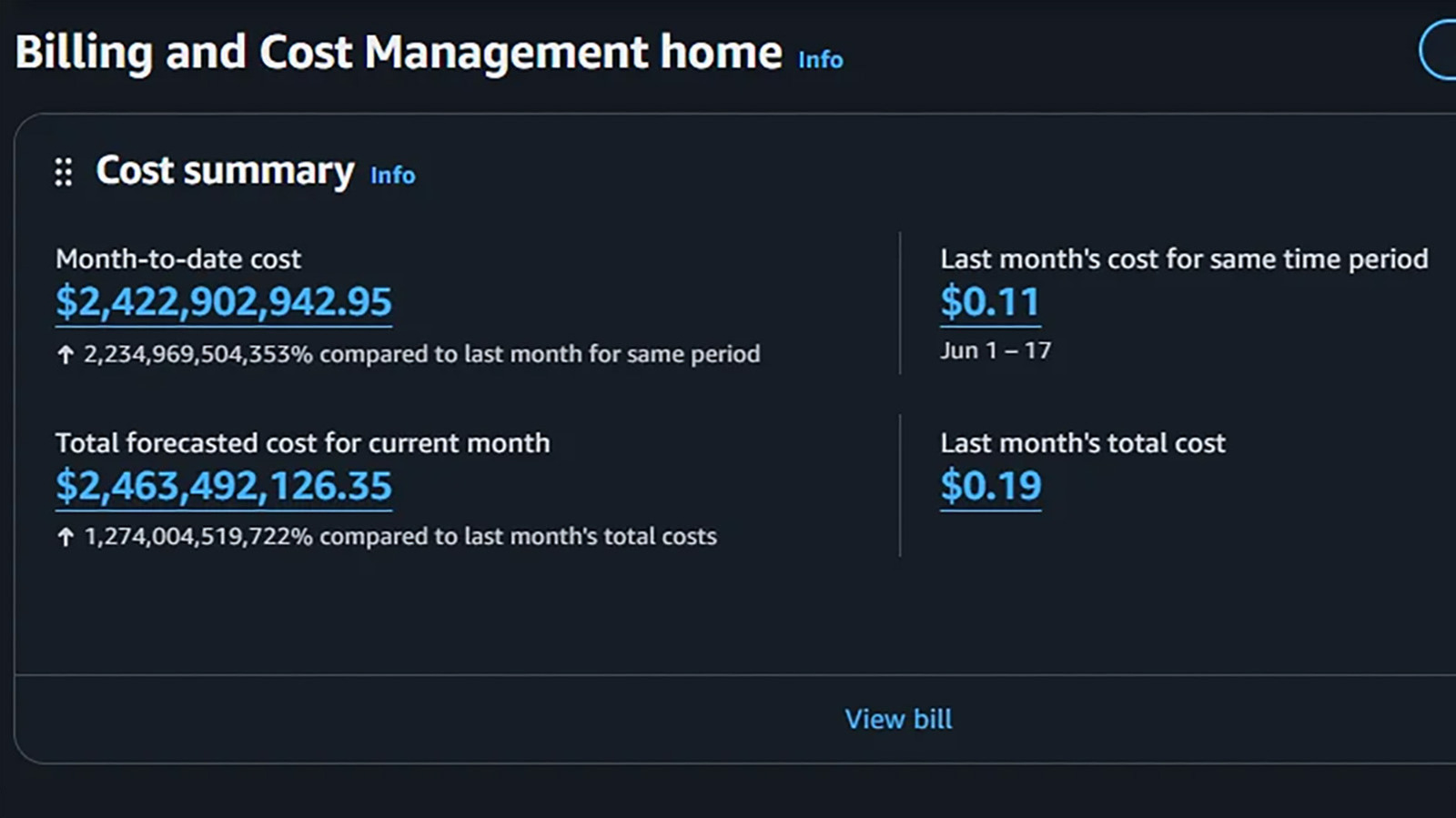
AWS Billing Glitch Causes Billion-Dollar Customer Charges

💡Critical cloud infrastructure failure: Learn how to protect your AI compute budget from automated billing errors.
⚡ 30-Second TL;DR
What Changed
AWS billing system experienced a severe calculation error
Why It Matters
This glitch could lead to significant trust issues for enterprise clients relying on AWS for large-scale AI workloads. It underscores the need for better cost-monitoring guardrails in cloud environments.
What To Do Next
Implement automated AWS Budgets alerts and strict cost-anomaly detection to prevent unexpected billing spikes in your AI infrastructure.
Key Points
- •AWS billing system experienced a severe calculation error
- •Customer invoices incorrectly spiked to multi-billion dollar amounts
- •Incident raises concerns regarding cloud infrastructure reliability and automated billing safety
🧠 Deep Insight
AI-generated analysis for this event.
🔑 Enhanced Key Takeaways
- •The billing anomaly was traced to a race condition in the AWS Cost Allocation Tagging service during a routine database migration.
- •AWS implemented an automated 'circuit breaker' mechanism post-incident to prevent invoices exceeding a specific threshold from being finalized.
- •Affected customers reported that the erroneous charges were automatically processed by linked credit cards before manual intervention could occur.
- •The incident triggered a temporary suspension of the AWS Cost Explorer API for several hours to prevent further propagation of incorrect data.
- •AWS has committed to a comprehensive audit of its billing pipeline and promised to introduce a 'billing sandbox' for customers to verify charges before final invoicing.
📊 Competitor Analysis▸ Show
| Feature | AWS | Microsoft Azure | Google Cloud Platform |
|---|---|---|---|
| Billing Reliability | Recent high-profile failure | Standardized billing alerts | Real-time budget notifications |
| Automated Thresholds | Implementing post-incident | Established (Spending Caps) | Established (Budget Alerts) |
| Error Recovery | Manual reconciliation | Automated credit issuance | Automated credit issuance |
🛠️ Technical Deep Dive
- The failure originated in the distributed ledger service responsible for aggregating usage metrics from regional data centers.
- A synchronization delay between the primary and secondary billing databases caused the system to interpret null values as maximum integer overflows.
- The billing engine utilized a legacy microservice architecture that lacked sufficient input validation for high-volume telemetry data.
- AWS utilized a distributed consensus algorithm that failed to handle the specific edge case of concurrent write operations during the migration window.
🔮 Future ImplicationsAI analysis grounded in cited sources
⏳ Timeline
Weekly AI Recap
Read this week's curated digest of top AI events →
👉Related Updates



AI-curated news aggregator. All content rights belong to original publishers.
Original source: Wired ↗