Autonomous Context Compression Tool
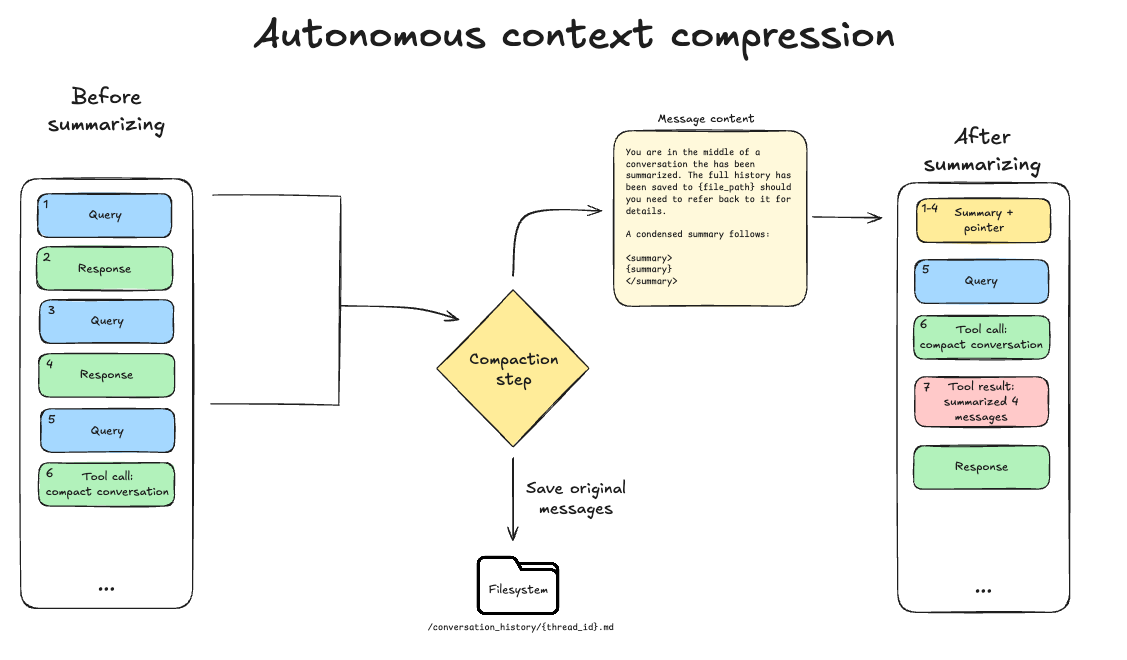
💡LangChain tool lets agents auto-compress context—cut costs, boost long-task performance.
⚡ 30-Second TL;DR
What Changed
New tool added to Deep Agents SDK (Python) and CLI
Why It Matters
Enhances agent efficiency for long interactions by dynamically managing context, lowering token costs and improving response quality.
What To Do Next
Install latest Deep Agents SDK and test autonomous context compression in your agent.
Key Points
- •New tool added to Deep Agents SDK (Python) and CLI
- •Models autonomously compress context at opportune times
- •Reduces agent's working memory by replacing older messages
🧠 Deep Insight
Background and context from public sources — not the original article. 5 sources cited.
🔑 Enhanced Key Takeaways
- •Deep Agents SDK implements three specific compression techniques: offloading large tool responses to filesystem immediately, trimming tool inputs at 85% context capacity using filesystem pointers, and LLM-generated summarization of message history when offloading is insufficient[1][2].
- •Compression triggers use LangChain's model profiles to determine token thresholds as fractions of the model's context window, with aggressive stress-testing at 10-20% capacity for evaluation[2].
- •Evaluation emphasizes recoverability testing, including needle-in-the-haystack scenarios to ensure agents can retrieve summarized details, and dedicated summarization fields for session intent and next steps improve post-compression performance[1][2].
🛠️ Technical Deep Dive
- •Triggers compression at configurable threshold fractions of model context window size, accessed via LangChain's model profiles for token limits[2].
- •Offloading: Large tool responses offloaded to filesystem on occurrence; old write/edit tool inputs truncated at 85% capacity and replaced with filesystem pointers[1][2].
- •Summarization: LLM generates structured summary including session intent, artifacts created, and next steps to replace full history; original messages preserved as filesystem record[1][2].
- •Evaluation: Stress-tests at 10-20% context to amplify compression events; tests recoverability with targeted scenarios verifying goal continuation and detail retrieval[1][2].
🔮 Future ImplicationsAI analysis grounded in cited sources
⏳ Timeline
📎 Sources (5)
Factual claims are grounded in the sources below. Forward-looking analysis is AI-generated interpretation.
Weekly AI Recap
Read this week's curated digest of top AI events →
👉Related Updates
AI-curated news aggregator. All content rights belong to original publishers.
Original source: LangChain Blog ↗
This is a summary, not the original. Read the source, or get the weekly briefing.
Weekly AI briefing
One email a week. Unsubscribe anytime.