Automating public sector email management with Amazon Bedrock
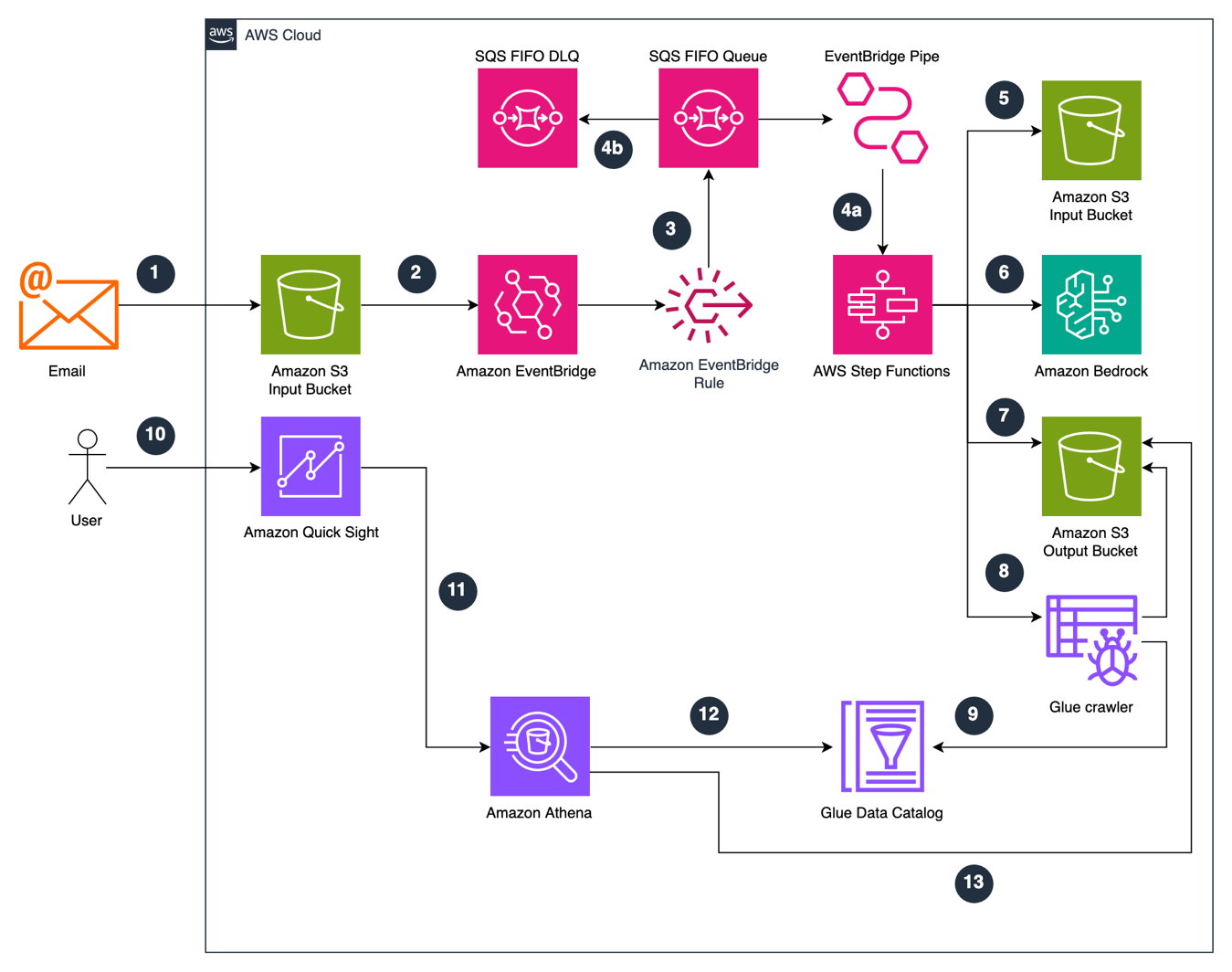
💡See how to apply generative AI to high-volume email workflows for improved operational efficiency.
⚡ 30-Second TL;DR
What Changed
Automates email classification and prioritization tasks
Why It Matters
Reduces manual administrative burden for government agencies by intelligently routing inquiries to the correct departments.
What To Do Next
Use Amazon Bedrock's prompt engineering to build a classifier that routes incoming support tickets based on semantic intent.
Key Points
- •Automates email classification and prioritization tasks
- •Designed specifically for public sector communication efficiency
- •Powered by Amazon Bedrock generative AI capabilities
🧠 Deep Insight
AI-generated analysis for this event — not the original article.
🔑 Enhanced Key Takeaways
- •The solution integrates Amazon Bedrock with Amazon Simple Email Service (SES) and AWS Lambda to create a serverless, event-driven architecture for real-time email processing.
- •It utilizes Amazon Bedrock's support for multiple foundation models, such as Anthropic Claude or Amazon Titan, to perform sentiment analysis and entity extraction on unstructured email text.
- •The architecture incorporates Amazon DynamoDB to maintain state and audit logs, ensuring compliance with public sector data retention and transparency requirements.
- •Security is managed through AWS Identity and Access Management (IAM) and AWS Key Management Service (KMS), providing encryption at rest and in transit for sensitive citizen communications.
- •The implementation often includes a human-in-the-loop (HITL) review mechanism via Amazon Augmented AI (A2I) to verify high-confidence classifications before automated responses are triggered.
📊 Competitor Analysis▸ Show
| Feature | Amazon Bedrock (AWS) | Google Cloud Vertex AI | Microsoft Azure OpenAI Service |
|---|---|---|---|
| Primary Model Access | Multi-model (Claude, Titan, Llama) | Gemini, PaLM, Open Models | GPT-4o, DALL-E, Llama |
| Public Sector Focus | High (GovCloud, FedRAMP) | High (Assurance Programs) | High (Azure for Government) |
| Integration | Deep AWS Native (SES, Lambda) | Deep GCP Native (Gmail, Pub/Sub) | Deep M365/Outlook Integration |
🛠️ Technical Deep Dive
- Architecture utilizes an event-driven pattern where incoming emails trigger an SES receipt rule, invoking an AWS Lambda function.
- The Lambda function calls the Amazon Bedrock InvokeModel API to process the email body and metadata.
- Prompt engineering templates are stored in Amazon Bedrock Prompt Management to ensure consistent classification logic across different departments.
- Data persistence layer uses DynamoDB for tracking email status, priority scores, and routing history.
- Monitoring and observability are handled through Amazon CloudWatch, providing metrics on latency and model performance.
🔮 Future ImplicationsAI analysis grounded in cited sources
⏳ Timeline
Weekly AI Recap
Read this week's curated digest of top AI events →
👉Related Updates
AI-curated news aggregator. All content rights belong to original publishers.
Original source: AWS Machine Learning Blog ↗
This is a summary, not the original. Read the source, or get the weekly briefing.
The weekly digest
One email a week. Unsubscribe anytime.