Automated AI Agent Failure Detection and Root Cause Analysis
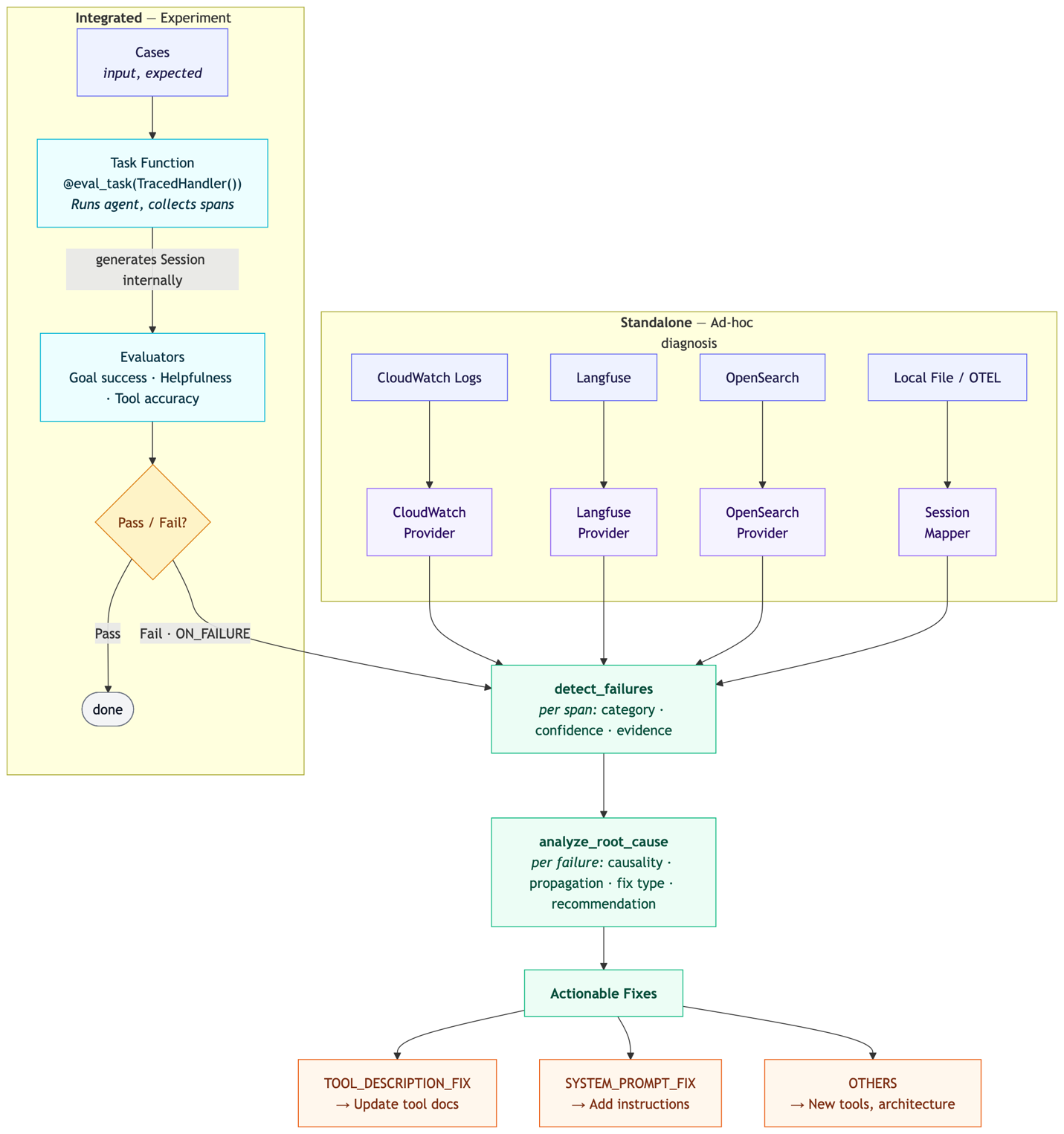
💡Stop guessing why your AI agents fail; use Strands Evals to get automated, actionable root cause analysis.
⚡ 30-Second TL;DR
What Changed
Provides categorized failure reports with specific confidence scores.
Why It Matters
This tool significantly reduces the debugging overhead for complex agentic workflows by automating the identification of failure patterns. It allows teams to iterate faster by pinpointing whether errors stem from prompt logic or tool integration.
What To Do Next
Integrate Strands Evals into your current evaluation pipeline to automate the diagnosis of agent failures during your next test run.
Key Points
- •Provides categorized failure reports with specific confidence scores.
- •Generates causal chains to link root causes with downstream symptoms.
- •Offers actionable fix recommendations for system prompts or tool definitions.
- •Supports integration into CI/CD pipelines for automated test run diagnosis.
🧠 Deep Insight
Background and context from public sources — not the original article. 10 sources cited.
🔑 Enhanced Key Takeaways
- •Strands Evals introduces a structured evaluation framework built on three foundational concepts: Cases (single test scenarios), Experiments (bundles of cases with evaluators), and Evaluators (primarily LLM-based judges for nuanced quality assessments).
- •The tool includes an
ExperimentGeneratorthat leverages Large Language Models (LLMs) to automatically create diverse test cases and tailored evaluation rubrics from high-level descriptions, significantly reducing the manual effort in building comprehensive test suites. - •Strands Evals features an
ActorSimulatordesigned for multi-turn conversation simulation, enabling the evaluation of conversational AI agents through realistic, goal-driven user interactions that adapt dynamically, moving beyond static single-turn tests. - •It provides a suite of ten built-in evaluators to assess various dimensions of AI agent quality, including helpfulness, faithfulness, tool selection accuracy, and overall goal success, offering a comprehensive assessment capability.
- •The framework supports both 'online evaluation,' where the agent is invoked live during the test run, and 'offline evaluation,' which involves analyzing historical session data, facilitated by a
Task Functioninterface that connects the agent to the evaluation system.
📊 Competitor Analysis▸ Show
| Feature / Platform | AWS Strands Evals | LangSmith (LangChain) | Galileo AI | Openlayer | Langfuse (Open-Source) | Arize Phoenix (Open-Source) |
|---|---|---|---|---|---|---|
| Core Focus | AI Agent Failure Detection & RCA, Evaluation Framework | LLM/Agent Observability, Evaluation, Debugging | AI Agent Reliability, Evaluation, Guardrails | AI Agent Evaluation, Testing, Monitoring | LLM/Agent Observability, Tracing, Evals, Prompt Mgmt | ML/LLM Observability, Tracing, Drift Detection |
| Evaluation Types | LLM-as-a-Judge, Deterministic, Multi-turn Simulation (ActorSimulator), 10+ Built-in Evaluators | LLM-as-a-Judge, Custom Evaluators, Trace-aware | SLM-based (Luna-2) for cost-efficiency, LLM-as-a-Judge, Agentic Metrics (Tool Selection Quality) | 100+ Prebuilt Evaluations, Custom Evaluators | LLM-as-a-Judge, Manual Annotations | Custom Evaluators, Embedding Clustering |
| Trace & Debugging | OpenTelemetry-based TraceExtractor, Causal Chains, Root Cause Analysis | High-fidelity Traces, Execution Tree Visualization, Collaborative Workflows | Hierarchical Trace Visualization, Automated Failure Pattern Detection | Session Tracing, Decision Logic Validation | Full Trace Capture (nested spans), Prompt Versioning | Span-level Tracing, Real-time Dashboards, Trace Replay |
| CI/CD Integration | Yes, for automated diagnosis on test runs | Yes, for quality gates | Yes, for blocking deployments | Yes, integrated test library | Yes, for evaluation workflows | Yes, OpenTelemetry-first approach |
| Multi-turn Simulation | Yes, ActorSimulator for realistic user behavior | Yes, for agent debugging and evaluation | Yes, for agent flow and action completion | Yes, for agent workflows | Limited/Focus on trace capture | Limited/Focus on trace capture |
| Key Differentiator | Automated root cause analysis with fix recommendations, LLM-powered test case generation | Comprehensive platform for LangChain/LangGraph, collaborative workflows | Cost-efficient SLM-based evaluators (Luna-2), agentic metrics | 100+ prebuilt tests, runtime guardrails, compliance | Self-hostable, open-source, prompt management | OpenTelemetry-native, ML monitoring heritage, drift detection |
| Pricing | AWS service pricing (Bedrock, CloudWatch) | Not publicly detailed (enterprise solution) | Not publicly detailed (enterprise solution) | Not publicly detailed (enterprise solution) | Free self-hosted, cloud free tier, paid plans | Open-source (Phoenix), managed cloud (Arize AX) |
| Benchmarks | N/A | N/A | Luna-2 SLMs for cost-efficient hallucination detection | N/A | N/A | N/A |
🛠️ Technical Deep Dive
- Strands Evals utilizes LLM-based evaluators to make nuanced judgments on agent quality, moving beyond simple assertion checks.
- It employs a
TraceExtractorto parse session data, enabling evaluators to process information at different granularities, including session-level (complete conversation) and trace-level (individual turns). - The
Task Functionserves as the interface connecting the agent's output to the evaluation system, supporting both live agent invocation (online evaluation) and analysis of historical data (offline evaluation). - The
ActorSimulatorcomponent is designed to build persona consistency, goal tracking, and adaptive behavior into simulated users for realistic multi-turn conversation testing. - Strands Agents SDK, which Strands Evals is part of, uses OpenTelemetry (OTEL) standards to emit agent trajectories, including traces and spans, allowing integration with compatible monitoring backends like AWS X-Ray and Amazon CloudWatch.
- The underlying detectors for root cause analysis leverage large language model (LLM)-based analysis to identify failures and generate causal chains.
- Strands Agents SDK is model-agnostic, supporting various LLM providers, and also supports both the Model Context Protocol (MCP) and A2A (Agent-to-Agent).
🔮 Future ImplicationsAI analysis grounded in cited sources
⏳ Timeline
📎 Sources (10)
Factual claims are grounded in the sources below. Forward-looking analysis is AI-generated interpretation.
Weekly AI Recap
Read this week's curated digest of top AI events →
👉Related Updates
AI-curated news aggregator. All content rights belong to original publishers.
Original source: AWS Machine Learning Blog ↗
This is a summary, not the original. Read the source, or get the weekly briefing.
Weekly AI briefing
One email a week. Unsubscribe anytime.