Automate AI Operations on Amazon Bedrock at Scale
๐กReduce AI SRE burnout with automated monitoring, intelligent alarm grouping, and smart support case management.
โก 30-Second TL;DR
What Changed
Proactive detection of operational issues within Amazon Bedrock environments.
Why It Matters
This solution significantly reduces the manual overhead for SRE teams managing large-scale generative AI applications. By automating incident response, organizations can maintain higher uptime and reliability for their production AI models.
What To Do Next
Review the solution architecture in the AWS blog post and deploy the Ops Alert stack in your staging environment to test automated alarm categorization.
Key Points
- โขProactive detection of operational issues within Amazon Bedrock environments.
- โขDynamic alarm threshold adjustment and categorization to reduce noise.
- โขAutomated, context-aware support case creation to prevent duplicate tickets.
- โขIntegrated notification system specifically designed for AI SRE teams.
๐ง Deep Insight
Web-grounded analysis with 10 cited sources.
๐ Enhanced Key Takeaways
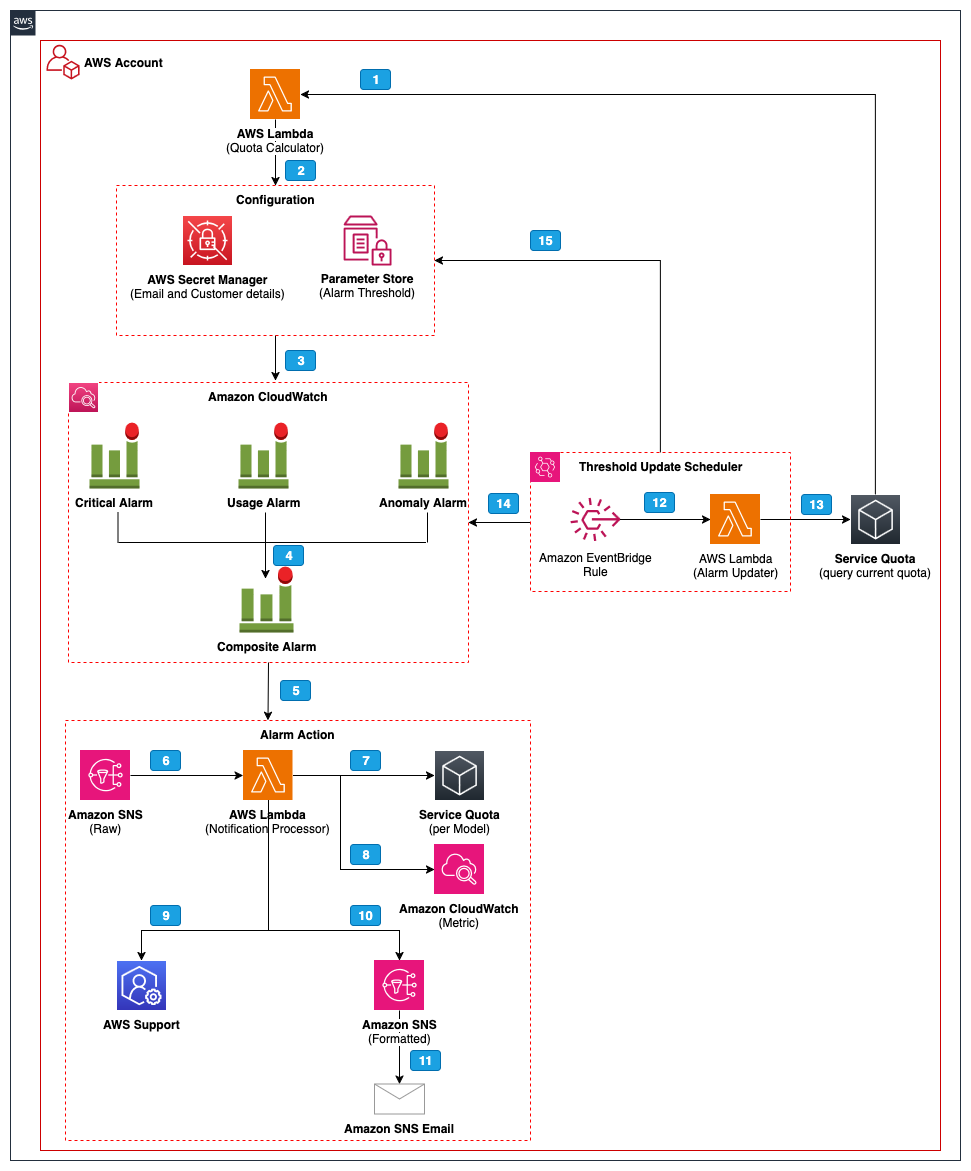
- โขAmazon Bedrock Ops Alert is implemented as an AWS CloudFormation-based solution, providing comprehensive generative AI observability through three distinct detection layers, ranging from immediate issue detection to predictive anomaly identification.
- โขThe solution dynamically adjusts alarm thresholds by querying the Service Quotas API for current Requests Per Minute (RPM) and Tokens Per Minute (TPM) quota values, storing these calculated thresholds in AWS Systems Manager Parameter Store.
- โขBeyond traditional operational metrics, Bedrock Ops Alert's monitoring capabilities are designed to address generative AI-specific concerns such as prompt-response quality, detection of toxicity or bias, and drift in language or contextual relevance.
- โขIt integrates with core AWS services including Amazon CloudWatch for alarms and metrics, AWS Lambda for functions like Quota Calculator, Amazon Simple Notification Service (SNS) for alerts, and the AWS Support API for automated case creation.
- โขThe system stores AI SRE team email contacts in AWS Secrets Manager to facilitate context-aware notifications, ensuring relevant personnel are promptly informed of operational issues.
๐ Competitor Analysisโธ Show
Competitor Analysis: Generative AI MLOps and Monitoring Platforms
| Feature / Platform | Amazon Bedrock Ops Alert (on Bedrock) | Google Vertex AI | Microsoft Azure MLOps | MLflow (Open Source) | Arize AI (LLMOps Platform) |
|---|---|---|---|---|---|
| Core Focus | Proactive operational monitoring for generative AI workloads on Bedrock, automated incident response. | End-to-end ML platform with strong MLOps tools for custom training and managed FMs. | Comprehensive MLOps platform with deep integration into Azure ecosystem, supporting GenAI. | Open-source platform for managing the ML lifecycle, including GenAI workflows. | Dedicated LLMOps platform for semantic quality, hallucination, and RAG monitoring. |
| Generative AI Monitoring | Proactive detection, dynamic thresholding, alarm classification, context-aware support cases, notifications. Monitors for prompt-response quality, toxicity/bias, language/context drift. | Real-time monitoring for model performance, data drift, and fairness. Supports prompt flow orchestration for GenAI. | Real-time monitoring for model performance, data drift, and fairness. Facilitates prompt flow orchestration. | Supports experiment tracking, model versioning, deployment, and monitoring for GenAI workflows. | Embedding monitoring for RAG, AI-driven anomaly detection, OpenTelemetry-based LLM observability, hallucination detection. |
| Integration | Deeply integrated with AWS services (CloudWatch, Lambda, SNS, Support API, SSM, Secrets Manager). | Well-integrated with Google Cloud ecosystem. | Integrates with Azure DevOps, GitHub Actions, and other Azure services. | Integrates with Hugging Face, TensorFlow, OpenAI, LangChain; framework and cloud-agnostic. | Open standards (OpenTelemetry) for framework-agnostic flexibility. |
| Deployment Model | Fully managed AWS service. | Fully managed Google Cloud service. | Fully managed Microsoft Azure service. | Self-hosted or managed by third parties; open-source. | SaaS platform, multi-cloud deployment. |
| Pricing Model | Pay-per-use for underlying AWS services. | Flexible pricing with pay-as-you-go and free tiers; costs can escalate. | Flexible pricing with pay-as-you-go and free tiers. | Free (open-source), but incurs infrastructure and maintenance costs. | Transparent pricing (e.g., $50/month for 50k spans). |
| Key Differentiator | Focus on automating incident response and SRE workflows specifically for Bedrock-based GenAI applications. | Robust MLOps for custom models, strong ecosystem integration, and comprehensive model lifecycle management. | Strong enterprise focus, governance, and integration with existing DevOps pipelines. | Flexibility, framework-agnostic, community-driven, avoids vendor lock-in. | Specialized LLM-native capabilities like semantic quality, hallucination detection, and RAG system monitoring. |
๐ ๏ธ Technical Deep Dive
- Architecture Foundation: Amazon Bedrock Ops Alert is built as an AWS CloudFormation-based solution, enabling declarative deployment and management of its infrastructure.
- Three-Layered Detection: The solution employs three complementary detection layers to provide comprehensive generative AI observability, offering different levels of visibility from immediate operational issue detection to predictive anomaly identification.
- Core AWS Service Integration: It leverages a suite of AWS services for its functionality:
- Amazon CloudWatch: Used for alarms and collecting runtime metrics from Amazon Bedrock.
- AWS Lambda: Functions, such as a 'Quota Calculator,' query the Service Quotas API to determine current Requests Per Minute (RPM) and Tokens Per Minute (TPM) quota values. These functions then calculate dynamic alarm thresholds based on configured percentages.
- Amazon Simple Notification Service (SNS): Utilized for sending contextual notifications to AI SRE teams.
- Service Quotas API: Directly queried by Lambda functions to retrieve real-time quota information for Bedrock.
- AWS Support API: Used for automated creation of support cases, preventing duplicate tickets and streamlining incident management.
- AWS Systems Manager Parameter Store: Stores the dynamically calculated alarm thresholds.
- AWS Secrets Manager: Securely stores AI SRE team email contacts for notification purposes.
- Observability Scope: The monitoring extends to critical generative AI metrics, including prompt-response quality, detection of toxicity or bias, and identification of drift in language or context relevance.
- Incident Response Context: Related AIOps solutions on Bedrock, such as 'NovaOps,' demonstrate the use of Amazon Nova foundation models for reasoning, Amazon ECS with AWS Fargate for control plane APIs, Amazon DynamoDB for incident state, and Amazon S3 for storing investigation artifacts.
๐ฎ Future ImplicationsAI analysis grounded in cited sources
โณ Timeline
๐ Sources (10)
Factual claims are grounded in the sources below. Forward-looking analysis is AI-generated interpretation.
Weekly AI Recap
Read this week's curated digest of top AI events โ
๐Related Updates
AI-curated news aggregator. All content rights belong to original publishers.
Original source: AWS Machine Learning Blog โ