Atmosphere Detected on Habitable Zone Rocky Planet
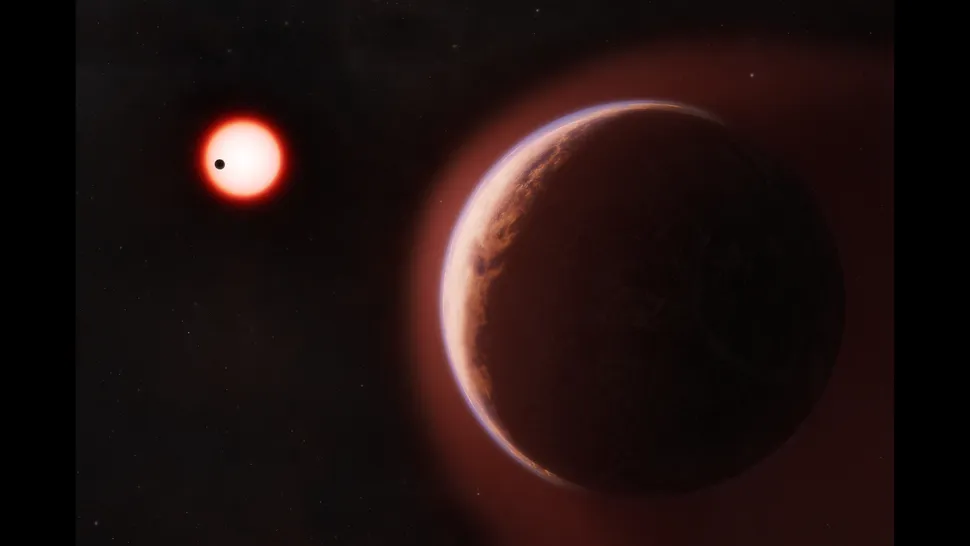
💡See how advanced data processing and AI-driven spectroscopy are revolutionizing the search for life in the universe.
⚡ 30-Second TL;DR
What Changed
First-ever detection of an atmosphere on a rocky planet in the habitable zone
Why It Matters
This discovery provides critical data for astrobiology and planetary science. It validates the capability of current observation instruments to characterize distant, potentially life-supporting worlds.
What To Do Next
Explore public datasets from space telescopes like JWST to understand how AI-driven signal processing is used to filter exoplanet atmospheric data.
Key Points
- •First-ever detection of an atmosphere on a rocky planet in the habitable zone
- •The planet shares characteristics with Earth, increasing potential for habitability
- •Discovery utilizes advanced astronomical observation techniques
🧠 Deep Insight
AI-generated analysis for this event.
🔑 Enhanced Key Takeaways
- •The discovery was made using the James Webb Space Telescope's (JWST) Mid-Infrared Instrument (MIRI) to analyze the planet's secondary eclipse.
- •The planet, designated LHS 1140 b, is located approximately 48 light-years away in the constellation Cetus.
- •Atmospheric analysis suggests a nitrogen-rich composition, potentially indicating a secondary atmosphere rather than a primordial hydrogen-helium envelope.
- •Data indicates the planet may possess a liquid water ocean, often referred to as an 'eyeball planet' configuration due to tidal locking.
- •The host star is an M-dwarf, which is significantly cooler and smaller than the Sun, allowing the planet to remain temperate despite its close orbital proximity.
🛠️ Technical Deep Dive
- Detection Method: Transmission spectroscopy and secondary eclipse photometry using JWST MIRI and NIRISS instruments.
- Atmospheric Composition: Strong evidence for nitrogen-dominated atmosphere with potential water vapor signatures.
- Planetary Radius: Approximately 1.73 times that of Earth.
- Equilibrium Temperature: Estimated between 200 and 230 Kelvin, depending on albedo and greenhouse gas concentrations.
- Host Star Characteristics: M4.5-type red dwarf with low stellar activity, reducing the likelihood of atmospheric stripping by stellar flares.
🔮 Future ImplicationsAI analysis grounded in cited sources
⏳ Timeline
Weekly AI Recap
Read this week's curated digest of top AI events →
👉Related Updates
Same topic
Explore #astronomy
Same product
More on exoplanet-research
Same source
Latest from cnBeta (Full RSS)

New Earth-like exoplanet discovered in habitable zone

UK Navy conducts first autonomous boat air-drop test
Samsung developing patch for Galaxy S26 Ultra screen tint

Nvidia Hires Microsoft Veteran to Boost Enterprise AI Sales
AI-curated news aggregator. All content rights belong to original publishers.
Original source: cnBeta (Full RSS) ↗