ASWF Launches Wayland Working Group for Creative Professionals
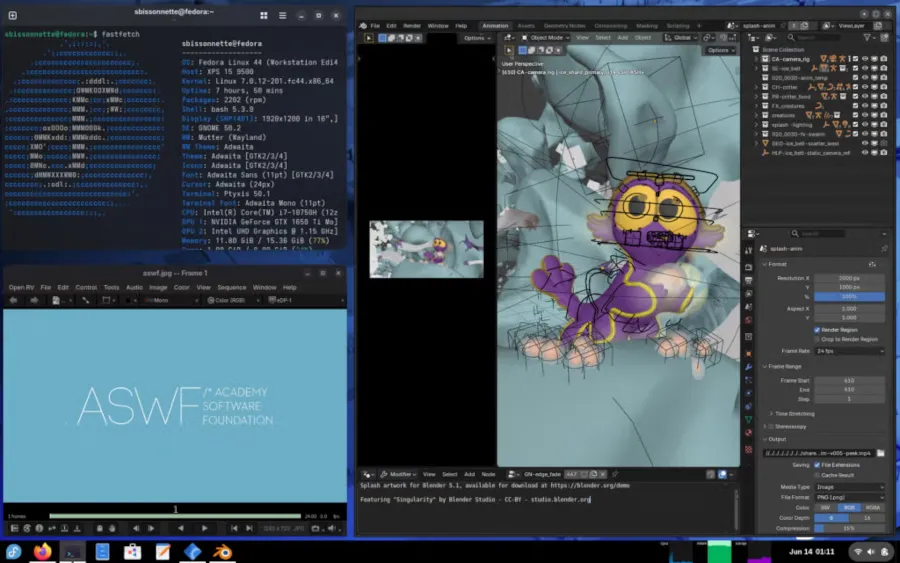
Critical for Linux-based creative developers ensuring professional software compatibility during the X11 to Wayland shif
30-Second TL;DR
What Changed
ASWF and VES co-founded the 'Wayland for Artists Working Group'.
Why It Matters
This initiative will stabilize the Linux ecosystem for creative studios, reducing fragmentation and encouraging more professional software to adopt Wayland natively.
What To Do Next
If you develop Linux-based creative tools, review the ASWF Wayland working group documentation to align your roadmap with industry standards.
Key Points
- •ASWF and VES co-founded the 'Wayland for Artists Working Group'.
- •Focuses on bridging the gap between professional VFX software and Wayland.
- •Addresses specific technical hurdles for artists in Linux environments.
- •Ensures the visual effects industry maintains high-performance standards during the transition.
Deep Insight
AI-generated analysis for this event — not the original article.
Enhanced Key Takeaways
- •The working group specifically targets the lack of color management protocols and tablet input handling parity that currently hinder professional creative workflows on Wayland.
- •Industry leaders from major studios including Industrial Light & Magic (ILM), Weta FX, and DNEG are contributing engineering resources to the group to standardize Wayland support across VFX pipelines.
- •The initiative aims to influence the development of new Wayland protocols, such as those for high-bit-depth color precision and multi-monitor synchronization, which are critical for color-critical VFX work.
- •The group is collaborating directly with the XDG (Cross-Desktop Group) to ensure that proposed extensions for professional creative tools are upstreamed into the core Wayland specification.
- •A primary objective is to reduce the reliance on XWayland, which currently serves as a compatibility layer but fails to provide the low-latency performance required for real-time viewport interaction in tools like Maya or Nuke.
Technical Deep Dive
- Focuses on implementing the zwp_tablet_v2 protocol to ensure Wacom and other professional pen displays achieve sub-millisecond latency and pressure sensitivity parity with X11.
- Addresses the absence of global coordinate systems in Wayland by proposing new protocols for absolute window positioning, essential for multi-monitor VFX workstation setups.
- Investigates the integration of color management protocols (such as those proposed by the Wayland color management working group) to support HDR and wide-gamut displays required for professional grading.
- Targets the elimination of XWayland-induced input lag by enabling native Wayland support in Qt and GTK-based creative applications.
Future ImplicationsAI analysis grounded in cited sources
Timeline
- 2018-08Academy Software Foundation (ASWF) is founded by the Academy of Motion Picture Arts and Sciences and the Linux Foundation.
- 2023-05ASWF identifies the transition from X11 to Wayland as a critical technical debt item in its annual industry landscape survey.
- 2025-11Initial discussions between ASWF and VES regarding the formation of a dedicated Linux graphics working group.
- 2026-06Official launch of the Wayland for Artists Working Group.
Weekly AI Recap
Read this week's curated digest of top AI events →
Related Updates
AI-curated news aggregator. All content rights belong to original publishers.
Original source: cnBeta (Full RSS) ↗
This is a summary, not the original. Read the source, or get the weekly briefing.
The weekly digest
One email a week. Unsubscribe anytime.