AstraTennis Moment: Humanoid Robots Enter Live Tennis
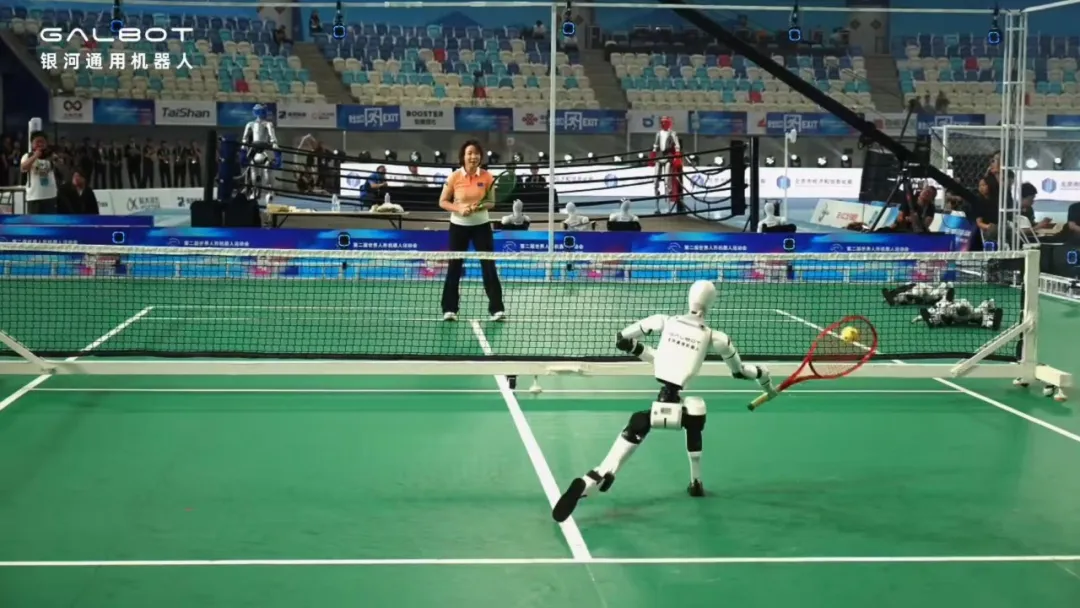
💡A humanoid robot’s live tennis match reveals how embodied AI combines self-play, control, and sim-to-real transfer.
⚡ 30-Second TL;DR
What Changed
The robot executed serves, forehands, backhands, returns, baseline rallies, volleys, emergency saves, and autonomous recovery after falls.
Why It Matters
The demonstration suggests embodied AI is progressing from scripted motion showcases toward real-time perception, control, and strategic interaction in unpredictable environments. It also highlights simulation, multi-agent self-play, and sim-to-real transfer as practical ways to overcome the scarcity of high-quality robot training data.
What To Do Next
Prototype a MuJoCo tennis benchmark with randomized ball trajectories and evaluate whether your embodied policy remains stable during sim-to-real transfer.
Key Points
- •The robot executed serves, forehands, backhands, returns, baseline rallies, volleys, emergency saves, and autonomous recovery after falls.
- •In doubles play, it coordinated with a human teammate and adapted positioning and tactics to changing game situations.
- •Galaxy Star Brain integrates high-level game understanding, motion planning, and neural control into one embodied intelligence architecture.
- •Galaxy Star Workshop converts imperfect human data into training data and uses millions of simulated multi-agent rallies to develop tennis skills before real-world transfer.
🧠 Deep Insight
Background and context from public sources — not the original article. 13 sources cited.
🔑 Enhanced Key Takeaways
- •The demonstration occurred at the National Speed Skating Oval in Beijing during the 2nd World Humanoid Robot Games, involving over 2,000 robots from 16 countries.
- •The robot achieved a record-breaking 100+ consecutive autonomous rallies against professional players, including tennis star Zheng Jie.
- •The project was developed through a strategic partnership between Galbot and Tsinghua University to advance real-time ball trajectory prediction and agile movement.
- •Industry analysts have categorized this event as the physical-world equivalent of the 2016 AlphaGo victory, marking a shift from digital strategy to complex physical interaction.
- •The robot's physical resilience was showcased when it successfully performed an autonomous recovery sequence after falling during a high-speed chase for the ball.
📊 Competitor Analysis▸ Show
| Feature | Galbot (AstraTennis) | Tesla Optimus | Figure AI |
|---|---|---|---|
| Primary Focus | High-speed athletic interaction | General purpose labor | Industrial/Logistics |
| Athletic Benchmarks | 100+ rally tennis match | Basic sorting/walking | Basic manipulation |
| Architecture | Unified StarBrain model | End-to-end neural net | Multi-modal VLM |
🛠️ Technical Deep Dive
- Architecture: Utilizes the Galaxy StarBrain (AstraBrain) foundation model which merges high-level task planning with low-level whole-body motor control.
- Training Pipeline: Employs Galaxy StarWorks for sim-to-real transfer, leveraging multi-agent adversarial training to simulate complex rally scenarios.
- Perception: Real-time ball trajectory prediction integrated with dynamic movement controllers for lateral shuffles and crossover steps.
- Recovery: Autonomous self-righting algorithms triggered by sensor-detected loss of balance during high-intensity physical maneuvers.
🔮 Future ImplicationsAI analysis grounded in cited sources
⏳ Timeline
📎 Sources (13)
Factual claims are grounded in the sources below. Forward-looking analysis is AI-generated interpretation.
Weekly AI Recap
Read this week's curated digest of top AI events →
👉Related Updates
AI-curated news aggregator. All content rights belong to original publishers.
Original source: 极客公园 ↗
This is a summary, not the original. Read the source, or get the weekly briefing.
Weekly AI briefing
One email a week. Unsubscribe anytime.