Astellas Pharma's strategy for the CLDN18.2 era
💡See how a pharma giant uses aggressive M&A and pipeline diversification to defend a high-value oncology target.
⚡ 30-Second TL;DR
What Changed
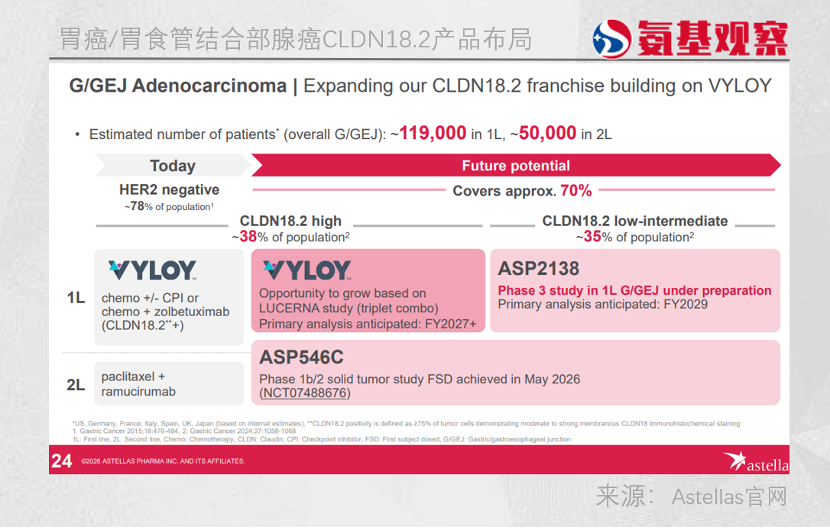
Astellas has invested over $3 billion in CLDN18.2-related assets to build a comprehensive product ecosystem.
Why It Matters
The race for CLDN18.2 dominance is driving rapid innovation in precision oncology, potentially setting new standards for gastrointestinal cancer treatment.
What To Do Next
Monitor clinical trial outcomes for CLDN18.2-targeted ADCs on ClinicalTrials.gov to identify potential shifts in therapeutic efficacy standards.
Key Points
- •Astellas has invested over $3 billion in CLDN18.2-related assets to build a comprehensive product ecosystem.
- •The company is transitioning from a single-drug strategy to a multi-modality approach including TCEs and ADCs.
- •Intense competition from Chinese biotech firms in the ADC space threatens the company's first-mover advantage.
🧠 Deep Insight
AI-generated analysis for this event — not the original article.
🔑 Enhanced Key Takeaways
- •Astellas' flagship CLDN18.2 asset, zolbetuximab, received FDA approval in March 2024 under the brand name Vyloy, marking the first CLDN18.2-targeted therapy to reach the US market.
- •The company is actively exploring combination therapies, specifically pairing zolbetuximab with immune checkpoint inhibitors like pembrolizumab to overcome resistance mechanisms in gastric and gastroesophageal junction cancers.
- •Astellas has faced significant regulatory hurdles in the EU and other regions regarding manufacturing and supply chain scalability for its monoclonal antibody products, impacting initial rollout timelines.
- •Beyond gastric cancer, Astellas is leveraging its CLDN18.2 platform to investigate potential applications in pancreatic and other solid tumors where CLDN18.2 expression is prevalent but historically difficult to target.
- •The company's R&D strategy has shifted toward 'next-generation' CLDN18.2 modalities, including CAR-T cell therapies and bispecific T-cell engagers (TCEs), to improve upon the efficacy limitations of first-generation monoclonal antibodies.
📊 Competitor Analysis▸ Show
| Competitor | Modality | Development Stage | Key Advantage |
|---|---|---|---|
| Astellas (Vyloy) | Monoclonal Antibody | Approved | First-mover, established clinical data |
| Amgen (Bemarituzumab) | Monoclonal Antibody | Phase 3 | Potential for higher affinity/efficacy in FGFR2b+ subsets |
| Legend Biotech | CAR-T | Phase 1/2 | Superior tumor penetration in solid tumors |
| Innovent/Roche | Bispecific/ADC | Phase 2 | Enhanced cytotoxic payload delivery |
🛠️ Technical Deep Dive
- Zolbetuximab mechanism: A chimeric IgG1 monoclonal antibody that binds to the CLDN18.2 protein on the surface of gastric epithelial cells.
- Effector functions: Induces antibody-dependent cellular cytotoxicity (ADCC) and complement-dependent cytotoxicity (CDC) to trigger tumor cell lysis.
- Expression threshold: Clinical efficacy is strictly dependent on patient selection based on CLDN18.2 expression levels, typically defined as >=75% of tumor cells showing moderate-to-strong staining.
- TCE Architecture: Astellas' newer TCE candidates utilize a 2:1 or 1:1 bispecific format designed to bridge CD3 on T-cells with CLDN18.2 on tumor cells, aiming to bypass MHC-restricted antigen presentation.
🔮 Future ImplicationsAI analysis grounded in cited sources
⏳ Timeline
Weekly AI Recap
Read this week's curated digest of top AI events →
👉Related Updates


AI-curated news aggregator. All content rights belong to original publishers.
Original source: 虎嗅 ↗
This is a summary, not the original. Read the source, or get the weekly briefing.
The weekly digest
One email a week. Unsubscribe anytime.