ASIC Market Shifts from Monopoly to Diverse Competition
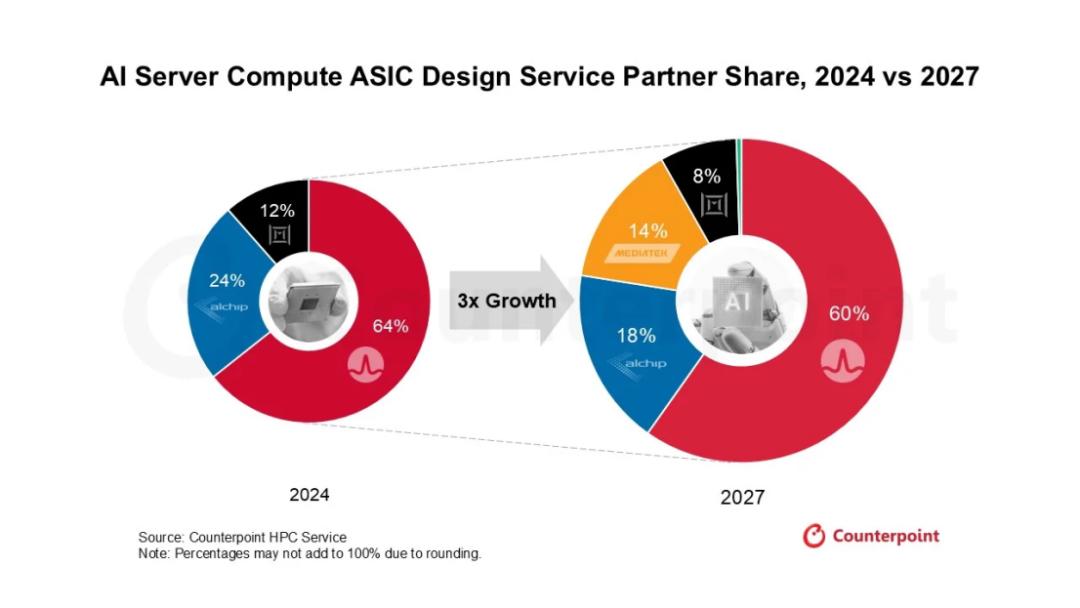
💡Understand the shifting landscape of AI hardware and the rise of custom silicon alternatives to GPUs.
⚡ 30-Second TL;DR
What Changed
Breakdown of single-player dominance in ASIC market
Why It Matters
Increased competition in the ASIC market will likely lower costs for AI infrastructure and accelerate the development of custom silicon for specific AI workloads.
What To Do Next
Evaluate custom ASIC solutions for your specific AI inference workloads to optimize cost and performance compared to standard GPUs.
Key Points
- •Breakdown of single-player dominance in ASIC market
- •Rise of diverse competitive landscape
- •Increased demand for specialized AI hardware driving market shifts
🧠 Deep Insight
Background and context from public sources — not the original article. 29 sources cited.
🔑 Enhanced Key Takeaways
- •The 'single-player dominance' in the AI hardware market primarily refers to NVIDIA's historical stronghold with general-purpose GPUs, which held an estimated 70-87% of the AI chip market share. This dominance is now being challenged by the rise of specialized AI ASICs.
- •Hyperscale cloud providers such as Google, Amazon, Microsoft, and Meta are leading the shift by developing custom AI ASICs (e.g., Google TPUs, AWS Trainium/Inferentia, Microsoft Maia, Meta MTIA) to achieve better performance-per-watt, reduce operational costs, gain supply chain independence, and differentiate their AI services.
- •The AI ASIC market is projected for substantial growth, with a compound annual growth rate (CAGR) of 32.4% from 2025 to 2031, and the ASIC segment is expected to be the fastest-growing within the broader AI accelerator chip market.
- •Key trends driving this market shift include an increased focus on energy efficiency, the expansion of AI processing to edge computing devices, tighter integration with machine learning frameworks, and the development of highly customizable chips tailored for specific AI workloads.
- •Taiwan Semiconductor Manufacturing Company (TSMC) plays a critical role as an indispensable enabler, fabricating advanced process nodes (e.g., 5nm, 3nm, 2nm) and scaling advanced packaging technologies like CoWoS for most hyperscalers and custom AI chip designers like Broadcom.
📊 Competitor Analysis▸ Show
| Company/Product | Type | Primary Focus | Key Differentiators | Market Share/Positioning |
|---|---|---|---|---|
| NVIDIA (GPUs) | General-Purpose GPU | AI Training, HPC, Graphics | Dominant software ecosystem (CUDA), high flexibility, strong performance in training. | ~70-87% of overall AI chip market (2024). |
| Google (TPUs) | Custom AI ASIC | AI Training & Inference (Google Cloud) | Optimized for TensorFlow/JAX, strong price-performance, lower TCO for LLM workloads. | Leading in AI Server Compute ASIC shipments among hyperscalers (64% in 2024, projected 52% in 2027). |
| AWS (Trainium/Inferentia) | Custom AI ASICs | AI Training (Trainium) & Inference (Inferentia) | Optimized for AWS cloud, provides alternatives to NVIDIA GPUs. | Significant share in hyperscaler AI ASICs (36% in 2024). |
| Microsoft (Maia) | Custom AI ASIC | AI Training & Inference (Azure Data Centers) | Designed for large language models (LLMs) like GPT-5.2, aims for reduced reliance on third-party GPUs. | Volume ramp-ups expected by 2027. |
| Meta (MTIA) | Custom AI ASIC | AI Training & Inference (Meta's AI models) | Focus on efficiency and cost reduction for internal AI workloads. | Volume ramp-ups expected by 2027. |
| Broadcom | Custom ASIC Design Partner | Designing custom chips for hyperscalers | Leading designer for Google, Meta, OpenAI; strong in high-end custom ASIC market. | >60% of the AI ASIC market (2026). |
| Marvell | Custom ASIC Design Partner | Designing custom chips for hyperscalers | Focus on ASIC solutions for AI server demands. | ~20-25% share in custom AI ASIC market. |
| Groq, Cerebras, Etched | Specialized AI ASICs | Low-latency inference, specific AI architectures | Highly specialized for niche applications, direct competitors to NVIDIA in inference. | Emerging players, gaining traction in specific segments. |
🛠️ Technical Deep Dive
- AI ASICs are purpose-built chips optimized for specific AI workloads, primarily matrix multiplications and tensor operations, by stripping away general-purpose features found in GPUs to achieve higher throughput and power efficiency.
- These chips are often specialized for either AI training (e.g., Google TPU v7 Ironwood, AWS Trainium2) or AI inference (e.g., AWS Inferentia2, Groq's LPU, Etched's Sohu), though some designs handle both.
- Modern AI ASICs utilize advanced process nodes such as 5nm, 3nm, and 2nm to enable greater transistor density, faster clock speeds, and improved power efficiency crucial for demanding AI workloads.
- Innovations in packaging, including 3D-packaged XPUs and CoWoS (Chip-on-Wafer-on-Substrate) advanced packaging, are employed to reduce latency and enhance energy efficiency by vertically stacking chip layers.
- Google's TPU v7 Ironwood, for instance, delivers 4,614 FP8 TFLOPS with 192 GB of HBM3E memory at 7.37 TB/s bandwidth, featuring a dual-chiplet design manufactured on TSMC's N3P process, and includes specialized TensorCores and SparseCores.
- Microsoft's Maia 200 offers over 10 PFLOPS FP4 and 5 PFLOPS FP8 with 216GB HBM3E at 7 TB/s bandwidth within a 750W power envelope.
- AI ASICs can provide up to five times more bandwidth compared to general-purpose chips.
- A strong emphasis is placed on energy efficiency in AI ASIC design to mitigate the substantial operational costs and environmental impact associated with large-scale AI deployments.
🔮 Future ImplicationsAI analysis grounded in cited sources
⏳ Timeline
📎 Sources (29)
Factual claims are grounded in the sources below. Forward-looking analysis is AI-generated interpretation.
- tomshardware.com
- snsinsider.com
- ibm.com
- synovus.com
- semiconductorintelligence.com
- future-bridge.us
- medium.com
- bloomberg.com
- counterpointresearch.com
- techinsights.com
- hashrateindex.com
- investorplace.com
- enkiai.com
- researchandmarkets.com
- cubefabs.com
- tradingkey.com
- seco.com
- jonpeddie.com
- rapidcanvas.ai
- devops.com
- hashrateindex.com
- letsdatascience.com
- substack.com
- hashrateindex.com
- medium.com
- imeciclink.com
- marketsandmarkets.com
- marketintelo.com
- aicerts.ai
Weekly AI Recap
Read this week's curated digest of top AI events →
👉Related Updates



AI-curated news aggregator. All content rights belong to original publishers.
Original source: 钛媒体 ↗
This is a summary, not the original. Read the source, or get the weekly briefing.
The weekly digest
One email a week. Unsubscribe anytime.