Artificial cell achieves limited rounds of cell division
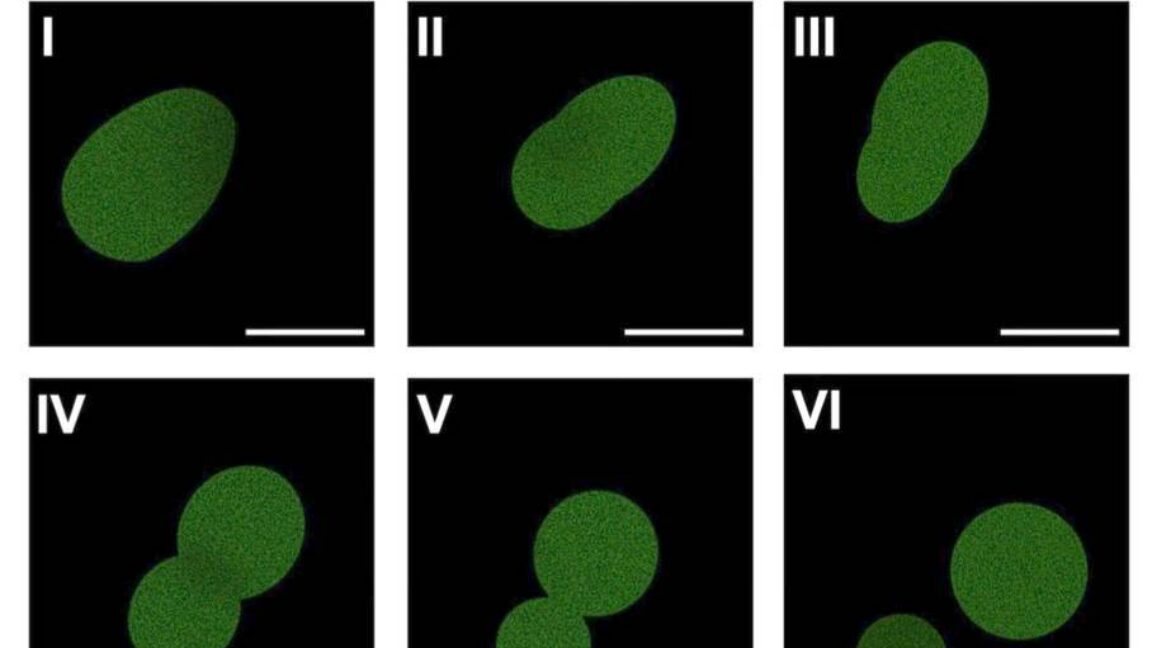
Synthetic biology breakthroughs are paving the way for future bio-computing and AI hardware.
30-Second TL;DR
What Changed
Artificial cell successfully divided multiple times
Why It Matters
Advances in synthetic biology and artificial life forms are foundational for future bio-computing and AI-integrated biological systems.
What To Do Next
Explore synthetic biology datasets if building bio-inspired AI architectures.
Key Points
- •Artificial cell successfully divided multiple times
- •Requires high levels of added materials
- •Demonstrates progress in synthetic biology
Deep Insight
AI-generated analysis for this event — not the original article.
Enhanced Key Takeaways
- •The artificial cell utilizes a microfluidic platform to precisely control the delivery of lipids and proteins required for membrane expansion and division.
- •Researchers employed a bottom-up synthetic biology approach, assembling purified biological components rather than modifying existing living cells.
- •The division mechanism relies on a synthetic FtsZ-based contractile ring, mimicking the bacterial cytokinesis process.
- •A major bottleneck identified is the lack of an autonomous metabolic system, necessitating the external replenishment of ATP and building blocks.
- •This study represents a transition from static synthetic vesicles to dynamic systems capable of transient morphological changes.
Technical Deep Dive
- Architecture: Bottom-up synthetic cell constructed from lipid bilayer vesicles (proteoliposomes).
- Division Mechanism: Reconstitution of the bacterial FtsZ protein ring system to induce membrane constriction.
- Energy Source: External supply of ATP and enzymatic regeneration systems to power protein synthesis and membrane remodeling.
- Material Input: Microfluidic-based injection of phospholipids and membrane proteins to maintain surface-area-to-volume ratios during growth.
- Limitation: Lack of self-replicating genetic material; division is driven by external chemical triggers rather than internal cell-cycle regulation.
Future ImplicationsAI analysis grounded in cited sources
Timeline
- 2010-05J. Craig Venter Institute creates the first synthetic bacterial cell with a fully synthesized genome.
- 2016-03Researchers at the J. Craig Venter Institute announce the creation of a minimal cell (Syn 3.0) containing only essential genes.
- 2021-01Scientists successfully engineer a minimal cell that divides and maintains normal morphology.
- 2026-07Advancement in artificial cell division demonstrating multiple rounds of division via external material input.
Weekly AI Recap
Read this week's curated digest of top AI events →
AI-curated news aggregator. All content rights belong to original publishers.
Original source: Ars Technica ↗
This is a summary, not the original. Read the source, or get the weekly briefing.
The weekly digest
One email a week. Unsubscribe anytime.