Arm Surges on AI Data Center Chip Demand
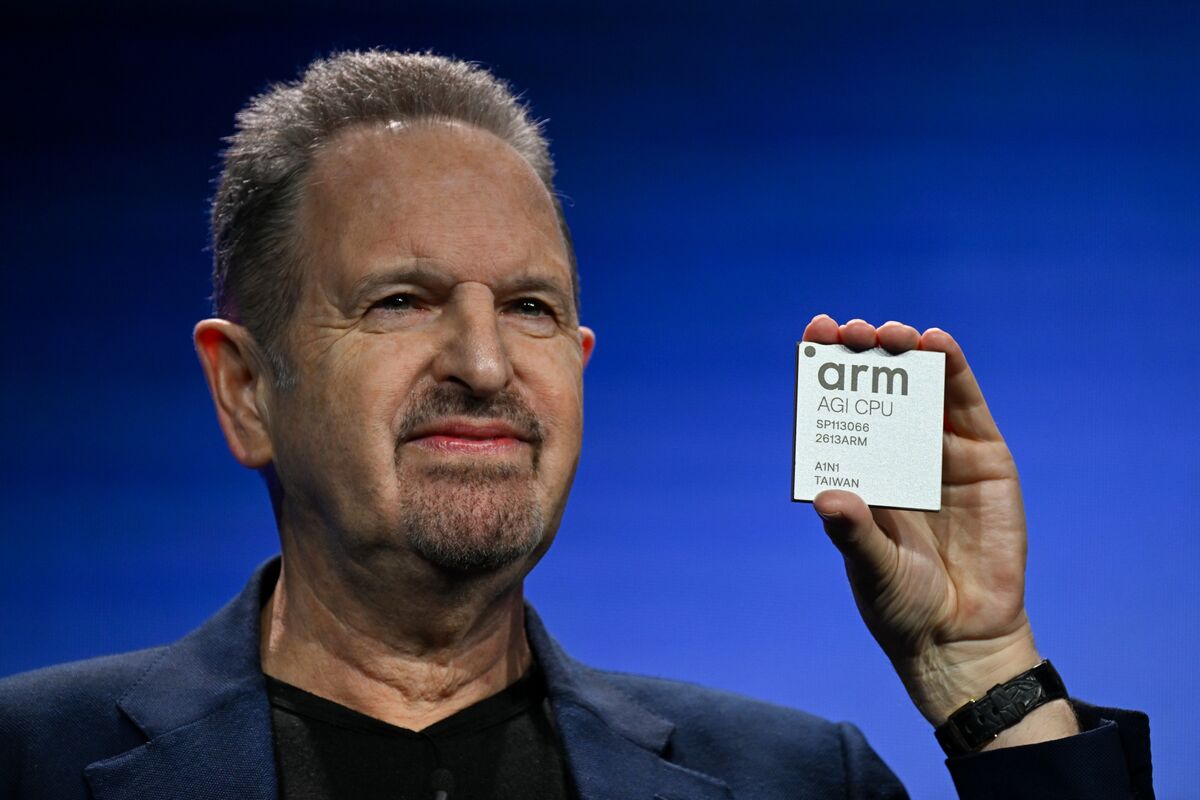
Arm's AI data center chip demand drives forecast—vital for infra builders.
30-Second TL;DR
What Changed
Solid forecast delivered by Arm
Why It Matters
Boosts confidence in Arm's AI infrastructure role, potentially lowering costs for AI workloads on Arm-based servers. Signals growing adoption beyond mobile.
What To Do Next
Benchmark Arm's new data center chip against x86 for your AI inference workloads.
Key Points
- •Solid forecast delivered by Arm
- •Demand for new homegrown data center chip
- •Push into AI data centers paying off
- •Shares jumped in late trading
Deep Insight
AI-generated analysis for this event — not the original article.
Enhanced Key Takeaways
- •Arm's growth is increasingly driven by the adoption of its Neoverse V3 and N3 compute subsystems, which are specifically optimized for hyperscaler AI workloads and custom silicon development.
- •The company has successfully transitioned its business model to capture higher royalty rates per chip by moving from simple IP licensing to providing comprehensive compute platforms that include interconnect and security features.
- •Strategic partnerships with major cloud service providers, such as AWS, Google Cloud, and Microsoft Azure, have accelerated the deployment of Arm-based server CPUs, directly challenging the traditional x86 dominance in data centers.
Competitor Analysis
- Arm (Neoverse)
- RISC (ARMv9)
- Intel (Xeon)
- CISC (x86_64)
- AMD (EPYC)
- CISC (x86_64)
- Arm (Neoverse)
- Industry-leading (Performance/Watt)
- Intel (Xeon)
- Moderate
- AMD (EPYC)
- High
- Arm (Neoverse)
- High (Licensable IP)
- Intel (Xeon)
- Low (Standardized)
- AMD (EPYC)
- Low (Standardized)
- Arm (Neoverse)
- Cloud/AI/Edge
- Intel (Xeon)
- Enterprise/Cloud
- AMD (EPYC)
- Cloud/HPC
| Feature | Arm (Neoverse) | Intel (Xeon) | AMD (EPYC) |
|---|---|---|---|
| Architecture | RISC (ARMv9) | CISC (x86_64) | CISC (x86_64) |
| Power Efficiency | Industry-leading (Performance/Watt) | Moderate | High |
| Customization | High (Licensable IP) | Low (Standardized) | Low (Standardized) |
| Primary Market | Cloud/AI/Edge | Enterprise/Cloud | Cloud/HPC |
Technical Deep Dive
- Neoverse V3 Core: Features advanced branch prediction and increased instruction-per-clock (IPC) throughput tailored for AI inference and large language model (LLM) workloads.
- AMBA CHI (Coherent Hub Interface): Enhanced interconnect protocol allowing for high-bandwidth, low-latency communication between CPU cores, accelerators, and memory controllers in multi-chiplet designs.
- SVE2 (Scalable Vector Extension): Provides hardware-level acceleration for vector processing, critical for machine learning mathematical operations.
- Chiplet-based Architecture: Enables modular design, allowing vendors to combine Arm compute dies with proprietary AI accelerators on a single package.
Future ImplicationsAI analysis grounded in cited sources
Timeline
- 2020-09NVIDIA announces intent to acquire Arm (later terminated in 2022).
- 2022-06Arm launches the Neoverse V2 platform, targeting cloud-native and HPC workloads.
- 2023-09Arm Holdings completes its initial public offering (IPO) on the Nasdaq.
- 2024-05Arm introduces the Neoverse V3 and N3 compute subsystems for AI-focused data centers.
- 2025-11Arm reports record quarterly licensing revenue driven by AI infrastructure demand.
Weekly AI Recap
Read this week's curated digest of top AI events →
AI-curated news aggregator. All content rights belong to original publishers.
Original source: Bloomberg Technology ↗
This is a summary, not the original. Read the source, or get the weekly briefing.
The weekly digest
One email a week. Unsubscribe anytime.