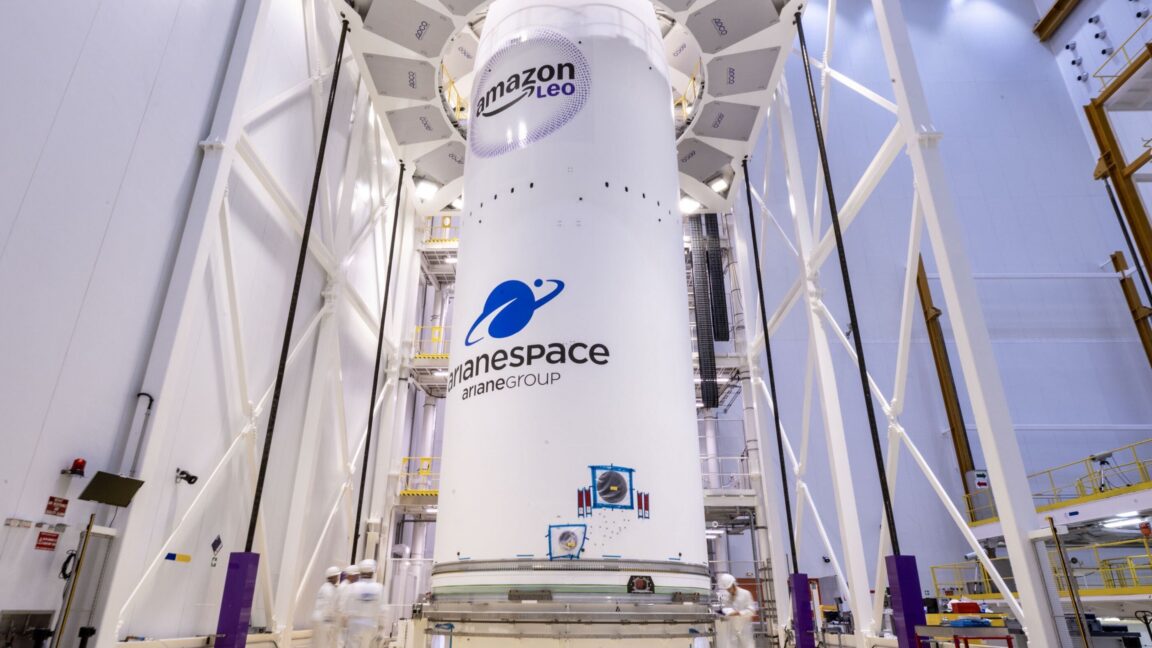
Arianespace leads in delivering rockets for Amazon's constellation
💡Infrastructure stability for satellite internet directly impacts the feasibility of global edge-AI deployments.
⚡ 30-Second TL;DR
What Changed
Amazon depends on multiple launch providers for Project Kuiper
Why It Matters
Reliable launch infrastructure is essential for the scaling of global AI-driven satellite internet services and edge computing connectivity.
What To Do Next
If building edge-AI solutions for remote areas, monitor the deployment schedule of Project Kuiper to plan your infrastructure connectivity.
Key Points
- •Amazon depends on multiple launch providers for Project Kuiper
- •Arianespace is currently the only provider meeting delivery expectations
- •Launch delays impact the timeline for global satellite internet deployment
🧠 Deep Insight
Background and context from public sources — not the original article. 33 sources cited.
🔑 Enhanced Key Takeaways
- •Amazon's Project Kuiper, now rebranded as Amazon Leo, plans to deploy a total of 3,236 satellites into Low Earth Orbit (LEO) to provide global broadband internet.
- •Beyond Arianespace, Amazon has secured launch contracts with United Launch Alliance (ULA) for 46 missions (8 Atlas V and 38 Vulcan Centaur), Blue Origin for 12 New Glenn launches (with options for 15 more), and SpaceX for 3 Falcon 9 missions.
- •Both Blue Origin's New Glenn and ULA's Vulcan Centaur have experienced significant delays; New Glenn suffered an explosion during a static fire test in May 2026, severely damaging its launch pad and potentially causing over a year of disruption, while Vulcan Centaur has been grounded for months due to recurring issues with its solid rocket boosters as of March 2026.
- •Amazon faces a Federal Communications Commission (FCC) mandate to deploy at least 50% of its authorized satellites by July 2026 and the entire constellation by July 2029.
- •Arianespace's contract with Amazon, signed in April 2022 for 18 Ariane 6 launches, represents the largest launch services agreement in Arianespace's history, with 16 of these missions utilizing an upgraded Ariane 64 variant featuring P120C+ boosters for increased payload capacity.
📊 Competitor Analysis▸ Show
| Feature / Provider | Amazon Leo (Project Kuiper) | SpaceX Starlink | Eutelsat OneWeb |
|---|---|---|---|
| Constellation Size (Planned/Deployed) | 3,236 satellites (over 330 deployed by April 2026) | ~7,000 active satellites (authorized for 12,000 Gen1, 30,000 Gen2) | 648 satellites (fully deployed Gen1) |
| Orbital Altitude | 590-630 km LEO | 340-570 km LEO (majority around 550 km) | 1,200 km LEO |
| Target Market | Consumer, enterprise, government | Direct-to-consumer, business, maritime, aviation, government | Wholesale, enterprise, government |
| Business Model | Expected mass-market competitive pricing, potential bundling with AWS | Subscription model (hardware + monthly fee), aggressively subsidized terminals initially | Wholesale and contract-based, sells capacity via partners |
| Latency (Round Trip) | 30-50 ms | ~30 ms (often 20-40 ms) | ~70 ms |
| Inter-satellite Links | Optical Inter-Satellite Links (OISL) with infrared lasers (up to 100 Gbps) | Inter-satellite laser links (deployed across most of constellation) | Yes, but details less prominent in search results. |
| Launch Strategy | Multiple providers (Arianespace, ULA, Blue Origin, SpaceX) | Vertically integrated (SpaceX Falcon 9 rockets) | Multiple providers (e.g., Soyuz, Falcon 9, OneWeb Satellites) |
🛠️ Technical Deep Dive
- Constellation Size & Orbit: Amazon Leo plans for 3,236 satellites operating in Low Earth Orbit (LEO) at altitudes ranging from 590 km to 630 km, distributed across 98 orbital planes.
- Satellite Design: Each satellite is designed for mass production at Amazon's facilities in Redmond and Kirkland, Washington. They are equipped with advanced Hall-effect thrusters using electric propulsion (krypton-fueled) for precise maneuvering, collision avoidance, and controlled deorbiting at the end of their 7-year operational lifespan.
- Inter-satellite Connectivity: The satellites utilize Optical Inter-Satellite Links (OISL) with infrared lasers, enabling high-speed data transfer at rates up to 100 Gbps directly between satellites, forming a mesh network in space to reduce reliance on ground stations.
- Onboard Processing: Satellites are powered by Amazon's custom-designed "Prometheus" baseband chip (System-on-a-Chip), which integrates the functions of a 5G modem, cellular base station, and microwave backhaul antenna, capable of processing up to 1 terabit per second per satellite.
- User Terminals: Amazon Leo offers three classes of customer terminals, all featuring electronically steered, phased-array antennas with custom silicon chips:
- Compact (Nano): Approximately 18x18 cm (7x7 inches), offering up to 100 Mbps downlink and 20-40 Mbps uplink, with ~60W power draw.
- Standard (Pro): Approximately 28x28 cm, providing up to 400 Mbps downlink and 100 Mbps uplink, with ~90W power draw.
- Professional/Enterprise (Ultra): Approximately 76x51 cm, capable of up to 1 Gbps downlink and 400 Mbps uplink, with ~225W power draw.
- Ground Infrastructure: The ground segment comprises a global network of 300-350 autonomous gateway stations equipped with 2.4-meter Ka-band antennas, alongside Telemetry, Tracking, and Control (TT&C) antennas for monitoring and orbit maintenance.
- Launch Vehicles: Amazon Leo utilizes a diverse fleet of heavy-lift rockets, including Arianespace's Ariane 64 (capable of delivering over 21 tonnes to LEO), ULA's Atlas V and Vulcan Centaur, Blue Origin's New Glenn, and SpaceX's Falcon 9.
🔮 Future ImplicationsAI analysis grounded in cited sources
⏳ Timeline
📎 Sources (33)
Factual claims are grounded in the sources below. Forward-looking analysis is AI-generated interpretation.
- eoportal.org
- reddit.com
- space.com
- spaceconnectonline.com.au
- emergentmind.com
- bcsatellite.net
- businessinsider.com
- ulalaunch.com
- ulalaunch.com
- spaceflightnow.com
- thedefensewatch.com
- youtube.com
- youtube.com
- medium.com
- wikipedia.org
- theweek.com
- arianespace.com
- apscc.or.kr
- cnes.fr
- avio.com
- avio.com
- europeanspaceflight.com
- arianespace.com
- wikipedia.org
- wikipedia.org
- aboutamazon.com
- spacenexus.us
- ts2.tech
- aws.com
- techtarget.com
- comintel-tp.com
- skylinker.io
- fcc.report
Weekly AI Recap
Read this week's curated digest of top AI events →
👉Related Updates
AI-curated news aggregator. All content rights belong to original publishers.
Original source: Ars Technica ↗
This is a summary, not the original. Read the source, or get the weekly briefing.
Weekly AI briefing
One email a week. Unsubscribe anytime.