Toshiba Advances Quantum-Inspired Optimization for Embedded Systems
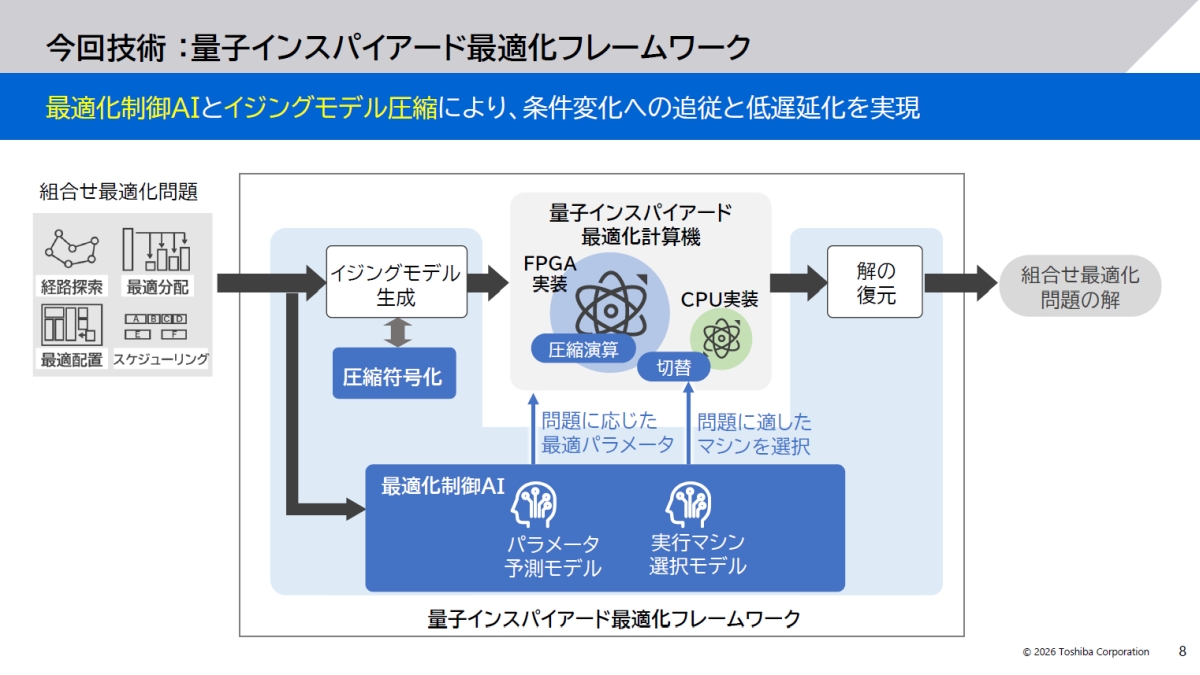
💡A breakthrough in running complex optimization tasks on edge devices without needing actual quantum hardware.
⚡ 30-Second TL;DR
What Changed
Optimized for real-time, dynamic environmental changes
Why It Matters
This framework allows edge devices to solve complex logistics or scheduling problems locally without relying on cloud-based quantum hardware. It significantly lowers the barrier for deploying advanced optimization algorithms in industrial IoT.
What To Do Next
Evaluate your current edge-computing bottlenecks to see if combinatorial optimization tasks can be offloaded to this new framework.
Key Points
- •Optimized for real-time, dynamic environmental changes
- •Balances high-speed processing with computational stability
- •Targeted specifically for embedded system integration
🧠 Deep Insight
Background and context from public sources — not the original article. 8 sources cited.
🔑 Enhanced Key Takeaways
- •Toshiba's latest third-generation algorithm for its Simulated Bifurcation Machine (SBM) achieves approximately 100 times faster Time to Solution (TTS) compared to its predecessor.
- •The breakthrough algorithm leverages the principle of 'harnessing chaos at the boundary between order and disorder' to dramatically improve the success probability of finding optimal solutions, approaching 100%.
- •The innovation involves assigning individual bifurcation parameters to each position variable, enabling finer-grained control and adaptive allocation of computational resources.
- •The technology, commercialized as SQBM+, can solve Ising problems with up to 100,000 variables and aims to support problems with up to 10 million variables.
- •Toshiba has successfully deployed its quantum-inspired optimization computer on an autonomous mobile robot, demonstrating its capability for real-time decision-making in embedded systems under strict constraints on size, power consumption, and cost.
🛠️ Technical Deep Dive
- The core technology is the Simulated Bifurcation Machine (SBM), which simulates quantum mechanical theories, specifically the Quantum Bifurcation Machine utilizing nonlinear phenomena from Kerr-parametric oscillators (KPO), on classical computers.
- The algorithm solves Hamiltonian equations by leveraging classical parallel computing resources such as GPUs and FPGAs.
- The third-generation algorithm introduces individual bifurcation parameters for each position variable, providing more adaptive and effective solution searching compared to previous versions that used a single global parameter.
- It operates at the 'edge of chaos'—the boundary between regular dynamics and chaotic motion—to efficiently escape local optima and achieve a success probability approaching 100% for reaching global optima.
- The commercial offering, SQBM+, includes two primary algorithms: the Ballistic Simulated Bifurcation (bSB) algorithm for high-speed approximate solutions and the Discrete Simulated Bifurcation (dSB) algorithm for high-accuracy solutions, with an auto-tune function to select the optimal algorithm.
- The dSB algorithm, when implemented on a 16-GPU machine, has solved a one-million-bit problem approximately 20,000 times faster than a CPU-based simulated annealing machine.
- The bSB algorithm, implemented on an FPGA (bSBM), can obtain good solutions to 2,000-bit problems approximately 10 times faster than the previous Adiabatic Simulated Bifurcation Algorithm (aSBM).
- The framework supports Quadratic Unconstrained Binary Optimization (QUBO) problems and can handle up to 10 million variables.
🔮 Future ImplicationsAI analysis grounded in cited sources
⏳ Timeline
📎 Sources (8)
Factual claims are grounded in the sources below. Forward-looking analysis is AI-generated interpretation.
Weekly AI Recap
Read this week's curated digest of top AI events →
👉Related Updates
AI-curated news aggregator. All content rights belong to original publishers.
Original source: ITmedia AI+ (日本) ↗
This is a summary, not the original. Read the source, or get the weekly briefing.
Weekly AI briefing
One email a week. Unsubscribe anytime.