Architecting production-grade AI Agents for enterprises
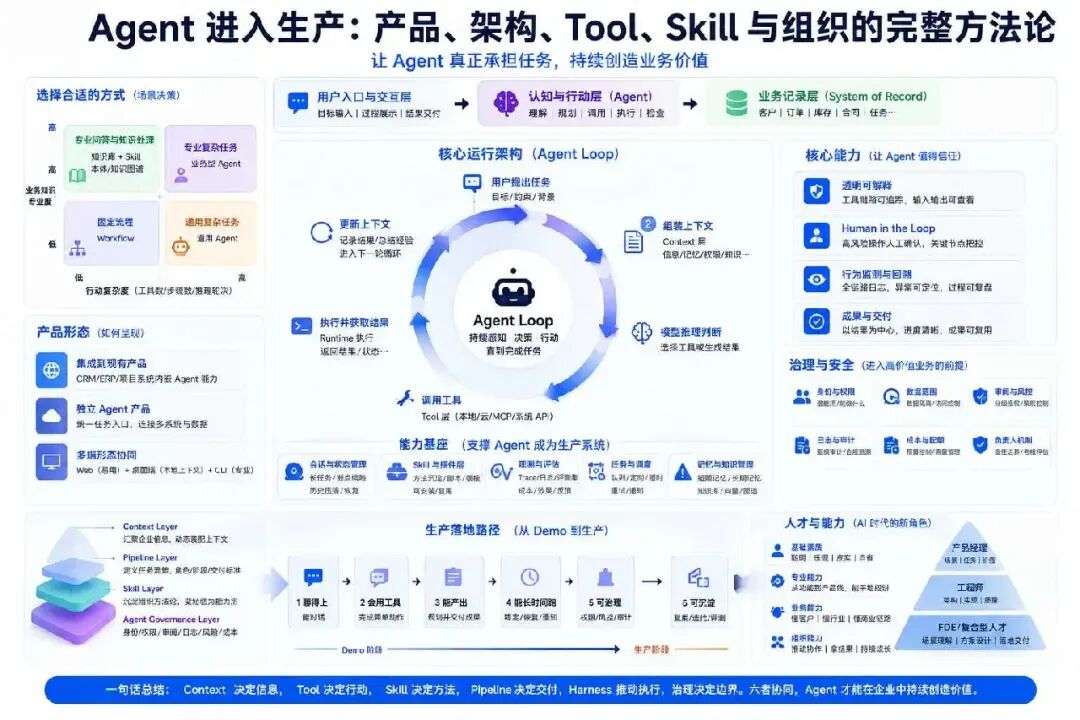
💡A comprehensive guide on moving AI Agents from chat demos to reliable, production-ready enterprise systems.
⚡ 30-Second TL;DR
What Changed
Distinguish between fixed workflows and autonomous agents based on task complexity.
Why It Matters
Provides a blueprint for engineering teams to transition from experimental AI prototypes to reliable, scalable enterprise systems.
What To Do Next
Implement a 'human-in-the-loop' verification layer for any Agent action that modifies critical business data.
Key Points
- •Distinguish between fixed workflows and autonomous agents based on task complexity.
- •Production-grade agents require transparency in tool chains and human-in-the-loop for high-risk actions.
- •Knowledge engineering is critical for specialized domains like finance and healthcare.
- •Multi-agent systems should be partitioned based on clear context and responsibility boundaries.
🧠 Deep Insight
AI-generated analysis for this event — not the original article.
🔑 Enhanced Key Takeaways
- •Production-grade agents are increasingly adopting 'Stateful Orchestration' layers, which decouple agent reasoning from long-running process persistence to ensure reliability during system failures.
- •The industry is shifting toward 'Semantic Caching' for tool-use, where agent decisions are cached based on intent rather than exact prompt matches to reduce latency and API costs.
- •Observability frameworks for agents now prioritize 'Trace-based Evaluation,' allowing developers to debug multi-step reasoning chains by visualizing the latent space transitions between tool calls.
- •Security architectures for enterprise agents are moving toward 'Zero-Trust Tooling,' where agents are granted ephemeral, scoped permissions rather than static API keys to mitigate prompt injection risks.
- •Data governance in agentic systems is evolving to include 'Automated Feedback Loops' that use RAG-based verification to automatically prune hallucinated knowledge from vector databases.
🛠️ Technical Deep Dive
- Agentic Orchestration Layer: Implementation of Directed Acyclic Graphs (DAGs) to manage complex task dependencies and fallback logic.
- Memory Management: Utilization of hybrid memory systems combining short-term context windows with long-term vector-based episodic memory.
- Tool Integration: Use of OpenAPI/Swagger specifications to enable standardized, type-safe communication between LLMs and external enterprise APIs.
- Human-in-the-loop (HITL): Integration of asynchronous approval workflows via event-driven architectures (e.g., Kafka or RabbitMQ) to pause agent execution pending external validation.
🔮 Future ImplicationsAI analysis grounded in cited sources
Weekly AI Recap
Read this week's curated digest of top AI events →
👉Related Updates



AI-curated news aggregator. All content rights belong to original publishers.
Original source: 虎嗅 ↗
This is a summary, not the original. Read the source, or get the weekly briefing.
The weekly digest
One email a week. Unsubscribe anytime.