April LLMs Surge Benchmarks, Lose Human Voice
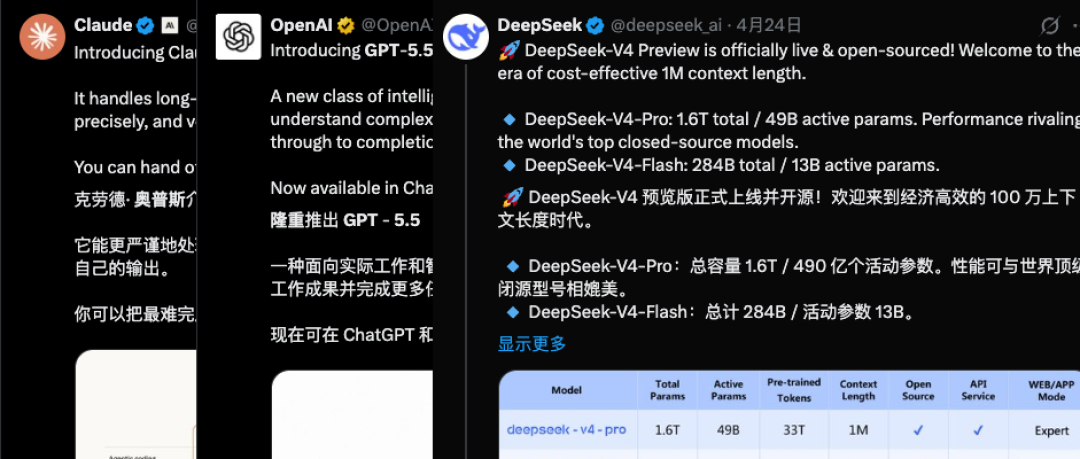
💡Why benchmark-topping LLMs now sound like lifeless bots (RLHF pitfalls)
⚡ 30-Second TL;DR
What Changed
Models boost context length, reasoning, code; e.g., DeepSeek V4 aids Notion-TG sleep tracker build.
Why It Matters
Forces AI devs to choose capability vs. relatability; may slow consumer adoption as blandness kills shareability. Signals RLHF limits for natural interaction.
What To Do Next
Test DeepSeek V4 Pro in Claude Code for project builds, tweak system prompts for personality.
Key Points
- •Models boost context length, reasoning, code; e.g., DeepSeek V4 aids Notion-TG sleep tracker build.
- •RLHF enforces polite, balanced outputs erasing info-rich traits like doubt, stance, rhythm.
- •Past hits like DeepSeek R1 viral via visible thinking chains and natural Chinese idioms.
- •New versions mimic overtrained CS reps: 'Great question' intros, proactive offers.
🧠 Deep Insight
AI-generated analysis for this event — not the original article.
🔑 Enhanced Key Takeaways
- •The 'language uncanny valley' is being exacerbated by a shift toward 'Constitutional AI' 2.0, which mandates specific tone-policing parameters that override model-native linguistic patterns.
- •Recent developer feedback indicates that the over-polishing is a direct result of 'Reward Model Over-Optimization,' where models are trained to maximize safety scores at the expense of entropy and stylistic variance.
- •Industry data suggests a growing 'personality premium' market, where specialized, non-RLHF-heavy fine-tuned models are gaining traction among creative professionals who find the current flagship models too sterile for drafting.
📊 Competitor Analysis▸ Show
| Feature | Anthropic Opus 4.7 | OpenAI GPT 5.5 | DeepSeek V4 |
|---|---|---|---|
| Primary Focus | Constitutional Safety | General Reasoning | Coding/Efficiency |
| Pricing | Enterprise Tiered | Usage-based/Subscription | Token-efficient/Open Weights |
| Benchmark Lead | Reasoning/Ethics | Multi-modal/Logic | Code/Context Length |
🛠️ Technical Deep Dive
- •Opus 4.7 utilizes a refined 'Constitutional AI' layer that applies a secondary filtering pass on top of the base model's logits to suppress non-compliant stylistic markers.
- •GPT 5.5 incorporates a new 'Dynamic Context Window' architecture that allows for 5M+ token processing by utilizing a sparse attention mechanism that prioritizes semantic density over raw token retention.
- •DeepSeek V4 employs a Mixture-of-Experts (MoE) architecture with a significantly higher number of active parameters during the reasoning phase, specifically optimized for long-chain code generation tasks.
🔮 Future ImplicationsAI analysis grounded in cited sources
⏳ Timeline
Weekly AI Recap
Read this week's curated digest of top AI events →
👉Related Updates




AI-curated news aggregator. All content rights belong to original publishers.
Original source: 虎嗅 ↗
This is a summary, not the original. Read the source, or get the weekly briefing.
The weekly digest
One email a week. Unsubscribe anytime.