Apple's Strategy: From Smartwatches to Eyewear Dominance
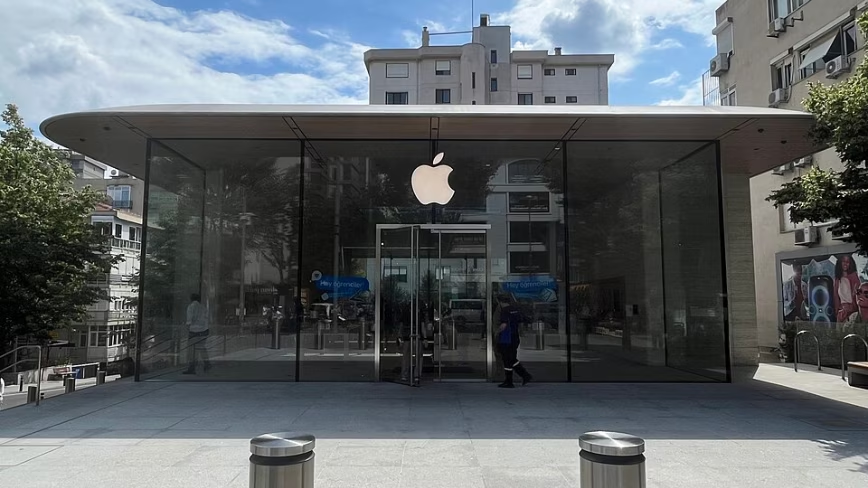
💡Understand how Apple's hardware strategy shifts from wrist to face, impacting future spatial computing development.
⚡ 30-Second TL;DR
What Changed
Apple Watch launch in 2015 significantly disrupted established watchmakers like Swatch and Fossil.
Why It Matters
Apple's entry into eyewear suggests a shift toward spatial computing and AR-integrated fashion, forcing traditional eyewear manufacturers to accelerate their digital transformation.
What To Do Next
Monitor Apple's ARKit updates and visionOS developer documentation for new spatial interaction APIs relevant to wearable hardware.
Key Points
- •Apple Watch launch in 2015 significantly disrupted established watchmakers like Swatch and Fossil.
- •The company is now targeting the $200 billion global eyewear market.
- •Apple's strategy relies on integrating high-tech features into personal wearable accessories.
🧠 Deep Insight
Background and context from public sources — not the original article. 42 sources cited.
🔑 Enhanced Key Takeaways
- •Apple Watch achieved significant market dominance, capturing over 50% of the global smartwatch market share and, by 2019, outselling the entire Swiss watch industry in terms of units shipped.
- •Apple's eyewear strategy is bifurcated, encompassing the high-end mixed-reality "spatial computer" (Apple Vision Pro) and rumored display-less smart glasses designed to directly challenge Meta's mainstream Ray-Ban offerings.
- •The Apple Vision Pro, launched in February 2024, is marketed as a "spatial computer" running visionOS, integrating digital content with the physical world through advanced 3D tracking, camera passthrough, and intuitive eye, hand, and voice input.
- •Apple's rumored display-less smart glasses (codenamed N50), expected for a late 2027 debut, will prioritize a premium, recognizable design using materials like acetate, integrating cameras, microphones, and sensors for AI-powered features like an upgraded Siri and visual intelligence.
- •The company's overarching ecosystem strategy, which tightly integrates hardware, software, and services, creates a "digital gravity" that enhances user retention and justifies premium pricing across its product categories, including its wearables.
📊 Competitor Analysis▸ Show
| Feature/Product | Apple Vision Pro | Meta Quest 3 | XREAL One Pro / VITURE Luma Pro (Display Glasses) | Ray-Ban Meta Smart Glasses (AI Glasses) |
|---|---|---|---|---|
| Category | Spatial Computer (Mixed Reality Headset) | VR/MR Headset | AR Display Glasses | AI Glasses (Camera-Enabled) |
| Introductory Price | US$3,499 | US$499 | US$399 - US$599 (VITURE Luma Pro) | US$299 (Ray-Ban Meta) |
| Display | Dual micro-OLED, 23 million pixels (approx. 3660x3200 per eye), up to 100/120 Hz refresh rate, ~100° FoV | Dual LCD, 2K resolution per eye (full 4K picture), 90Hz refresh rate, ~110° FoV | Micro-OLED, 1920x1200 per eye, 120Hz, 152" screen simulation | None (camera/audio only) |
| Processor | Apple M2 or M5 and Apple R1 | Qualcomm Snapdragon XR2 Gen 2 | (Often tethered, uses host device's processing or external compute unit like XREAL Beam Pro) | (Integrated chip for AI/camera functions) |
| Input | Hand gestures, eye tracking, voice input; supports keyboards, trackpads, game controllers | Hand tracking, controllers | (Often relies on host device or companion app) | Voice AI assistant, touch controls |
| Key Features | Spatial computing, visionOS, EyeSight, 12 cameras, 5 sensors (LiDAR), 6 microphones, ZEISS Optical Inserts | Full-color passthrough, mixed reality, large app catalog, Microsoft Teams/Zoom support | Portable virtual display for productivity/entertainment, 2D-to-3D video support | Hands-free photos/video, voice AI, open-ear audio, stylish design |
| Market Share (2025) | 89% market share above $1,500 price point (premium spatial computing) | Significant share in VR/MR headset market | Leads tethered AR display glasses category (XREAL shipped over 1 million units lifetime) | 73-82% market share in AI glasses segment (Meta) |
🛠️ Technical Deep Dive
- Apple Vision Pro:
- Chips: Dual-chip design featuring Apple M2 (or M5 in later variants) for computational demands and a dedicated Apple R1 chip for real-time sensor processing.
- Display System: Ultra-high-resolution micro-OLED displays, packing 23 million pixels across two displays (more than 4K TV per eye, approximately 3660x3200 per eye), with wide color and high dynamic range, and refresh rates up to 100 Hz (M2) or 120 Hz (M5). Features custom catadioptric lenses for clarity.
- Sensors & Cameras: Equipped with 12 cameras (including 2 main RGB, 4 lower-side-view, 2 outer-side-view, 4 eye-tracking infrared) and 5 sensors (1 LiDAR, 2 depth-of-field, 2 IR sensors). This suite enables environment capture, gesture recognition, eye tracking, and 6DOF tracking.
- Audio: Advanced Spatial Audio system with dual-driver audio pods and audio ray tracing, creating the sensation that sounds originate from the user's environment.
- Input: Relies on hand gesture recognition, eye tracking, and voice input, eliminating the need for external controllers. Supports virtual keyboard, dictation, and external Bluetooth accessories.
- Operating System: visionOS, a mixed-reality OS derived from iPadOS frameworks, featuring a 3D user interface.
- Apple Watch (General Evolution):
- Processors: Evolution from S1P (Series 1) to S9 SiP (Series 9) with Neural Engine for enhanced performance and on-device AI.
- Health Sensors: Advanced optical heart rate sensor, ECG (Series 4+), blood oxygen (SpO2) tracking (Series 6+), dual temperature sensors (Series 8+).
- Display: Always-On Retina display (Series 5+), increased brightness (e.g., 2000 nits on Series 9, 3000 nits on Ultra 2), LTPO technology for variable refresh rates.
- Connectivity: Bluetooth, Wi-Fi (including 5GHz on later models), GPS, and optional LTE cellular connectivity (Series 3+).
- Other Features: Fall detection (Series 4+), crash detection (Series 8+), UWB chip (Series 9+), Taptic Engine.
- Rumored Apple Smart Glasses (N50):
- Design: Display-less, higher-end build using acetate, designed for a recognizable, iconic look. Expected in at least four styles and various colors.
- Integrated Components: Cameras (vertically-oriented oval lenses with indicator lights), microphones, and sensors for hands-free interaction.
- Functionality: Primarily for AI features like upgraded Siri and visual intelligence, capturing photos/videos, handling calls, and relaying notifications, without an integrated display for AR overlays.
🔮 Future ImplicationsAI analysis grounded in cited sources
⏳ Timeline
📎 Sources (42)
Factual claims are grounded in the sources below. Forward-looking analysis is AI-generated interpretation.
- longvadon.com
- statista.com
- inc.com
- dazeinfo.com
- wikipedia.org
- indiatimes.com
- tomsguide.com
- apple.com
- phonearena.com
- groovejones.com
- apple.com
- thenextweb.com
- quasa.io
- medium.com
- productcoalition.com
- grokipedia.com
- markhub24.com
- tomsguide.com
- oliur.com
- reality-atlas.com
- techinsights.com
- panoxdisplay.com
- treeview.studio
- cnet.com
- ibselectronics.com
- phonearena.com
- pcmag.com
- medium.com
- uctoday.com
- dymesty.com
- setapp.com
- wikipedia.org
- phonearena.com
- buckleandband.com
- buckleandband.com
- ijfmr.com
- juniperresearch.com
- 4dproducts.co.uk
- officetimeline.com
- everymac.com
- medium.com
- bgr.com
Weekly AI Recap
Read this week's curated digest of top AI events →
👉Related Updates


AI-curated news aggregator. All content rights belong to original publishers.
Original source: The Next Web (TNW) ↗
This is a summary, not the original. Read the source, or get the weekly briefing.
The weekly digest
One email a week. Unsubscribe anytime.