Apple Refreshes Macs for Local AI Development
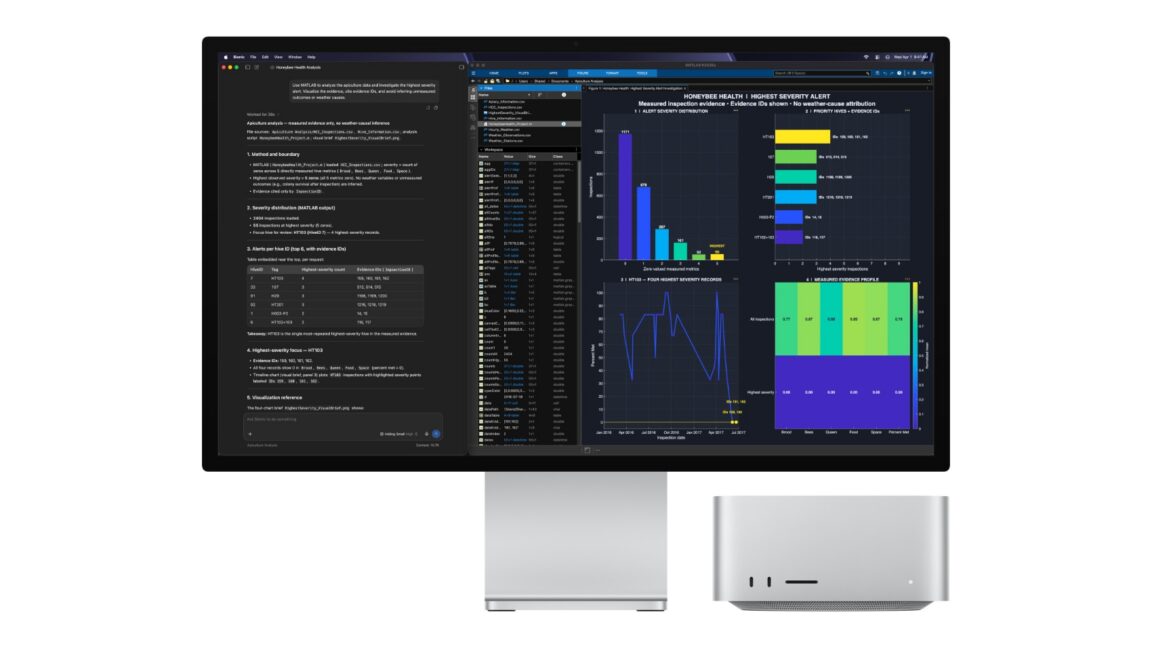
💡Apple is optimizing its desktop strategy for developers running AI locally across one or more Macs.
⚡ 30-Second TL;DR
What Changed
Apple’s new desktop Macs target local AI development workflows.
Why It Matters
The update could make Apple’s desktop lineup more relevant to developers who prefer running AI workloads locally instead of relying entirely on cloud infrastructure. Multi-Mac workflows may also encourage experimentation with distributed local compute.
What To Do Next
Evaluate the new Apple desktop Macs against your local model-development stack, including multi-Mac orchestration and memory requirements.
Key Points
- •Apple’s new desktop Macs target local AI development workflows.
- •The refresh takes into account developers daisy-chaining multiple Macs.
- •The positioning emphasizes desktop hardware as part of an AI development setup.
🧠 Deep Insight
Background and context from public sources — not the original article. 6 sources cited.
🔑 Enhanced Key Takeaways
- •The new Mac Studio supports up to 512GB of unified memory, enabling the execution of massive LLMs entirely on-device without cloud offloading.
- •Apple introduced Thunderbolt 5 connectivity specifically to facilitate high-speed clustering of multiple Mac units for distributed AI inference.
- •The M6 chip, featured in the new Mac mini, utilizes TSMC's 2-nanometer process node to achieve a 4x increase in AI performance over previous generations.
- •The hardware refresh is explicitly optimized for 'agentic AI' workflows, positioning the desktop Mac as an always-on local compute platform.
- •The updated lineup integrates with macOS 27 and next-generation Apple Intelligence, including enhanced Siri capabilities designed for local execution.
📊 Competitor Analysis▸ Show
| Feature | Apple Mac Studio (M5 Ultra) | NVIDIA Workstation (RTX 6000 Ada) | Dell Precision (Intel/NVIDIA) |
|---|---|---|---|
| Memory | 512GB Unified | 48GB VRAM | Up to 128GB RAM + 24GB VRAM |
| AI Architecture | Integrated Neural Engine | CUDA Cores / Tensor Cores | CUDA Cores / Tensor Cores |
| Pricing | Starts at $3,999 (est) | $6,800+ | $4,500+ |
🛠️ Technical Deep Dive
- M6 Chip: Manufactured on TSMC 2nm process node for increased transistor density and power efficiency.
- Unified Memory: Architecture allows CPU and GPU to share up to 512GB of memory, critical for loading large model weights without PCIe bottlenecks.
- Connectivity: Thunderbolt 5 implementation provides the bandwidth necessary for low-latency distributed computing across daisy-chained Mac nodes.
- AI Acceleration: Neural Engine improvements deliver 4.3x faster performance in Mac Studio compared to M4-series predecessors.
- Wireless Standards: Integration of Wi-Fi 7 and Bluetooth 6 for improved data throughput in networked AI development environments.
🔮 Future ImplicationsAI analysis grounded in cited sources
⏳ Timeline
📎 Sources (6)
Factual claims are grounded in the sources below. Forward-looking analysis is AI-generated interpretation.
Weekly AI Recap
Read this week's curated digest of top AI events →
👉Related Updates

AI-curated news aggregator. All content rights belong to original publishers.
Original source: Ars Technica AI ↗
This is a summary, not the original. Read the source, or get the weekly briefing.
Weekly AI briefing
One email a week. Unsubscribe anytime.