Apple may introduce Siri AI subscription model by 2027
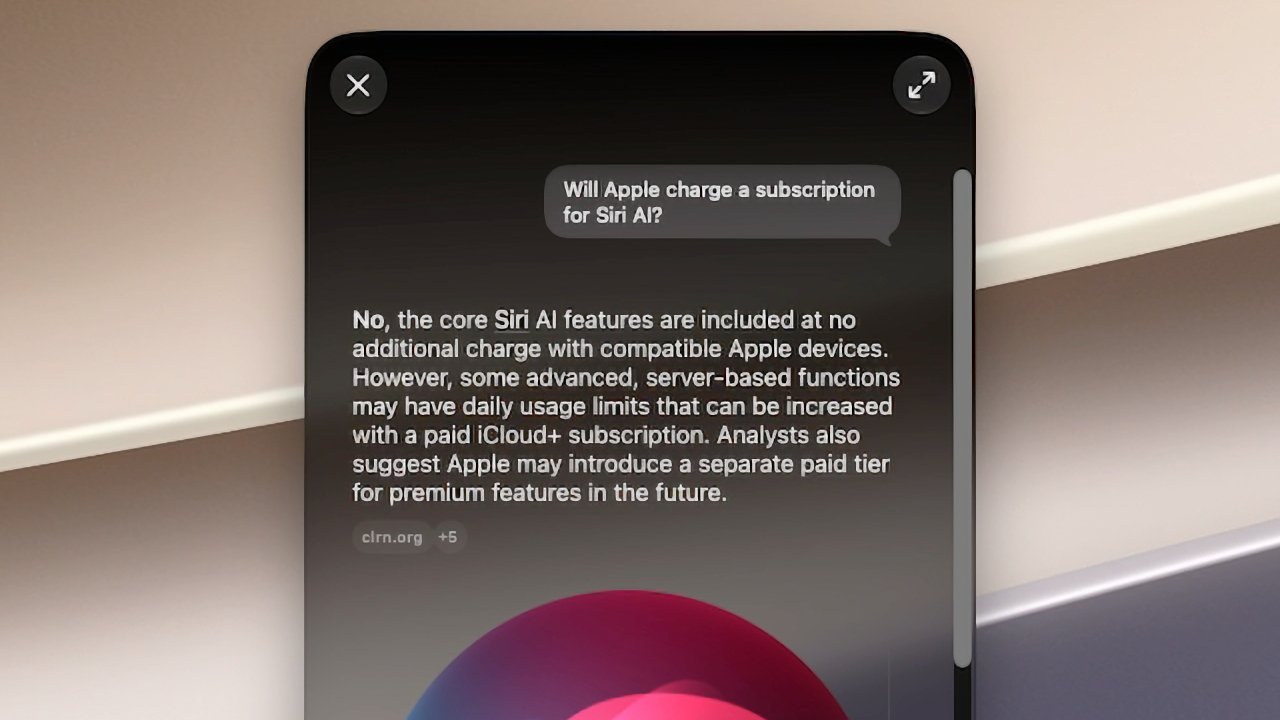
๐กUnderstand Apple's long-term strategy for monetizing AI features and potential impacts on your app's ecosystem.
โก 30-Second TL;DR
What Changed
Apple Intelligence is driving the need for potential monetization of Siri AI.
Why It Matters
This signals a shift in Apple's business model toward recurring revenue for on-device and cloud-based AI services. It suggests that high-compute AI features will likely be gated behind premium tiers.
What To Do Next
Monitor Apple's developer documentation for changes in API usage limits and potential new subscription-gated AI endpoints.
Key Points
- โขApple Intelligence is driving the need for potential monetization of Siri AI.
- โขA subscription model could be implemented as early as 2027.
- โขCurrent usage limits are already being tested via iCloud+ integration.
๐ง Deep Insight
Web-grounded analysis with 34 cited sources.
๐ Enhanced Key Takeaways
- โขSpecific advanced Siri AI features, such as image generation and potentially 'World Knowledge' capabilities, are identified as candidates for a paid tier due to their reliance on powerful server models and associated high operational costs.
- โขApple's monetization strategy for advanced Siri AI features is already being implemented by offering increased usage limits to existing iCloud+ subscribers, suggesting a tiered access model rather than a completely separate, standalone subscription.
- โขThe most advanced on-device Apple Intelligence features, including the full capabilities of the new Siri AI, require devices with at least 12 GB of unified memory, which is expected to drive a significant hardware upgrade cycle for compatible iPhones and Macs.
- โขApple's AI architecture employs a hybrid approach, utilizing on-device processing for privacy and standard tasks, while more complex requests are handled by 'Private Cloud Compute' running on Apple silicon servers and, for some advanced models, on NVIDIA GPUs in Google Cloud.
- โขThe revamped Siri AI and Apple Intelligence features are not available in the European Union or mainland China at launch, indicating potential regional regulatory or strategic challenges for global deployment.
๐ Competitor Analysisโธ Show
| Competitor | Feature/Pricing Model | Benchmarks/Key Differentiators |
|---|---|---|
| ChatGPT Plus | $20/month for individuals. Offers general access during peak times, faster response, priority access to new features, higher message limits (160 messages/3 hours with GPT-5.2), custom GPTs, advanced voice mode, and image generation. | |
| ChatGPT Pro | $200/month for individuals. Provides practically uncapped usage, unlimited access to top models (GPT-5, o1 Pro mode for enhanced reasoning). | |
| ChatGPT Team | $25-$30/user/month (minimum 2 users). Includes shared workspace, custom GPTs, and collaboration features. | |
| Microsoft Copilot Pro | $20/user/month (personal). Requires Microsoft 365 Personal or Family subscription. Integrates Copilot into Word, Excel, PowerPoint, Outlook, and OneNote; offers priority access to latest AI models and enhanced image generation. | |
| Microsoft 365 Copilot Business | $18-$30/user/month (add-on, paid annually for promotional rates). Requires a qualifying Microsoft 365 base license (e.g., M365 E3/E5, Business Standard/Premium). Provides AI capabilities within Microsoft 365 apps and AI chat connected to work data. | |
| Amazon Alexa+ | $19.99/month, or free for Amazon Prime members. Offers a more conversational and natural language understanding assistant, multi-step command processing, smart home integration, shopping assistance, and calendar management. | Powered by large language models from Amazon Nova and Anthropic. |
| Apple Siri AI (current) | Free, with some features having daily usage limits. Increased access to certain features (e.g., image generation) available with most iCloud+ subscription plans. | Emphasizes on-device processing and Private Cloud Compute for privacy. Requires 12GB unified memory for advanced on-device features. |
๐ ๏ธ Technical Deep Dive
- Architecture: Apple Intelligence utilizes a hybrid architecture, combining on-device processing for privacy and standard tasks with Private Cloud Compute (PCC) for more complex requests.
- On-Device Processing: Most data processing occurs directly on the user's iPhone, iPad, or Mac, ensuring personal information remains on the device.
- Private Cloud Compute (PCC): For computationally intensive tasks, PCC extends the privacy and security of Apple devices into the cloud. Data is processed on Apple silicon servers and is not stored or made accessible to Apple, with independent verification possible.
- Apple Foundation Models (AFM): Apple Intelligence is powered by a family of generative models, including both on-device and server-based AFMs.
- On-Device Models:
- AFM 3 Core: A ~3 billion-parameter dense model optimized for Apple silicon, featuring architectural innovations like KV-cache sharing and 2-bit quantization-aware training.
- AFM 3 Core Advanced: A 20-billion-parameter sparse architecture model that activates 1 to 4 billion parameters at a time, natively multimodal, and requires 12 GB of unified memory.
- Server-Based Models (via PCC):
- AFM 3 Cloud: Optimized for speed, efficiency, and performance.
- ADM 3 Cloud (Image): Specifically for high-quality image generation and editing, enabling features like Image Playground and Genmoji.
- AFM 3 Cloud Pro: The most capable server-based model, designed for demanding use cases such as agentic tool use and complex reasoning, running on NVIDIA GPUs hosted in Google Cloud under Apple's PCC guidelines.
- On-Device Models:
- Model Training: AFMs are trained on Apple's open-source AXLearn framework, which builds on JAX and XLA, using large-scale multilingual and multimodal datasets from web crawling, licensed corpora, open-sourced data, and synthetic data.
- Developer Integration: A single Swift interface allows developers to access both on-device and server-side models seamlessly.
- Hardware Requirements: Advanced on-device AI features, including the most powerful Siri AI capabilities, necessitate devices with at least 12 GB of unified memory.
- Third-Party Integration: Apple Intelligence includes integration with OpenAI's ChatGPT for certain requests, with user consent.
๐ฎ Future ImplicationsAI analysis grounded in cited sources
โณ Timeline
๐ Sources (34)
Factual claims are grounded in the sources below. Forward-looking analysis is AI-generated interpretation.
- appleinsider.com
- seekingalpha.com
- tradingview.com
- apple.com
- cloudmagazin.com
- morningstar.com
- uoregon.edu
- apple.com
- 9to5mac.com
- apple.com
- apple.com
- wikipedia.org
- macrumors.com
- 9to5mac.com
- intuitionlabs.ai
- cloudeagle.ai
- tomsguide.com
- openai.com
- lovable.dev
- copilot-experts.com
- gosearch.ai
- microsoft.com
- microsoft.com
- laptopmag.com
- aboutamazon.com
- reddit.com
- techradar.com
- howtogeek.com
- apple.com
- apple.com
- reddit.com
- aiexpert.network
- mashable.com
- techstrong.ai
Weekly AI Recap
Read this week's curated digest of top AI events โ
๐Related Updates
AI-curated news aggregator. All content rights belong to original publishers.
Original source: cnBeta (Full RSS) โ


