Apple Intelligence features restricted to newer hardware
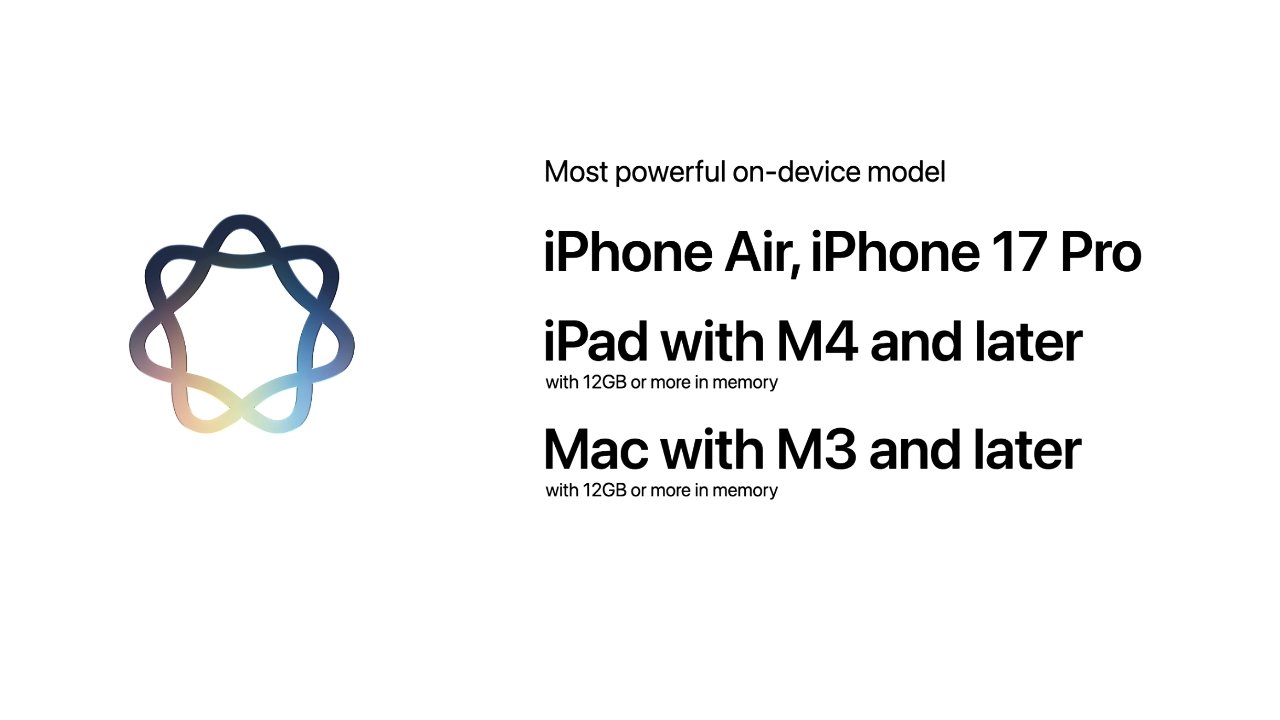
💡Understand hardware constraints for local AI deployment on Apple devices to optimize your app's feature set.
⚡ 30-Second TL;DR
What Changed
Apple Intelligence features tiered by hardware capability
Why It Matters
Developers building for the Apple ecosystem must account for hardware fragmentation, as advanced local AI features will not be universally available to all users.
What To Do Next
Update your app's hardware compatibility requirements to reflect the specific chipsets needed for Apple Intelligence features.
Key Points
- •Apple Intelligence features tiered by hardware capability
- •Key advanced AI features require latest silicon (A-series/M-series chips)
- •Highlights the compute-heavy requirements of on-device LLMs
🧠 Deep Insight
Background and context from public sources — not the original article. 20 sources cited.
🔑 Enhanced Key Takeaways
- •Apple Intelligence requires specific hardware configurations, including the A17 Pro chip for iPhones (iPhone 15 Pro and Pro Max models), M1 or newer chipsets for iPads and Macs, and a minimum of 8 GB of RAM for optimal functionality.
- •The system employs a hybrid AI model, utilizing a 3-billion parameter on-device LLM for simpler tasks and a larger LLM housed in Apple's Private Cloud Compute (PCC) for more complex operations, ensuring user data privacy.
- •Apple's on-device LLM is highly optimized for Apple Silicon through architectural innovations such as 2-bit quantization-aware training, KV-cache sharing, speculative decoding, context pruning, and Grouped-Query Attention to maximize efficiency.
- •Initial availability of Apple Intelligence is restricted to US English and requires specific operating system updates, namely iOS 18.1, iPadOS 18.1, or macOS Sequoia 15.1 or later.
- •Intel-based Macs are explicitly excluded from Apple Intelligence support due to their lack of a dedicated Neural Engine and the unified memory architecture, which are fundamental for the required on-device AI inference.
🛠️ Technical Deep Dive
- Neural Engine Evolution: Apple's Neural Engine, a dedicated AI accelerator, was first introduced in the A11 Bionic chip in September 2017, capable of 0.6 trillion operations per second (TOPS). Subsequent iterations significantly increased performance, with the A17 Pro reaching 35 TOPS, the M3 at 18 TOPS, and the M4 at 38 TOPS, specifically optimized for transformer models and on-device LLMs. The recently introduced M5 chip reportedly achieves approximately 133 TOPS.
- Unified Memory Architecture (UMA): M-series chips feature a unified memory architecture where the CPU, GPU, and Neural Engine share a single pool of high-bandwidth memory. This design is crucial for on-device AI, as it reduces data movement bottlenecks and latency, which is not present in traditional PC architectures like Intel-based Macs.
- On-Device LLM Architecture: Apple's local LLM is approximately 3 billion parameters. It is optimized for speed and resource constraints using techniques such as low-bit quantization (specifically 2-bit and a hybrid 3.7-bit palettization for memory reduction), Grouped-Query Attention, shared embedding tables, and a smaller vocabulary of 49,000 tokens.
- Performance Optimizations: To achieve low latency and rapid token generation, Apple employs speculative decoding, context pruning, and a hardware-optimized Key-Value cache. The iPhone 15 Pro, for instance, achieves 0.6 milliseconds per input token and generates about 30 tokens per second.
- Private Cloud Compute (PCC): For tasks requiring more computational power than on-device hardware can provide, Apple Intelligence utilizes larger LLMs hosted in Private Cloud Compute. These are built on Apple Silicon servers and designed to maintain user privacy by ensuring that Apple itself cannot access user data processed within these private containers.
- Software Frameworks: Core ML and Metal frameworks are integral to optimizing and executing compressed machine learning models directly on Apple Silicon hardware, supporting advanced model compression techniques like 2-bit and 4-bit quantization.
🔮 Future ImplicationsAI analysis grounded in cited sources
⏳ Timeline
📎 Sources (20)
Factual claims are grounded in the sources below. Forward-looking analysis is AI-generated interpretation.
Weekly AI Recap
Read this week's curated digest of top AI events →
👉Related Updates
AI-curated news aggregator. All content rights belong to original publishers.
Original source: cnBeta (Full RSS) ↗
This is a summary, not the original. Read the source, or get the weekly briefing.
The weekly digest
One email a week. Unsubscribe anytime.