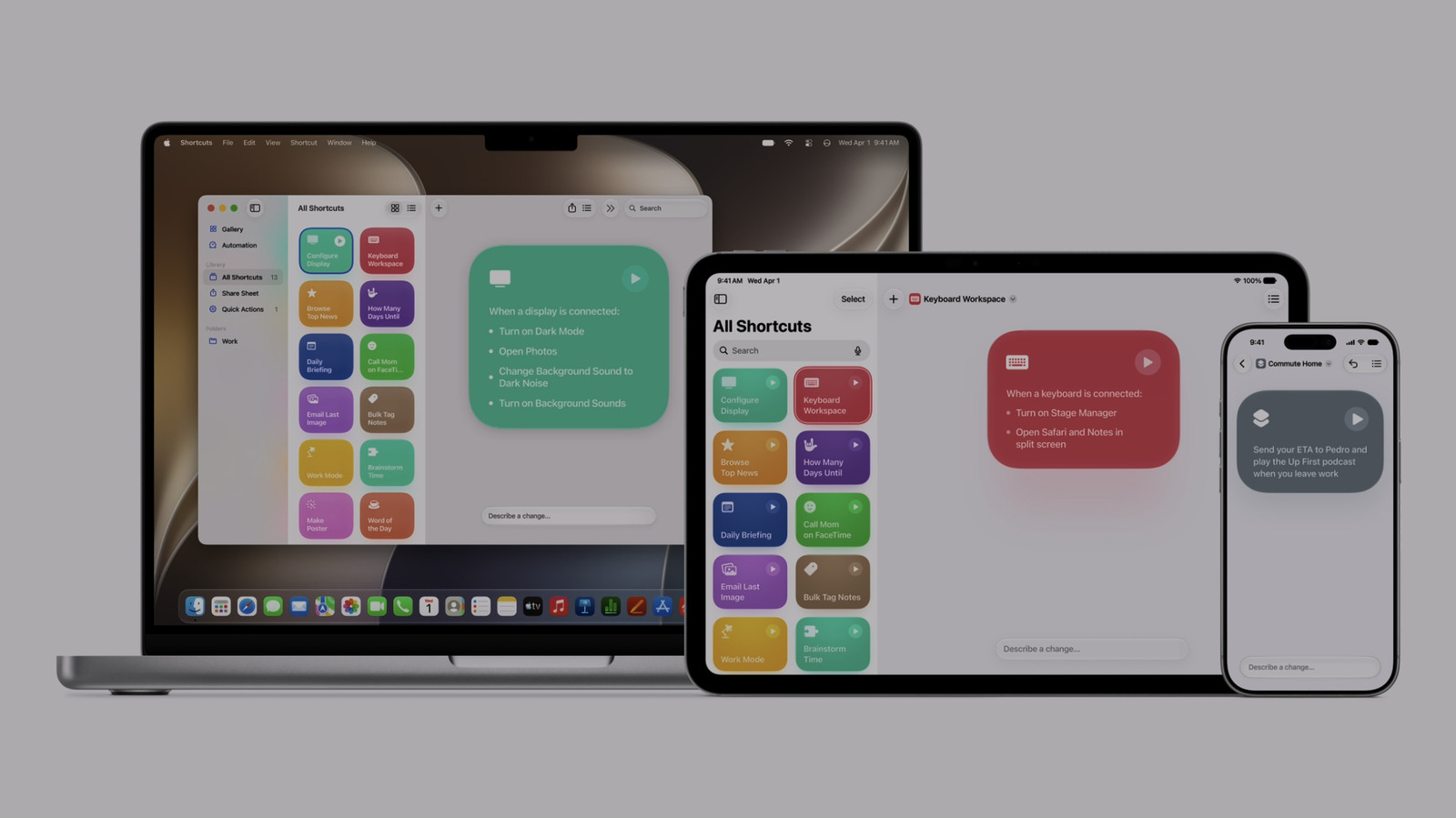
Apple Intelligence integration coming to Shortcuts app
💡Learn how Apple is embedding AI directly into system-level automation tools for deeper OS integration.
⚡ 30-Second TL;DR
What Changed
Shortcuts app will receive native Apple Intelligence upgrades
Why It Matters
This update allows developers and power users to build more sophisticated, AI-augmented automation scripts, potentially replacing manual tasks with intelligent agents.
What To Do Next
Review the updated Shortcuts documentation to identify how to trigger AI-based logic in your custom automation workflows.
Key Points
- •Shortcuts app will receive native Apple Intelligence upgrades
- •Enhanced automation capabilities through AI logic
- •Integration allows for more complex, context-aware user workflows
🧠 Deep Insight
Background and context from public sources — not the original article. 19 sources cited.
🔑 Enhanced Key Takeaways
- •Apple Intelligence employs a hybrid architecture, combining on-device processing for privacy and immediate tasks with Private Cloud Compute for more complex requests, utilizing Apple silicon servers.
- •The integration enables users to build custom shortcuts that can leverage Apple Intelligence models (on-device or Private Cloud Compute) or even ChatGPT for tasks like text summarization and image generation.
- •To utilize Apple Intelligence features, devices must be equipped with an Apple M-series chip or an A17 Pro/newer chip, running iOS 18.1+, iPadOS 18.1+, or macOS 15.1+, and require at least 7GB of on-device storage.
- •Developers can integrate their applications' functionalities with Siri and Apple Intelligence through the App Intents framework, allowing for deeper system-wide automation and context-aware interactions.
🛠️ Technical Deep Dive
- Apple Intelligence is powered by two multilingual, multimodal foundation language models: a ~3B-parameter on-device model and a scalable server model.
- The on-device model is optimized for Apple silicon through architectural innovations like KV-cache sharing and 2-bit quantization-aware training.
- The server model is built on a Parallel-Track Mixture-of-Experts (PT-MoE) transformer, combining track parallelism, sparse computation, and interleaved global–local attention for high quality and cost efficiency on Private Cloud Compute.
- Both models are trained on extensive multilingual and multimodal datasets, including web crawls, licensed corpora, and synthetic data, further refined with supervised fine-tuning and reinforcement learning.
- A Swift-centric Foundation Models framework provides developers with tools for guided generation, constrained tool calling, and LoRA adapter fine-tuning to integrate these AI capabilities.
- Private Cloud Compute ensures data privacy by processing complex requests on Apple silicon servers without storing or making user data accessible to Apple, a process verifiable by independent researchers.
🔮 Future ImplicationsAI analysis grounded in cited sources
⏳ Timeline
📎 Sources (19)
Factual claims are grounded in the sources below. Forward-looking analysis is AI-generated interpretation.
Weekly AI Recap
Read this week's curated digest of top AI events →
👉Related Updates
AI-curated news aggregator. All content rights belong to original publishers.
Original source: Engadget ↗
This is a summary, not the original. Read the source, or get the weekly briefing.
The weekly digest
One email a week. Unsubscribe anytime.