Apple and OpenAI’s Hardware War Escalates
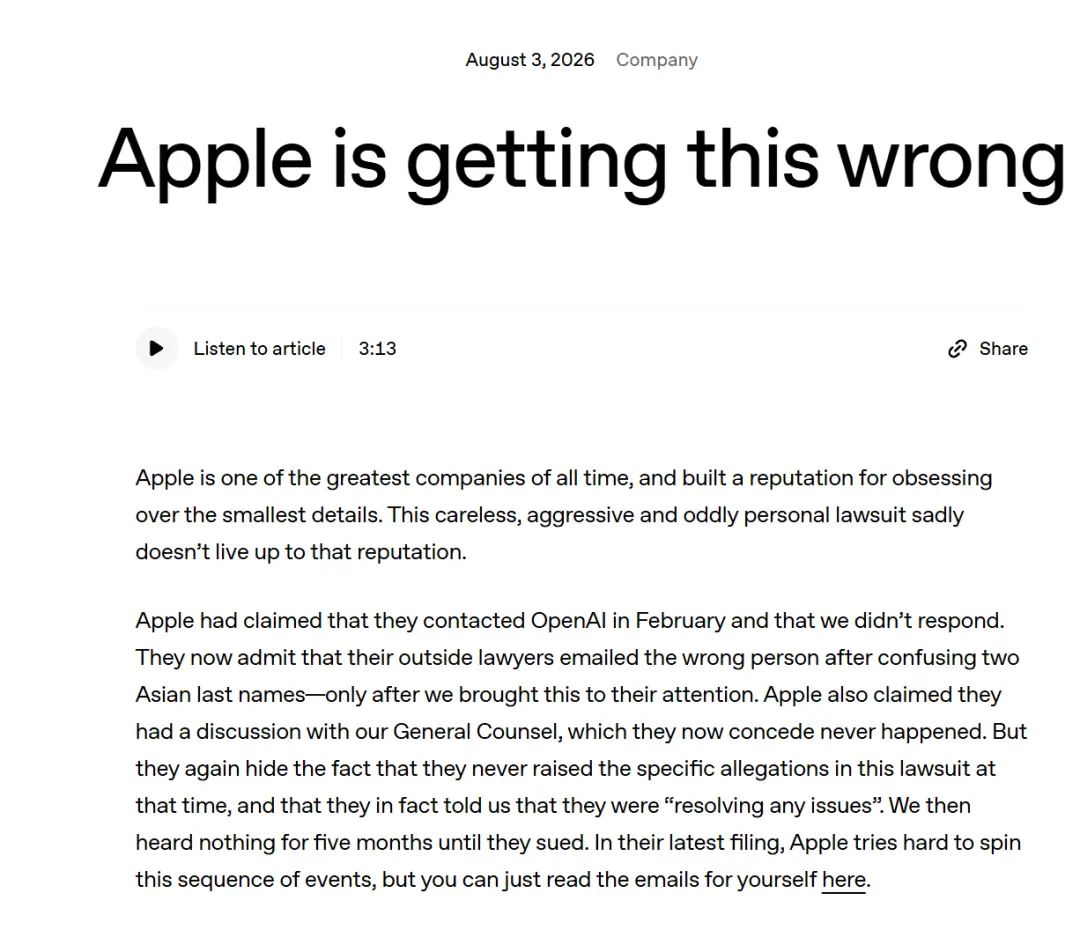
The Apple–OpenAI lawsuit shows how talent moves and confidential data can reshape the AI hardware race.
30-Second TL;DR
What Changed
Apple alleges that OpenAI and former Apple employees misappropriated trade secrets and breached contractual obligations.
Why It Matters
The dispute could increase legal and operational risks for companies recruiting AI hardware and platform talent from major technology firms. It may also make future partnerships between AI labs and device manufacturers more restrictive and more heavily governed by confidentiality controls.
What To Do Next
Audit employee offboarding and repository permissions for AI hardware projects, especially access retained by departing engineers or external collaborators.
Key Points
- •Apple alleges that OpenAI and former Apple employees misappropriated trade secrets and breached contractual obligations.
- •Apple’s requested preliminary injunction would bar the use or disclosure of its confidential information.
- •The company also wants OpenAI and former employees to lose access to Apple’s confidential materials and return proprietary assets.
Deep Insight
AI-generated analysis for this event — not the original article.
Enhanced Key Takeaways
- •The lawsuit centers on the 'Project Aether' initiative, a joint R&D effort between Apple and OpenAI that was intended to integrate advanced LLM capabilities directly into the Apple Silicon Neural Engine.
- •Apple's legal filing specifically identifies a former lead engineer from the Siri Intelligence team who allegedly transferred encrypted proprietary datasets to OpenAI servers shortly before resigning.
- •The dispute involves alleged violations of a 2024 Non-Disclosure Agreement (NDA) that governed the sharing of Apple's private 'CoreML' optimization techniques for on-device AI.
- •OpenAI has filed a countersuit claiming that Apple's 'Project Aether' was a pretext for Apple to gain unauthorized access to OpenAI's proprietary model weights and training methodologies.
- •Industry analysts suggest the litigation has effectively halted the planned 'Siri 2.0' rollout, which was originally scheduled for the iOS 20 release cycle.
Competitor Analysis
- Apple (Siri/Aether)
- On-device Privacy
- OpenAI (GPT-Integration)
- Cloud-Scale Reasoning
- Google (Gemini/Pixel)
- Hybrid Ecosystem
- Apple (Siri/Aether)
- Deep Neural Engine
- OpenAI (GPT-Integration)
- API-based
- Google (Gemini/Pixel)
- TPU-optimized
- Apple (Siri/Aether)
- Proprietary/Hybrid
- OpenAI (GPT-Integration)
- Transformer-based
- Google (Gemini/Pixel)
- Multimodal/Native
- Apple (Siri/Aether)
- Hardware-bundled
- OpenAI (GPT-Integration)
- Subscription/API
- Google (Gemini/Pixel)
- Ad-supported/Subscription
| Feature | Apple (Siri/Aether) | OpenAI (GPT-Integration) | Google (Gemini/Pixel) |
|---|---|---|---|
| Primary Focus | On-device Privacy | Cloud-Scale Reasoning | Hybrid Ecosystem |
| Hardware Integration | Deep Neural Engine | API-based | TPU-optimized |
| Model Architecture | Proprietary/Hybrid | Transformer-based | Multimodal/Native |
| Pricing Model | Hardware-bundled | Subscription/API | Ad-supported/Subscription |
Technical Deep Dive
- The core of the dispute involves the 'Aether-Link' protocol, a proprietary interface designed to allow Apple's Neural Engine to offload specific inference tasks to OpenAI's quantized models without exposing raw user data.
- Apple alleges the misappropriated files include 'Weight-Compression-Alpha,' a technique for reducing LLM parameter size by 40% while maintaining 98% accuracy on mobile hardware.
- OpenAI's defense references the 'Open-Weights Protocol,' arguing that the shared data was part of a collaborative open-source contribution agreement rather than a closed trade secret.
- Technical logs cited in the lawsuit indicate the transfer of over 4TB of data via an unauthorized peer-to-peer connection bypassing Apple's internal security gateways.
Future ImplicationsAI analysis grounded in cited sources
Timeline
- 2024-06Apple and OpenAI announce a strategic partnership for AI integration.
- 2024-11Launch of 'Project Aether' to optimize LLMs for Apple Silicon.
- 2025-05Internal audit at Apple detects unauthorized data exfiltration.
- 2026-02Apple issues a formal cease-and-desist to OpenAI regarding proprietary data usage.
- 2026-08Apple files formal lawsuit against OpenAI for trade-secret misappropriation.
Weekly AI Recap
Read this week's curated digest of top AI events →
Related Updates

AI-curated news aggregator. All content rights belong to original publishers.
Original source: cnBeta (Full RSS) ↗
This is a summary, not the original. Read the source, or get the weekly briefing.
The weekly digest
One email a week. Unsubscribe anytime.